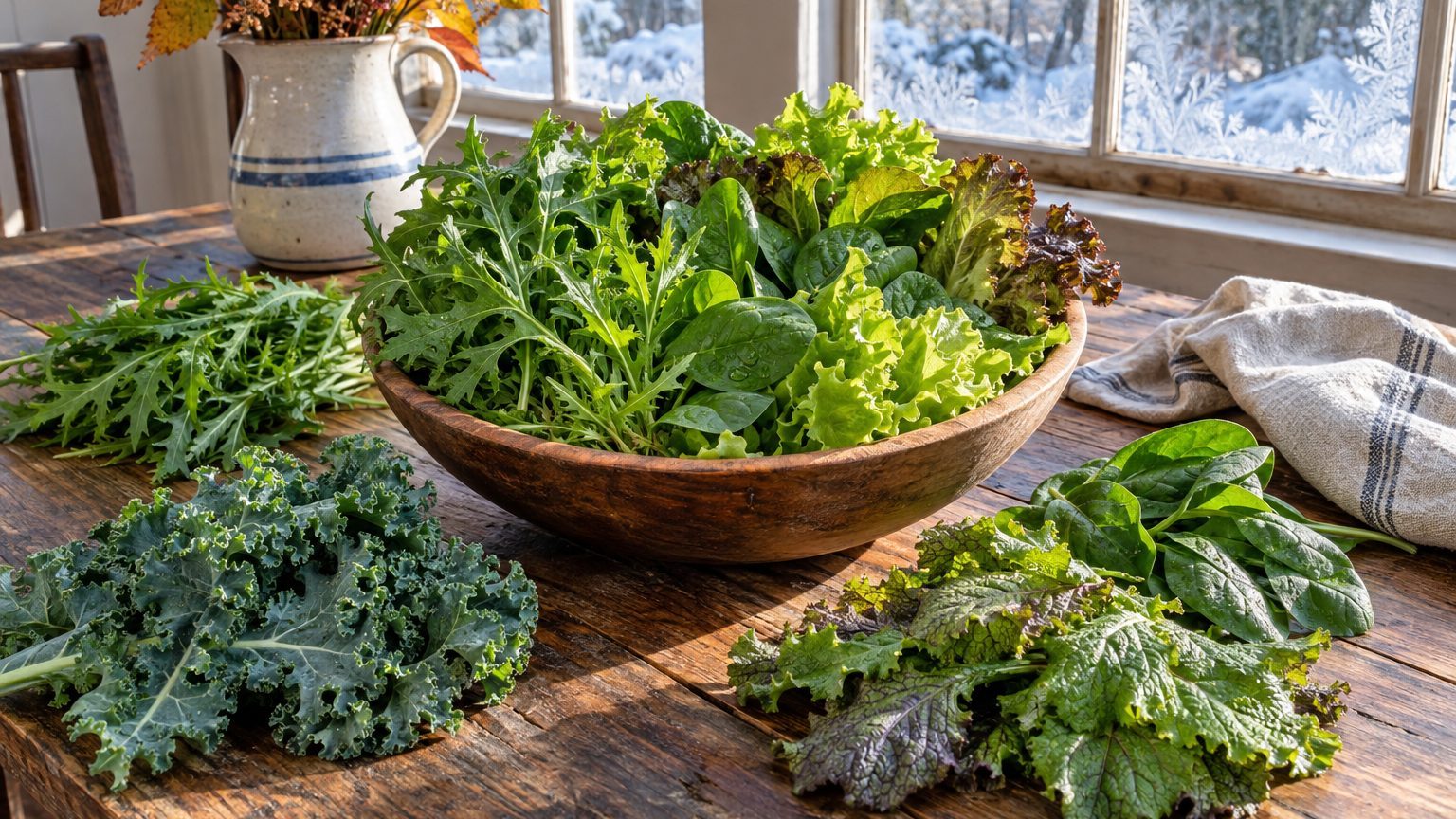

Maine’s winter salad question comes down to one number: 15.6°F. That is the mean daily minimum of the coldest month at the Portland reference station (NOAA 1991-2020 normals), and Portland is the mild end of the state. At that temperature, a salad bed is really a bed of cold-holding greens, and the choice of variety matters more than any trick of timing.
The short answer for Maine
Grow spinach, mâche (corn salad), claytonia and hardy kale for the cold months, and use tatsoi, mizuna and other quick Asian greens to fill the fall. Tender lettuce and arugula belong in the shoulder seasons, not in January. This is a decision by type, and it follows from two facts about Portland: the freeze odds and the winter minimum.
On the NOAA 1991-2020 Climate Normals, the last spring freeze at 32°F falls between April 22 and May 1, and the first fall freeze between October 9 and October 21. Both are probabilities, not promises. They mark the stretch where the chance of a 32°F freeze sits between 30 and 70 percent. A cold snap outside that stretch is unlikely but possible. Inside it, you are close to a coin flip.
Types that carry the winter
Spinach, mâche and claytonia take the most cold. Spinach is the workhorse, and a fall-sown planting can be picked through mild spells under cover. Mâche is slow but nearly indifferent to cold, with small rosettes that hold well. Claytonia (also called miner’s lettuce) is succulent, mild, and tolerant of low light. Kale belongs here too, though most people eat it as a cooked or baby green, not a salad base.
Types for fall and early spring
Tatsoi, mizuna, baby mustards, and cold-tolerant lettuce grow fast in cool weather and give you the first harvests. They sit in the middle on cold tolerance. Under cover they often last into winter, but they are the first to give up when the minimums drop. Arugula is the quickest of all and the least dependable once temperatures stay low.
| Type | Cold tolerance | Best role in Maine | Main weakness |
|---|---|---|---|
| Spinach | High | Core winter crop under cover | Needs an early enough fall sowing to size up |
| Mâche | Very high | Deep-winter salad base | Slow, small harvests |
| Claytonia | Very high | Winter greens in low light | Mild flavor, shallow roots |
| Hardy kale | High | Baby leaves and cooked greens | Less of a classic salad leaf |
| Tatsoi and mizuna | Moderate to high | Fall and early winter | Fade in the hardest cold |
| Cold-tolerant lettuce | Moderate | Fall and early spring | Struggles in sustained deep cold |
| Arugula | Low to moderate | Fall, early spring | Quick to stall once the cold sets in |
That table is a ranking, not a set of survival thresholds. This page does not carry hard temperature limits for individual varieties, so check the seed packet and your county’s trial results. For the sowing dates that go with each type, see When to Sow Winter Salads in Maine.
What will not work here
Planting by the first fall frost is the most common mistake. The Portland window for that freeze runs October 9 to October 21, and by then it is too late to start anything from seed. Plants have to be established, with real leaves, before the light and warmth fade. Sow on the day the frost arrives and you will be watching bare soil all winter.
Slow crops do poorly in this climate. Head lettuce that needs a long stretch to form, big cabbage-family heads, and anything you would normally wait on through a long fall will stall long before it is ready. The frost-free stretch at Portland runs roughly from late April or early May to mid-October. That is the whole growing season on the mild coast, and it is shorter inland. Anything that needs more than that to mature has to be chosen with care or skipped.
Unprotected tender lettuce is next. With a coldest-month mean minimum of 15.6°F, an average night in January or February is already about 16 degrees below freezing, and that is on the coast. Individual nights run colder than the mean. A bed of open-air butterhead is a bed of mush by midwinter. A thin row cover buys only a modest buffer, so it works for the shoulder months, not for the dead of winter.
Another failure is the expectation of winter growth. In the darkest weeks, even the hardiest greens mostly hold what they have, and they do not add much. A Maine winter bed is closer to a refrigerator than a production line. Plan on harvesting what grew in the fall, not on a steady supply of new leaves from December on.
Snow and wet weather cause their own trouble. Low hoops can collapse under a heavy, wet snowfall if nobody clears them, and ice sheets over fabric or plastic cut off light and air. Closed covers that never vent on mild, damp days invite rot and slugs. And thaw-and-freeze cycles, common through a Maine late winter, can heave shallow-rooted seedlings out of the soil. Cold alone is not the whole story. The swings are hard on plants too.
What changes across Maine
There is no single zone for Maine. The USDA Plant Hardiness Zone Map (2023, built on 1991-2020 normals) places the state anywhere from 3b to 6a. That is a wide spread, and it is based on one variable: the average annual extreme minimum temperature. Portland and the coast sit at the mild end. Interior valleys, the western mountains and the north run colder.
The frost dates quoted above come from Portland, so they describe the mild end only. Inland and northern Maine run substantially later in spring and earlier in fall. If you garden in Aroostook County or in the western foothills, your first fall freeze arrives before October 9, and your last spring freeze comes after May 1. The sowing window shrinks at both ends, and by how much depends on your location. This page cannot tell you precisely, because it holds only the Portland figures.
What should a gardener in the north or at altitude change? Lean harder on the hardiest types: mâche, claytonia, spinach. Start fall sowings earlier, since the light and warmth fade sooner. Use double layers, such as a hoop with fabric inside a plastic tunnel, in place of a single thin cover. Treat the tender greens as a fall-only crop, and expect the winter harvest to be small. On the coast, you have more room: tatsoi and mizuna may last longer, and a single cover may be enough through many winters.
Your own zone is not something to guess at. Look yourself up on the USDA Plant Hardiness Zone Map by ZIP code, and then compare what the map says to what your garden does. A sheltered south-facing wall can behave like a milder zone, and a frost pocket at the bottom of a slope can behave like a colder one.
Where to check this for your own county
Start with University of Maine Cooperative Extension, the state’s land-grant extension service. It is the right place for a county-level answer. A county recommendation beats a state one every time, and this page is the state one. It rests on one reference station on the coast, and it cannot see your valley, your hillside or your town.
Look for two things when you get there. First, the local planting calendar or vegetable timing guidance for your county, which will show frost dates and sowing windows closer to your own conditions than Portland’s. Second, any variety trials run in your county or a nearby one: which spinach, kale, mâche or lettuce actually held up through a Maine winter, under what kind of cover. Extension offices often have a gardening hotline or a local Master Gardener program, which is a good way to ask what works in your town.
One caution on sources. Extension calendars are usually published by crop, not by state. A calendar built for a lawn grass or a different crop will not tell you when to sow salad greens, and a neighboring state’s calendar will not match Maine’s season. This page does not cite a Maine extension salad calendar, so take the dates here as a starting range, not a final answer. For the broader picture of how winter salads work in the state, see Winter Salads for Maine Gardens.
Checking this against your own garden
Your own observations outrank every date on this page. A calendar is an average of past years, and your garden is one specific place. Three things are worth watching, and none needs a gadget.
- Soil warmth by feel. In spring, squeeze a handful of soil. If it crumbles and feels cool but not cold, it is ready for early sowings. If it is soggy or stays frozen in a lump, wait. Beds that thaw and drain first are your warmest microclimate, and those spots can take your earliest and latest sowings.
- The first true leaves. After the seed leaves, the first set of real leaves shows how fast a fall seedling is moving. If your September or early October sowings reach that stage with time to spare before the cold settles in, your timing works. If they are still tiny when frost arrives, sow earlier next year.
- Where frost shows up first. On the first frosty mornings, walk the yard and note where the white appears first and where it lingers. Low spots and open ground chill first. Spots near a wall, a house foundation or a stand of trees hold on longer.
Keep a few notes from year to year: when the soil first felt workable, when seedlings reached their true leaves, when the first hard frost arrived. After two or three seasons, those notes will tell you more about your garden than any state-level page can.
Common questions
Can I grow salad greens outdoors all winter in Maine without cover?
Mâche and claytonia come closest, but with a coldest-month mean minimum of 15.6°F at Portland, and colder inland, a protective layer makes the harvest far more reliable. Tender lettuce and arugula will not make it through uncovered.
Which varieties should I sow first?
Sow the slowest and hardiest types first: spinach, mâche and claytonia. Quick greens such as tatsoi and mizuna can go in later. See the sowing calendar for timing.
Do the Portland frost dates apply to my town?
Only if you garden near the coast. The dates here are from Portland: last spring freeze April 22 to May 1, first fall freeze October 9 to October 21, as 32°F probabilities. Inland and northern Maine run later in spring and earlier in fall.
Is a greenhouse necessary?
No. A low hoop with fabric or plastic will carry hardy greens through much of the cold season. A greenhouse widens the choices and extends the harvest, but it is not a requirement for growing a winter salad in Maine.