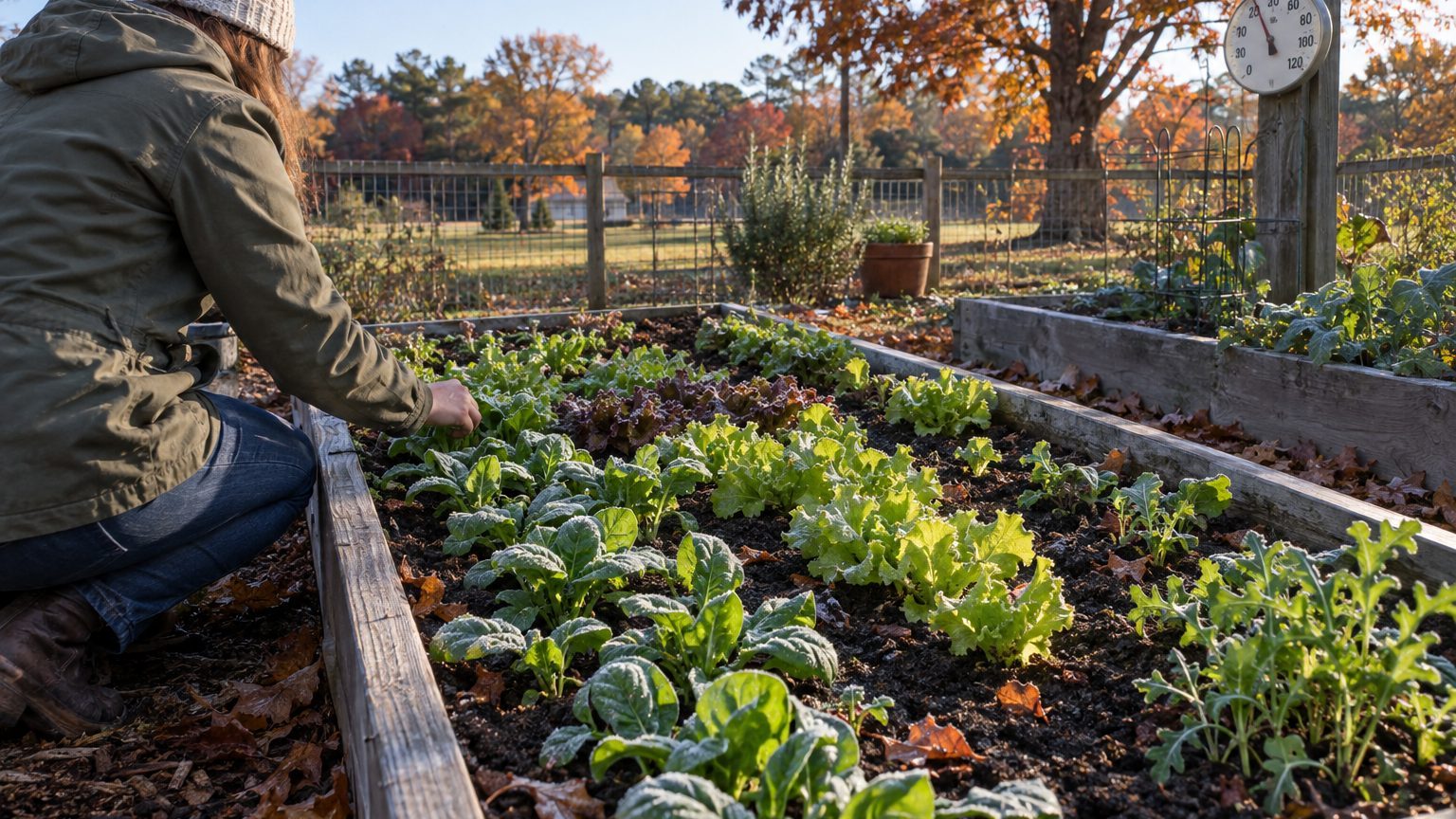

For Houston, the reference city used here, winter salads go in during fall and keep going through the mild months. The cutoff is spring heat, not winter cold. The frost band that opens December 1 and the one that closes February 4 to March 1 mark the edges of the cold season. Texas spans USDA zones 6a to 10a, so treat this as a Gulf Coast calendar, not a statewide one. For the bigger picture, start with Winter Salads for Texas Gardens.
The short answer for Texas
Sow winter salads in fall and winter, and time each sowing against your first freeze, not against the calendar page alone. In Houston the first fall frost falls between December 1 and December 19, so lettuce, arugula and other greens should be seeded before that band begins and again at intervals afterward.
Those dates are not a promise. They come from the NOAA NCEI 1991-2020 Climate Normals for the Houston Intercontinental (IAH) station, and they describe the stretch of the calendar where the probability of a 32°F freeze sits between 30 and 70 percent. Before December 1, a freeze is less likely than not. After December 19, it is more likely than not. Inside the band, it is close to a coin flip, and that is exactly when a row cover earns its keep.
| Houston (IAH) measure | Value | What it tells you |
|---|---|---|
| First fall frost, 30-70% band | December 1 to December 19 | Seed ahead of this; protect seedlings inside it |
| Last spring frost, 30-70% band | February 4 to March 1 | Cold risk fades; heat starts to take over |
| Coldest month, mean daily minimum | 43.7°F | Typical winter nights stay above freezing |
That last row changes how you read the first two. A mean daily minimum of 43.7°F in the coldest month means most winter nights on the Gulf Coast do not hurt a salad crop. Plants keep growing slowly all winter, so you can stagger sowings instead of betting everything on one date. Hobby airport runs about two weeks milder than IAH, which shifts every date above if you garden close to it.
Which seed to choose is a separate question, covered in The Best Winter Salads for Texas. This page stays on timing.
What will not work here
Copying a northern calendar fails first. Advice to sow in early spring, as soon as the soil can be worked, assumes a long cool season ahead. On the Gulf Coast the last-frost band ends between February 4 and March 1, and warm weather follows quickly. A lettuce seeded at the end of that band spends its short life heading into heat, which is how you end up with bitter leaves and a flower stalk instead of a salad.
Sowing too early in fall fails for the opposite reason. The urge to start when the first cool morning arrives is strong, but the first frost band does not open until December 1. Seed started in warm soil can stall or germinate poorly, and the seedlings that do come up struggle in hot afternoons. Waiting for steadier cool weather usually wins over rushing.
Weekly watering fails too. Seedlings in warm fall soil dry out at the surface long before a once-a-week soak arrives, and small salad roots sit in the top inch or so. Light, frequent watering until the plants are established suits them better than a deep weekly drench.
Close spacing is the quiet failure. Gulf humidity keeps leaves damp, and packed rows hold that moisture, which invites fungal disease. Thinning to the spacing on the seed packet, and giving rows room to dry in the morning, matters more here than in a dry climate.
Then there is the assumption that cold is the enemy. With a coldest-month mean minimum of 43.7°F, hardiness is rarely the limit in Houston. Picking a variety purely for how much frost it can take misses the real constraint: heat tolerance and bolt resistance.
The biggest failure is applying this page to a different part of the state. The Panhandle freezes months earlier in fall and months later in spring. A Houston schedule there would have seedlings meeting hard freezes before they are established.
What changes across Texas
The USDA Plant Hardiness Zone Map (2023 edition, built on 1991-2020 normals) places Texas in zones 6a to 10a. The system rests on one variable, the average annual extreme minimum temperature. A spread that wide means there is no single answer for the state, only a range, and the Houston numbers above sit at the mild Gulf end of it.
Moving north and into higher country, the adjustments follow a pattern. Fall freezes arrive sooner, so sowings should shift earlier. Spring freezes linger, so the winter growing window narrows and the case for row cover, cold frames or a sheltered south wall gets stronger. Hill Country and North Texas sit between the extremes and differ from both, so do not simply split the difference between Houston and the Panhandle.
Zone numbers are also a poor guide to salad timing. They record the coldest extreme, not how long the cool season lasts or how fast spring heat builds. Two gardens in the same zone can have very different sowing windows.
To find your own zone, look at the USDA map itself and enter your ZIP code. This page does not tell you which zone you are in, because the borders move over short distances. Once you have it, treat the Houston dates as a shape, a fall opening and a late-winter closing, and slide that shape earlier or later to match your freezes.
Where to check this for your own county
The best next stop is Texas A&M AgriLife Extension, the state’s land-grant extension service. It has a presence in counties across Texas, and its local offices work with the conditions you actually garden in.
Look for two things there. The first is a local planting calendar, ideally one written for your county or region. The second is a record of varieties trialled nearby, since a salad that performs well in one part of Texas can bolt or rot in another. Your county office can usually tell you which cultivars have held up in your soil and weather.
A county recommendation beats a state one, and this page is the state one. Worse, its dates come from a single Houston station, so this page does not have a county-level calendar for you. If the extension office gives a sowing date that differs from what is written here, trust the office.
Checking this against your own garden
Your own observations outrank every date above. Three things are worth watching, and none needs equipment.
- Soil warmth by feel. Push your fingers a couple of inches into the bed in the morning. If it still feels warm like bathwater in the shade, wait. Cool, damp soil means salad seed will germinate evenly. Beds against a south wall or paved area warm up first and cool last.
- First true leaves. The first pair of leaves after the seed leaves tells you how fast the seedling is moving. Fast growth means warm conditions, so thin early and keep watering. Slow growth means the bed is cool, and you can ease off.
- Your first frost. Note when frost first settles on grass or a car roof, and where. Low spots frost earlier than the high ground, and that tells you which corner needs cover.
Write those dates down for one season. By next fall you will have a calendar built from your own yard, which no statewide table can match.
Common questions
Can I sow winter salads in Texas in January?
In Houston, yes. January falls between the first-frost band, which ends December 19, and the last-frost band, which opens February 4. Seedlings can still meet a freeze, so keep a cover handy. In colder parts of Texas, January sowing outdoors is a different question, so check your county extension office.
What do the Houston frost dates actually mean?
They are the dates between which the probability of a 32°F freeze runs from 30 to 70 percent, based on NOAA 1991-2020 normals for the IAH station. They are not a guarantee that frost will or will not arrive on a specific day.
Does this calendar work for Dallas or Amarillo?
No. The figures here are for Houston, at the mild Gulf end of a state that spans USDA zones 6a to 10a. Northern and Panhandle gardens freeze earlier in fall and later in spring.
Is cold or heat the bigger risk to winter salads in Houston?
Heat. The coldest month has a mean daily minimum of 43.7°F, so frost is an occasional threat, while warm spells at both ends of the season can stall germination or push plants to bolt.