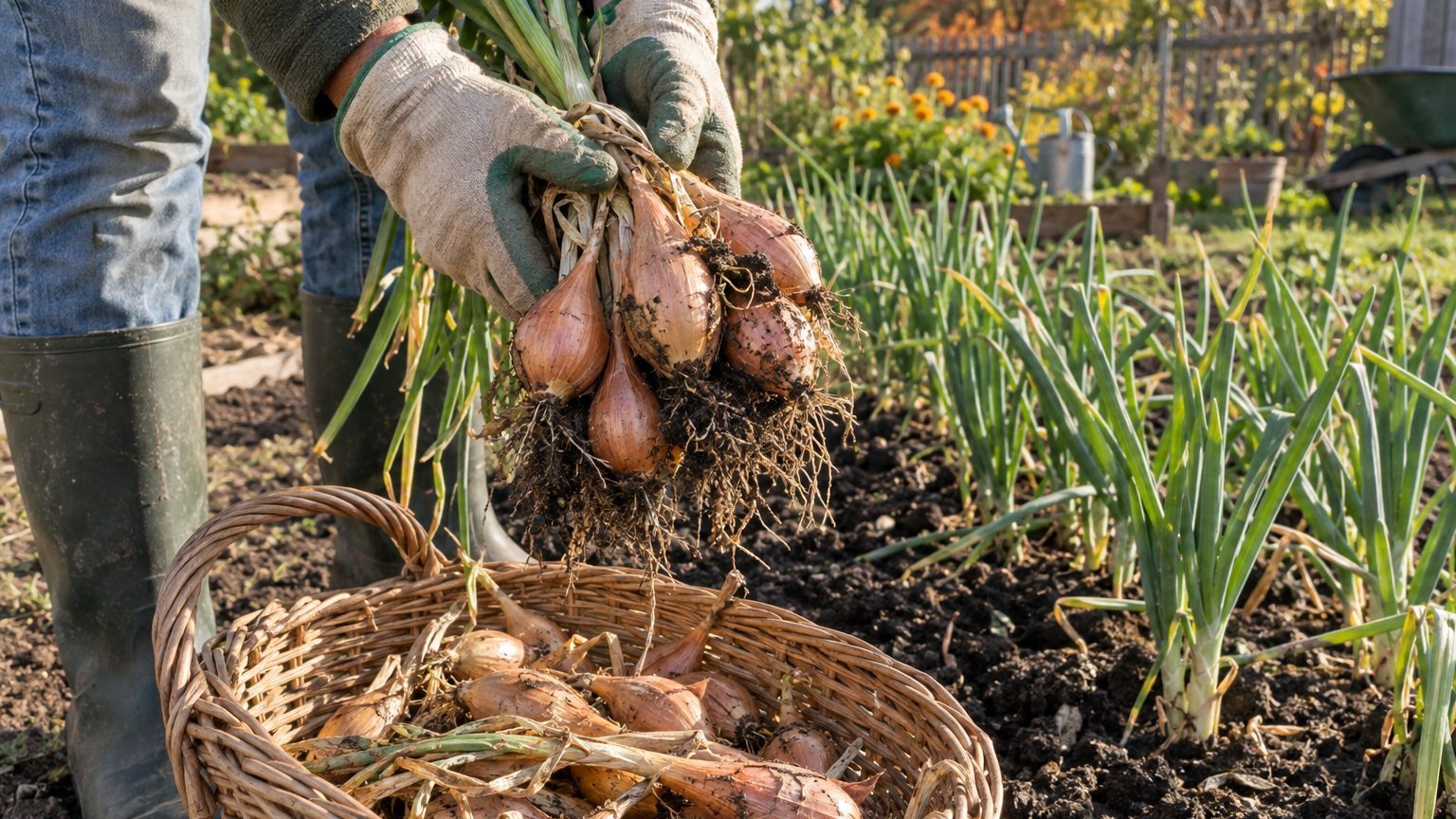

Plant one shallot set and it divides underground into a cluster of bulbs, so a small planting turns into a generous harvest. Set them in autumn where winters are mild and the soil drains well, or in spring where the ground freezes hard. Give each set room to multiply, in full sun and loose soil. Lift them when the tops fall over and yellow. Your winter low settles the timing.
One bulb goes in, a cluster comes out
An onion is one bulb that grows into one bulb. A shallot behaves differently. The planted bulb sprouts several shoots from its base, and each shoot swells into its own bulb, with all of them sharing the same root plate. By harvest, the single set you pushed into the ground has become a clump you pull up in one piece and break apart by hand.
That habit explains why shallots are planted from sets, meaning small bulbs, rather than sown like most onions. A bulb already carries the shoots that will divide. Seed-grown shallots do exist, and they are handled much like onions started indoors, but they make fewer bulbs per plant and they are the exception.
What the cluster does to your spacing
Crowd the sets and the cluster has nowhere to go. The bulbs come out small, pressed against each other, and slow to dry. A spacing of about 6 inches between sets is a common starting point, with rows far enough apart to hoe between them. Plant each set pointed end up, with the tip at or just below the soil surface. Deep planting buries the neck and invites rot.
Shallow roots mean shallow weeding. A hoe dragged too deep will nick the clusters you spent months growing. Mulch helps with weeds and keeps moisture even, but pull it back from the bulbs as the tops begin to yellow so the bases can dry.
Saving your own sets
Because every planted bulb returns several, you never need to buy sets twice. Keep back some of your best, medium-sized bulbs, store them dry and cool, and plant them next season. Small to medium bulbs tend to make the best sets, and very large ones are more likely to bolt. The caution is disease. Saved stock carries whatever the bed carried, so if a planting struggled with rot or stunting, start fresh from a clean source rather than propagating the trouble. Replacing your stock now and then is sensible even when everything looks fine.
Where garlic overlaps, and where it does not
Garlic gets its own section on this site, with national pages covering planting, curing, storing and rotation. Shallots share much of that ground, so those pages are the place to go for the basics, and there is no point repeating them here. Three differences matter. A shallot set is a whole bulb, not a clove broken from a head. Shallots are not a crop that needs a long winter chill to form bulbs, as most garlic does. And shallots do not send up the flower stalks that hardneck garlic is known for. Rotation follows the same rule as the garlic and onion pages: keep alliums out of a bed where alliums grew recently, because several allium diseases persist in the soil for years.
Curing needs a careful eye. Once the tops have fallen and yellowed, lift the clusters and let them dry in a shaded, airy, dry place until the necks are tight and the outer skins feel papery. Then inspect each bulb. A soft neck or a moldy base ends the question: that bulb goes in the compost, not the kitchen. A firm, dry-looking bulb is not proof of soundness, so check bulbs again as they sit in storage and pull any that soften.
Autumn or spring: the decision that depends on your winter
Gardeners who can choose usually plant in autumn. Roots establish before winter, growth restarts early in spring, and the bulbs often come out larger and ready sooner than spring-planted ones. The catch is that the bulbs have to survive the winter first.
What decides it
Three things sort a garden into one camp or the other. The first is the winter low: how cold the air and the soil actually get, and for how long. The second is drainage. A set sitting in cold, saturated soil rots long before it freezes. The third is whether the ground freezes hard. Repeated freezing and thawing heaves shallow-planted bulbs upward until they lie exposed on the surface, roots dangling.
Where winters are mild and the soil drains freely, autumn planting works well, and in much of the South it is the standard approach because summer heat arrives before a spring planting can finish. Where winters are harsh, autumn planting is a gamble. In the coldest territories it loses bulbs, even with a thick mulch, and spring planting is the safer choice. Plant as soon as the soil can be worked, since shallots tolerate cool weather and need time to bulk up before the long days of summer.
If you plant in autumn
Timing matters in both directions. Set the bulbs early enough to root, but not so early that they push lots of green top before freezing weather arrives. A layer of straw or shredded leaves over the bed after the ground begins to chill buffers temperature swings, and it can be pulled back in spring. If the bed holds water after rain, build a raised row or a low ridge for the shallots. It costs an afternoon and saves the planting.
If you plant in spring
Spring planting trades size and earliness for safety. The bulbs have less time, so a late start hurts more than it does in autumn. Keep the bed evenly watered during bulbing, and expect the harvest to come later in summer. Some gardeners in marginal climates split the risk, putting half the sets in the ground in autumn and holding half back for spring. After a hard winter, they know which approach fit their yard.
This page cannot tell you which side of the line you are on. That answer is local: it depends on your state, and often on your county and your own soil. The state pages in this cluster give the planting window for each, and your state extension service can say what has been trialled where you live.
The types, and what actually differs
Shallots sort into a handful of types, and the differences show up in the kitchen and in the garden. The table compares them on the traits gardeners ask about most. These are general tendencies, and individual varieties vary, which is why local trial results beat any national chart.
| Type | Skin color | Flavor | Bulbs per cluster | Keeping |
|---|---|---|---|---|
| Round, golden-brown | Coppery brown | Mild, sweet, classic shallot taste | Moderate | Generally good |
| Elongated, banana-shaped | Brown to pinkish | Mild, easy to slice into neat rings | Moderate | Fairly good |
| Red-skinned | Rosy red, purple-tinged flesh | Sweet, a little sharper raw | Moderate to many | Varies, often shorter |
| Gray-skinned | Hard, gray-brown shell | Strong, pungent, rich when cooked | Fewer, smaller bulbs | Generally good |
| Seed-grown | Usually golden or brown | Mild | Few per plant | Varies |
Keeping is the row to read with care. A type that stores well in general still fails if it was cured badly or harvested damaged, so treat any “good keeper” label as a starting point. Check bulbs on a regular schedule, and discard any with a soft neck or a moldy base.
A note on labels. Some bulbs sold as shallots are really multiplier onions or potato onions. They are closely related, they are grown the same way, and they also divide into clusters from a planted bulb. They differ in the details. Multipliers and potato onions tend to taste more like a plain onion, with a stronger edge, and their bulbs are often larger and less uniform than a true shallot. Nothing is wrong with them, and they are often easy and productive. But if you want the fine, sweet, layered flavor of a classic shallot, check what the seller actually describes.
Choosing among types comes down to use. Red-skinned shallots suit raw dishes and pickling. Gray-skinned ones are for cooks who want depth in sauces. Elongated shallots are the easy ones to slice. For specific varieties that have been tested in your climate and soil, your state extension service is the right source, and it will save you from buying something that sulks in your region.
Why the answer changes with where you garden
Gardening advice for shallots splits by climate more sharply than most vegetable guidance. A planting that thrives in coastal Georgia would freeze out in northern Minnesota, and the reverse is just as true: spring sets in the Gulf South can run out of cool weather before the bulbs finish growing.
Two numbers do the sorting. The first is your winter low, which decides autumn against spring. USDA hardiness zones summarize average annual minimum temperatures, so your zone is a quick first guide, though a local microclimate, a sheltered bed or a frost pocket can shift it. The second is your frost dates. The average last spring frost sets the earliest practical date for spring planting. The average first fall frost sets the window for autumn planting, which should end a few weeks before the ground freezes so roots can settle in. Both dates are averages, and any given year can run early or late.
The state pages in this cluster translate those two numbers into planting windows for each state, with notes on soil and weather that a national page cannot cover. Use the page for your state first. For the practices shallots share with garlic, such as autumn planting technique, curing, storage and allium rotation, the garlic section of this site has pages that apply directly, and the notes above cover how shallots differ.
Your state extension service is the last stop and often the most useful. Extension offices publish planting calendars, test varieties locally, and identify the diseases that are active in your area, including the soil-borne ones that make allium rotation worth the planning. If a planting fails, they can help work out whether weather, drainage or disease was the cause.
Common questions
Can I plant shallots from the grocery store?
Sometimes they sprout and grow, but results are unreliable. Produce may be treated to slow sprouting, and store bulbs can carry disease you would be adding to your bed. Sets sold for planting are a safer start, and your own saved bulbs are better still once you have a healthy crop.
How far apart should shallots be spaced?
About 6 inches between sets is a common guide, with rows spaced wide enough to weed between. Tighter spacing yields smaller, crowded bulbs, and wider spacing gives each cluster room to expand.
How do I know when shallots are ready to harvest?
The tops yellow and fall over. Lift the clusters gently, then cure them in a dry, shaded, airy spot until the necks are tight and the skins papery. Inspect every bulb afterward. A soft neck or a moldy base means discard it.
Can shallots go where garlic or onions grew last year?
It is best to avoid it. Garlic, onions and shallots are all alliums, and several allium diseases persist in soil for years. Rotating to a different bed lowers that risk, and the garlic section of this site covers rotation in more detail.