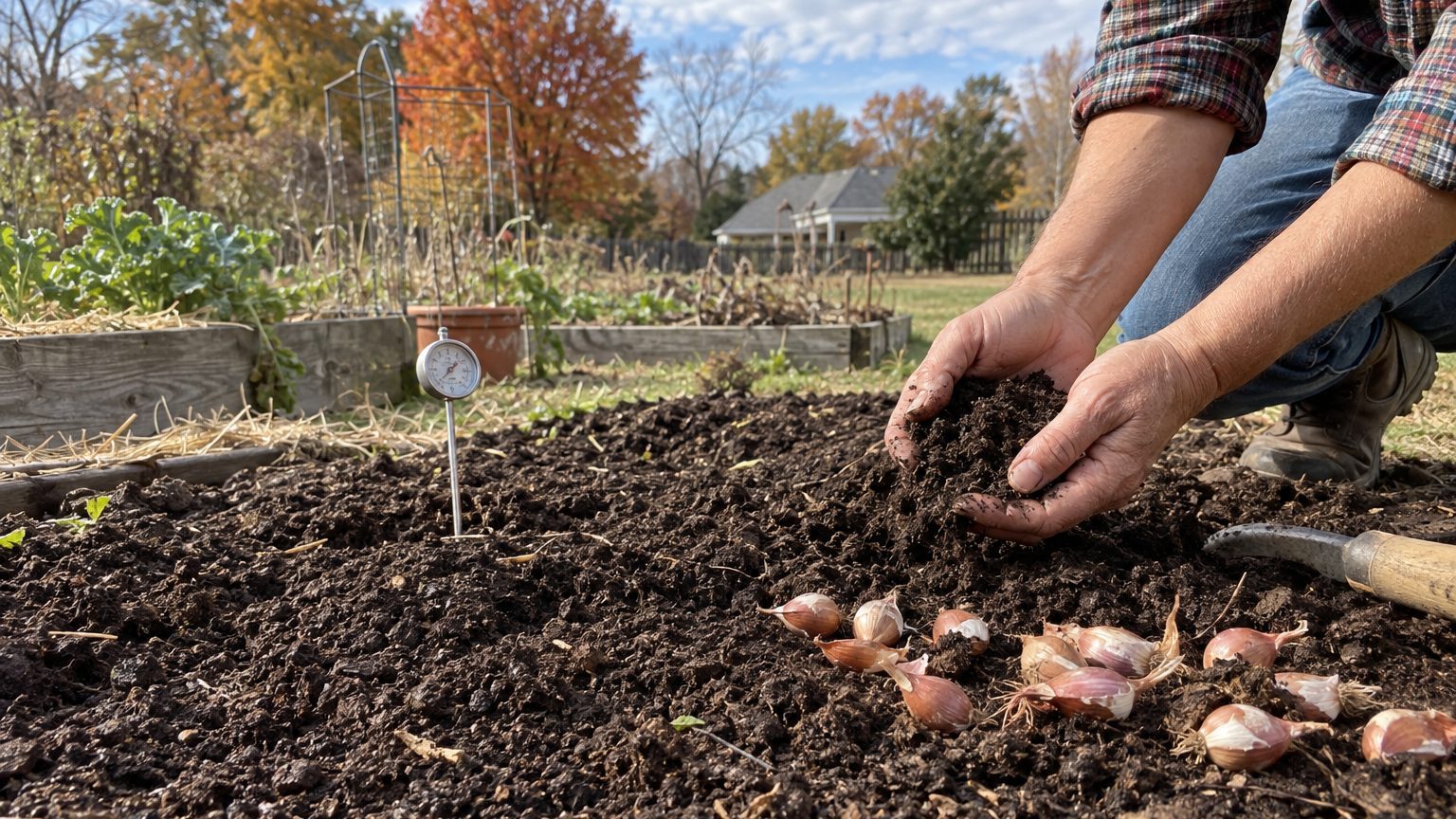

Growing shallots in British Columbia works best where winters are mild and the soil drains well. On the coast, the Vancouver station averages a last spring frost on March 18, and the coldest month’s average low is only 0.8 °C. That gives gardeners there a choice between autumn and spring planting that colder provinces rarely get. The interior and the north are a different story.
When the soil is warm enough in British Columbia
Start with the date everyone asks about. At the Vancouver International Airport station (climate ID 1108447), Environment and Climate Change Canada’s 1981-2010 normals put the last spring frost on average at March 18. That is a mean, not a safe date. In roughly one year out of two the last frost lands later, so treat March 18 as the middle of a window that opens a bit earlier and closes a bit later.
Frost, though, is only a proxy. Shallots care less about the air temperature at dawn than about the temperature of the ground around their roots. Soil lags behind the air. A bed can be frost-free for a week and still be cold, saturated and slow, and sets pushed into that sort of ground tend to sit idle or rot rather than root. In practice the soil warms after the frost risk ends, and the gap can be a couple of weeks in a wet spring.
What to check before you plant
Skip the calendar for a day and go outside. A soil thermometer pushed in at planting depth (an inch or two, roughly 2.5 to 5 cm) tells you more than any normal does. Shallots are cool-season alliums and will root in cool ground, so you are not waiting for tomato weather. You are waiting for soil that has stopped being a cold sponge: it crumbles in your hand instead of smearing, and it no longer holds standing water after rain.
This date belongs to one airport station near sea level. British Columbia is not one climate. Upland and northern districts run weeks behind Vancouver, and a gardener in the Okanagan, the Kootenays or the Peace region should expect a different calendar entirely. Also note that Canadian normals cover 1981-2010, while the US figures elsewhere on this site cover 1991-2020, so the two aren’t a like-for-like comparison.
Shallots and garlic share a lot of practice: autumn planting, curing, storing, and keeping alliums out of the same bed year after year. The garlic section of this site covers those in depth. What differs for shallots is mostly scale and habit. A single set multiplies into a cluster of bulbs, so spacing has to leave room for that clump, and the tops die back earlier than many garlic types, which shifts your harvest window.
Curing and storage touch food safety, so a few plain rules. Cure bulbs in a dry, airy, shaded place until the necks are fully dry and the skins rustle. Before you store any bulb, inspect it: press the neck and look at the base. A soft neck or a moldy base ends the question, and that bulb goes in the compost, not the pantry. Handle each bulb, and check stored bulbs again as the weeks pass.
For which varieties have been trialled in your part of the province, go to the Government of British Columbia agriculture and seafood pages and the regional agricultural contacts they point to. This page names no cultivar, and the reason is spelled out in the last section.
How long the season lasts here
The same station gives a first fall frost, on average, of November 10. Count from March 18 to November 10 and you get 237 days, a little under 34 weeks. Both dates are means from the same 1981-2010 normals, so the real window in any given year can be shorter or longer, and it will be quite different away from the coast.
| Measure | Value | Source |
|---|---|---|
| Average last spring frost | March 18 | ECCC normals 1981-2010, Vancouver Int’l A |
| Average first fall frost | November 10 | ECCC normals 1981-2010, Vancouver Int’l A |
| Days between the two means | 237 | Subtraction of the two dates above |
A window this long, at least on the coast, leaves room for more than one sowing. You can plant a first round of sets as soon as the soil is workable, then hold a second batch back for a few weeks, so the whole harvest doesn’t come ready on the same weekend. The succession sowing guide on this site shows how to stagger plantings and what spacing each round needs. With shallots, the point of staggering is mostly practical: curing space and kitchen demand, not squeezing extra weeks of growth out of the summer.
A long window also makes transplanting worth considering. If you start shallots from seed or bring on sets in cell trays, the seedlings have time to recover from the move. Before you commit, do the root check: slide one plant out of its cell and look. White roots wrapped around the plug mean it is ready to go out. A tangled, brown mass means it waited too long and will sulk for weeks.
In a short-season district, where the two frost dates sit much closer together, the first sowing is the only one. Direct-setting sets as early as the soil allows beats a transplant that spends its first fortnight recovering. Subtract your own two dates, from a station near you, before deciding. Don’t borrow the Vancouver figure of 237 days for a garden three hundred miles inland, because it will flatter the calendar.
For a comparison with colder places, see Growing Shallots in Manitoba, where the window shrinks and the planting calendar tightens accordingly. For the general logic of how one set becomes a cluster, Growing Shallots: One Bulb In, a Handful Out is the place to start.
Heat and water in British Columbia
This page’s verified figures include no count of days above 32 °C (90 °F) and no summer rainfall total, so I won’t quote either. What the verified figures do give is the winter, and for shallots the winter decides the autumn-versus-spring question.
The coldest month at the Vancouver reference station has a mean daily minimum of 0.8 °C (33.5 °F). That is the average of the nightly lows, not the record low, and it sits just above freezing. Natural Resources Canada places the reference city in Canadian hardiness zone 9a. That is the Canadian system, built on several climate variables, and it does not convert to a USDA zone, so don’t read it against the US maps. For a shallot bulb sitting in the ground, the practical meaning is simple: on the coast, hard ground freezing is not the usual threat.
That favors autumn planting where winters are mild. Sets planted in fall establish roots over the cool months and start growth early, which is how you get the larger, earlier bulbs that autumn planting is grown for. The risk on the coast is not cold but wet. Coastal British Columbia is known for rainy winters and comparatively dry summers, and a set sitting for months in heavy, poorly drained soil can rot. Raised beds, loose soil with plenty of organic matter, and a spot that does not collect runoff all lower that risk.
Where the ground freezes hard and stays wet, the answer flips. Autumn-planted sets in that kind of ground heave out as the soil freezes and thaws, or rot in cold saturated soil, so spring planting is the safer call. That is the situation in much of the interior and the north, and in places like Manitoba, whose own planting rhythm is laid out in Growing Shallots in Manitoba.
Summer brings its own trouble. In a cool, damp summer, the problems are mildew, slow ripening and disease, not scorching. Give plants space for airflow, water the soil rather than the leaves, and pull back on irrigation as the tops begin to yellow so the bulbs can finish. In a hot spell, the reverse applies: mulch to keep the root zone cooler and steady, and don’t let the bed swing between bone dry and soaked. For a US comparison of a wetter, colder-winter state, Growing Shallots in New York shows how that balance plays out.
Which shallots suit British Columbia
Choose by type. A short season favors the earliest-maturing types, because they finish before fall rain and cold arrive. A hot, dry spell favors types you can give airflow and shade at the root. A humid or wet-summer site makes disease resistance the first criterion, ahead of size or flavor. In British Columbia you may face all three, depending on whether you garden on Vancouver Island, in the Fraser Valley, in the Okanagan or in the north.
The other choice is how you start the crop. Sets, meaning small bulbs, are the usual route and give a quick, reliable start. Seed-grown types take more time and attention, but a long coastal window makes them a workable option for gardeners who like to experiment. In either case, buy planting stock from a source that sells it for planting, not from the grocery bin, since store bulbs may be treated to resist sprouting and can carry disease into your bed.
This page names no variety, and that is deliberate. The province spans coastal rainforest, dry interior valleys and northern plateaus, and a cultivar that thrives in one may fail in another. The only recommendation worth following is one backed by local trials, and this page doesn’t have those trials. The Government of British Columbia agriculture and seafood pages are the right place to start, and from there you can reach regional agricultural staff, local seed growers and garden clubs who know what has grown near you.
Whatever you plant, rotate. Alliums should not return to the same bed year after year, because soil-borne disease builds up, and the garlic section of this site covers allium rotation in detail.
Common questions
Can I plant shallots in fall in British Columbia?
On the mild coast, often yes, because the coldest month’s mean daily minimum at the Vancouver station is 0.8 °C. The danger there is wet soil, so drainage matters. Where the ground freezes hard and stays wet, as in much of the interior and north, spring planting is safer.
When is the last frost in British Columbia?
At the Vancouver International Airport station, the average last spring frost is March 18, from Environment and Climate Change Canada’s 1981-2010 normals. It is a mean, so in about half of years the last frost comes later, and districts away from the coast run weeks behind.
What hardiness zone is Vancouver for shallots?
Natural Resources Canada lists the reference city as Canadian hardiness zone 9a. That belongs to the Canadian system, which uses several climate variables, and it does not convert to a USDA zone.
Which shallot variety should I buy?
This page can’t name one, because it has no local trial data. Choose by type for your conditions, then check with the provincial agriculture contacts for what has been grown near you.