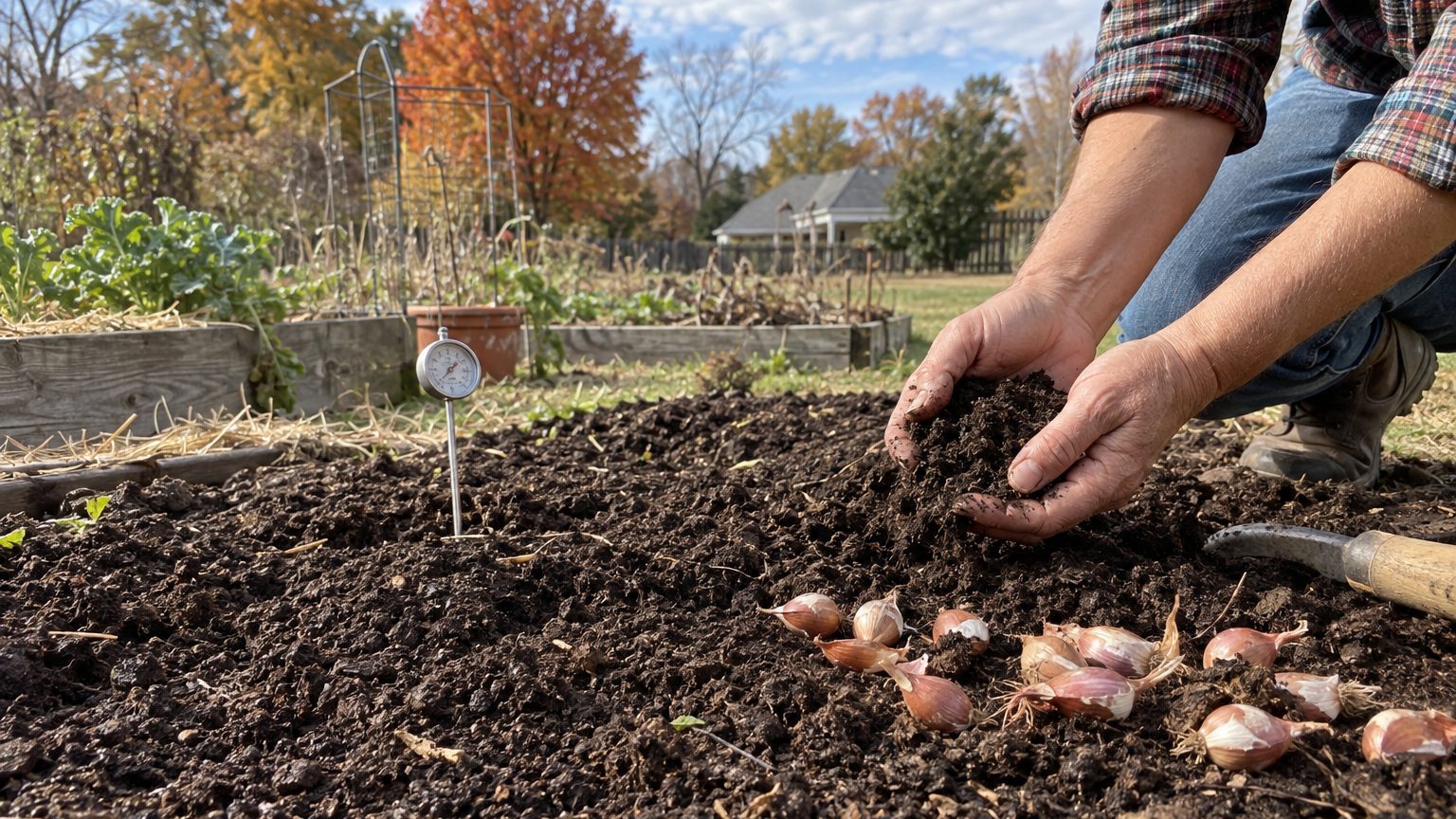

In Tennessee, shallots go in the ground either in autumn or in early spring, as soon as the soil is warm enough to root and not sitting in cold mud. At the Nashville reference station, the last spring freeze falls between March 31 and April 12, and the first fall freeze between October 28 and November 8. Those dates frame the choice, but they don’t make it for you.
When the soil is warm enough in Tennessee
What the frost date says, and what it doesn’t
Start with the number most people search for. According to the NOAA NCEI 1991-2020 Climate Normals, station USW00013897 (Nashville), the last spring freeze at 32°F falls between March 31 and April 12. That is the 30-70% probability band for a freeze. It’s a probability, not a promise, so a late cold snap after April 12 is possible in any given year.
The frost date is also a stand-in for what shallots actually care about. They wait for warm soil, not warm air. Soil lags behind the air, so it warms after the frost risk ends, not at the same moment. A bed that was frozen in January and soaked in February can still be cold and heavy on April 1, even if the forecast looks mild. Squeeze a handful from planting depth. If it crumbles, you’re ready. If it smears into a wet ribbon, wait a few days.
One caution on geography: East Tennessee and the Cumberland Plateau are cooler and run later in spring than Nashville. A gardener on the Plateau should push every date in this article later and treat the Nashville numbers as the early end of the state, not the middle of it.
Autumn planting follows a different clock
Shallots can also go in during fall, which is the same logic garlic growers use. The first fall freeze at the same station lands between October 28 and November 8. Planting in the weeks before that lets roots establish before the ground cools.
What differs for shallots is size. A shallot set is smaller than a garlic clove, so it sits shallower, and a freeze-thaw cycle can push it up toward the surface more easily. Check autumn beds after hard freezes and press any lifted sets back into the soil. Whether autumn is worth the risk depends on the winter, which the third section takes up.
For the general picture of how one bulb becomes a cluster, see Growing Shallots: One Bulb In, a Handful Out. For variety choices, your state extension service is the right authority, and the last section explains why.
How long the season lasts here
Two dates from the same NOAA station give you the arithmetic. Count from the last spring freeze (March 31 to April 12) to the first fall freeze (October 28 to November 8). Pairing the early dates gives 211 days, pairing the late dates gives 210 days, and the extremes run from 199 days (April 12 to October 28) to 222 days (March 31 to November 8). Call it roughly 210 days of frost-free growing at Nashville.
That number only matters for what it allows. Compare it with a northern prairie, where the window is far shorter and the first planting is the only planting. Our Growing Shallots in Manitoba page works through that squeeze. Here, 210 days is long enough to stagger things.
The simplest use is a second planting. Put in a first round of sets as soon as the soil allows, then another a few weeks later. Shallots size up as days lengthen and heat arrives, so a later planting has less time to build bulbs and will generally finish smaller. That is not a failure. Smaller shallots suit cooking fine, and the green tops of a late planting can be harvested young. The succession sowing guide on this site lays out how to space the rounds so that harvests don’t all land in the same week.
A long window also changes the transplanting question. Shallots grown from seed can be started indoors and moved out as seedlings. In a short season that head start can be the difference between a crop and none. In Tennessee it’s optional. If you do transplant, check the roots before setting them out. A seedling coiled tightly in its cell should be teased loose, because roots that stay in a circle sulk through summer.
The frost-to-frost count is a rough guide, not a measure of everything. East Tennessee and the Plateau start later in spring, so the window there is shorter. If you garden above Nashville in elevation, check your own county’s dates before planning a second round.
Heat and water in Tennessee
What can be said honestly is that Tennessee summers are hot and humid, and for shallots that combination matters more than any single reading. Humidity slows drying, encourages foliar disease, and makes the end of the season, when tops fall over and bulbs need to cure, a stretch where you watch the weather.
The winter low decides autumn against spring
The figure that does the real work is the winter minimum. At Nashville, the mean daily minimum of the coldest month is 30.1°F. That is just below freezing on an average night, not deep, sustained cold. The USDA Plant Hardiness Zone Map (2023, 1991-2020 normals) puts Tennessee across zones 5b to 8a, which is a wide spread. Zones rest on one variable, the average annual extreme minimum, so they say nothing about wet soil or humidity. Other parts of the state differ sharply from Nashville.
Where the ground freezes hard and stays wet, autumn-planted sets rot or heave, and spring is the safer call. Where winters are milder, autumn planting gives the larger, earlier bulbs it is grown for. Here is how the two compare.
| Factor | Autumn planting | Spring planting |
|---|---|---|
| Best where | Winters are milder, as around Nashville | Winters are harder or the soil stays wet, as on the Plateau |
| Main risk | Rot in soggy soil, heaving after freeze-thaw cycles | A short stretch to size up before summer heat |
| Payoff | Larger bulbs, earlier harvest | Lower winter loss, simpler management |
| Key practice | Well-drained bed, mulch over the winter | Plant as soon as the soil crumbles |
Drainage matters more than the calendar. A raised bed or a ridge of loose soil helps autumn sets avoid sitting in winter water. Mulch evens out the freeze-thaw swings that push bulbs up.
Summer is where humid heat bites. Space plants for airflow, water at the base rather than overhead, and keep a layer of mulch over the root zone, which holds the soil cooler and stops splashing. For a very different heat problem, with dry air and irrigation as the whole story, read Growing Shallots in Nevada. Tennessee’s problem is closer to the opposite: too much moisture hanging around for too long.
Which shallots suit Tennessee
The University of Tennessee Extension is the place to ask, through your county office, and its answer will be tied to your region of the state.
What can be reasoned from the facts is the type. Humidity makes disease resistance the first criterion. Ask the extension office which types stand up to the foliar and bulb diseases that thrive in warm, damp weather. Heat comes second, so favor types that cope with summer by finishing before the worst of it, and give whichever you grow airflow and shade at the root. A season of about 210 days at Nashville is not short, so you have no need to chase the earliest types, though gardeners on the Plateau, with later springs, may.
The other choice of type is how to start. Sets, meaning small bulbs, are the usual route and suit both autumn and spring planting. Seed-grown types start from seed and are transplanted, which works with the roughly 210-day window but adds the root check described earlier. Neither route is wrong. Sets are simpler, and seed gives you more options if the local extension recommends a seed type.
Harvest and storage touch food safety, so be careful here. Curing and storing work much as they do for garlic. Inspect each one instead. A soft neck means the bulb is finished, as does a moldy base. A bulb that looks firm on the outside is not proof it is sound, so cut open any you doubt, and discard anything soft, sour-smelling or moldy rather than trimming around it.
Common questions
Should I plant shallots in fall or spring in Tennessee?
It depends on your winter. Around Nashville, where the coldest month’s mean minimum is 30.1°F, autumn planting is workable and gives larger, earlier bulbs. In colder, wetter parts such as the Cumberland Plateau, spring is the safer call because sets can rot or heave over winter.
Is the last frost date the day to plant?
No. At the Nashville reference station the last spring freeze falls between March 31 and April 12, but that date is a stand-in. The real test is the soil: it should crumble in your hand and drain, not smear.
How can I tell whether a cured shallot is safe to keep?
Look and feel, but don’t trust looks alone. A soft neck or a moldy base ends the question, and the bulb goes in the trash or compost. Cut open any that feel doubtful, and don’t assume a firm outside means a sound inside.
What hardiness zone is Tennessee?
The USDA Plant Hardiness Zone Map (2023) spans 5b to 8a across the state, so no single zone applies. Zones also track only the average annual extreme minimum, which says nothing about humidity or wet winter soil, both of which matter more to shallots than a zone number does.