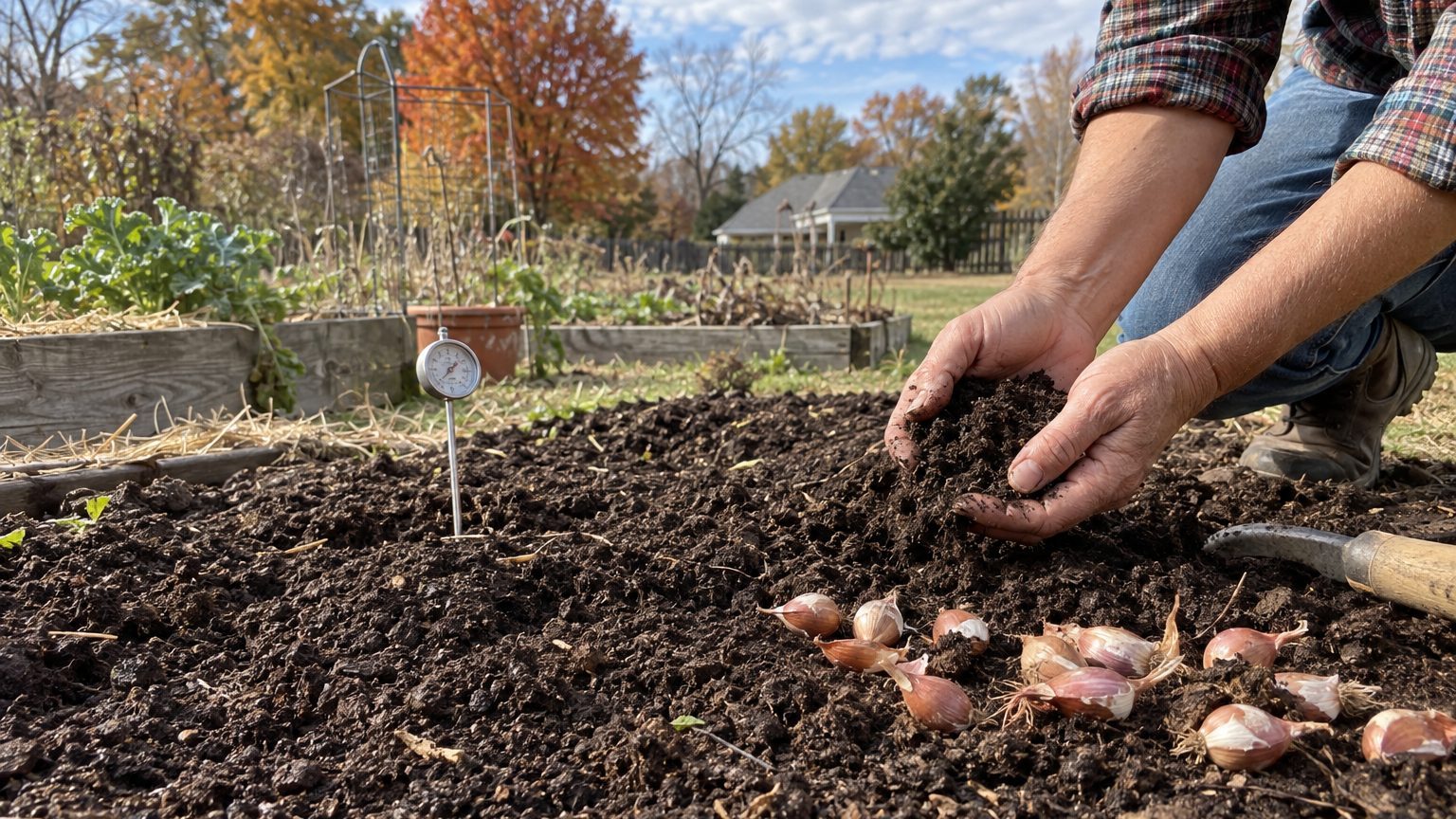

Shallots grow well in Utah, and the real decision is when to plant, not whether. Spring planting of sets works statewide once the ground thaws and drains. Autumn planting pays off only where winters stay mild enough to spare the bulbs. Elevation does most of the sorting, so a gardener in Cache Valley and one in St. George can follow the same logic and still plant weeks apart. For the general method, start with Growing Shallots: One Bulb In, a Handful Out.
When the soil is warm enough in Utah
Around Salt Lake City, the last spring freeze falls between April 12 and April 29. That comes from the NOAA NCEI 1991-2020 Climate Normals (station USW00024127, 32F freeze probabilities, 30-70% band). It is a probability, not a promise. Some springs run later than the band, and a cold snap in early May will not check the table first.
Frost is a proxy, soil is the signal
Shallots do not read calendars. They respond to the ground, and the ground warms after the frost risk ends, not at the same moment. Shallot sets root readily in cool soil, so you are not waiting for tomato conditions. You are waiting for soil that has thawed, crumbles in your hand, and does not shine when you squeeze a fistful. If it holds as a slick ball, give it another week. A soil thermometer costs a few dollars and beats any date on a chart.
The Salt Lake figure comes with a warning attached. That valley is one of the milder places in the state. Most of Utah sits higher and colder, and southern Utah runs warmer. The same bed of sets might go in during March in one county and in May in another, so treat the Salt Lake window as an anchor and slide it with your elevation.
Autumn is the other door
Planting in fall lets roots establish before the ground locks up, and those bulbs tend to come in larger and earlier the following summer. The garlic pages on this site cover the shared mechanics: timing ahead of the freeze, mulching, and rotating alliums so onions, garlic and shallots do not follow one another in the same bed. What differs for shallots is scale. A shallot set is a much smaller bulb than a garlic clove, with less stored energy to spare if frost heaves it out of the soil, so shallow planting and a loose mulch matter more than you might expect.
Whether a given shallot was trialled and performed at your elevation is a local question, and Utah State University Extension is the place to ask it.
How long the season lasts here
The same NOAA normals put the first fall freeze between October 18 and October 29. Pair those with the spring dates and the frost-free window at the Salt Lake City station runs from roughly 172 days, if you take the latest spring date and the earliest fall one, to roughly 200 days, if you take the earliest spring date and the latest fall one. That is the valley floor. Higher ground has fewer days.
What a long window allows
At 172 to 200 days, a Salt Lake valley gardener has options. A first planting of sets goes in as soon as the soil allows, and a second planting a few weeks later gives a staggered harvest. Be clear about what the second planting buys, though. Shallots form bulbs in response to lengthening days, so a late planting mostly yields green shallots for the kitchen rather than a second crop of cured bulbs. That is still worth doing, since the greens are mild and useful from late spring on. The succession sowing guide on this site walks through the spacing of those plantings.
The long window also makes transplanting seed-started shallots a reasonable gamble. Seedlings started indoors get a head start, and if a few lose a week to transplant shock, the season has room to absorb it.
What a short window changes
Move up into a high valley and the arithmetic reverses. The first planting becomes the only planting, because there is no slack for a second round to size up before the fall freeze. Transplanting also gets more expensive. A week lost to disturbed roots is a bigger share of a short season, so if you do transplant, check the roots before you commit. Look for firm white roots that hold the plug together, not a pot-bound tangle or a rotting base. For most high-elevation beds, planting sets directly in the first workable soil is the simpler route, since a set arrives already carrying its own energy and no roots to disturb.
Heat and water in Utah
Utah summers are hot and dry across its valleys, irrigation is the normal way to garden, and that shifts the shallot problem away from the one a cool, damp climate faces. Where summers are cool and wet, the trouble is downy mildew, slow ripening and rot in the field. Utah gardeners more often face the opposite: bulbs that stall in heat, and soil that swings between bone dry and overwatered.
The winter low decides autumn against spring
The figure that matters most is the cold. At the Salt Lake City reference station, the mean daily minimum of the coldest month is 24.2 F, from the NOAA NCEI 1991-2020 normals. That is the average nightly low in the coldest month, not a record low. By the USDA Plant Hardiness Zone Map (2023), Utah spans zones 4a to 9a, a huge range that tells you the state is really several climates. Salt Lake is only one reference point, and other parts of Utah differ sharply.
The rule of thumb follows from that. Where the ground freezes hard and stays wet through winter and snowmelt, autumn-planted sets can rot or heave out of the soil, and spring planting is the safer call. This is the same reasoning behind the advice in Growing Shallots in New York and Growing Shallots in Massachusetts, and it applies to Utah’s higher and colder valleys. Where winter is milder, as on the Salt Lake valley floor and farther south, autumn planting earns its keep with the larger, earlier bulbs it is grown for.
Water management in summer is mostly about steadiness. Shallots have shallow roots and need regular moisture while the tops are growing, then a dry-down as the tops begin to fall over. In heavy valley soils, overhead watering late in the season keeps bulbs wet when they should be drying. Drip lines or a dry spell near harvest give a cleaner cure.
Which shallots suit Utah
The shallots that perform in your garden are the ones trialled near you, at your elevation, in your soil. Utah State University Extension is the source for what has actually been grown and tested in the state, and county offices can speak to local conditions. Ask them before you order.
Choosing by type
What can be reasoned from Utah’s facts is the type of shallot to look for, depending on where you garden:
| Utah setting | What to favor |
|---|---|
| High, cold valleys with a short window | The earliest-maturing types, planted as sets in spring |
| Salt Lake valley floor | Either path: autumn-planted sets for earlier bulbs, or spring sets, with a second planting for greens |
| Hot southern Utah | Types that tolerate heat, planted so roots get airflow, light shade and consistent moisture |
Disease resistance sits lower on the list than it would in a humid state, since dry air does much of that work for you. It still counts if you irrigate overhead or grow in a crowded bed.
Harvest and storage inspection
Harvest once the tops have fallen over and yellowed, then cure the bulbs in a dry, airy, shaded spot until the necks are tight and the skins papery. A bulb that looks sound is not proven sound. Inspect each one: press the neck and check the base. A soft neck or a moldy base ends the question, and that bulb goes in the compost, not the pantry. Rotating the bed away from onions and garlic the next year, as the garlic pages explain, helps keep soil-borne trouble from building up.
Common questions
When should I plant shallots in Utah?
In spring, as soon as the soil has thawed and drains well. At Salt Lake City the last spring freeze falls between April 12 and April 29, and higher areas run later. For autumn planting, the milder valley floors and southern Utah are the better candidates.
Can I plant shallots in fall in Utah?
Where winters are mild enough, yes. At the Salt Lake City reference station the coldest month’s mean daily minimum is 24.2 F. In colder, higher areas where the ground stays frozen and wet, spring is the safer choice.
Which shallot variety is best for Utah?
Contact Utah State University Extension for the varieties trialled in your part of the state.
How do I know stored shallots are still good?
Inspect them. A soft neck or a moldy base means discard the bulb, however good the rest looks. Appearance alone does not prove a bulb is sound, and no keeping time is guaranteed.