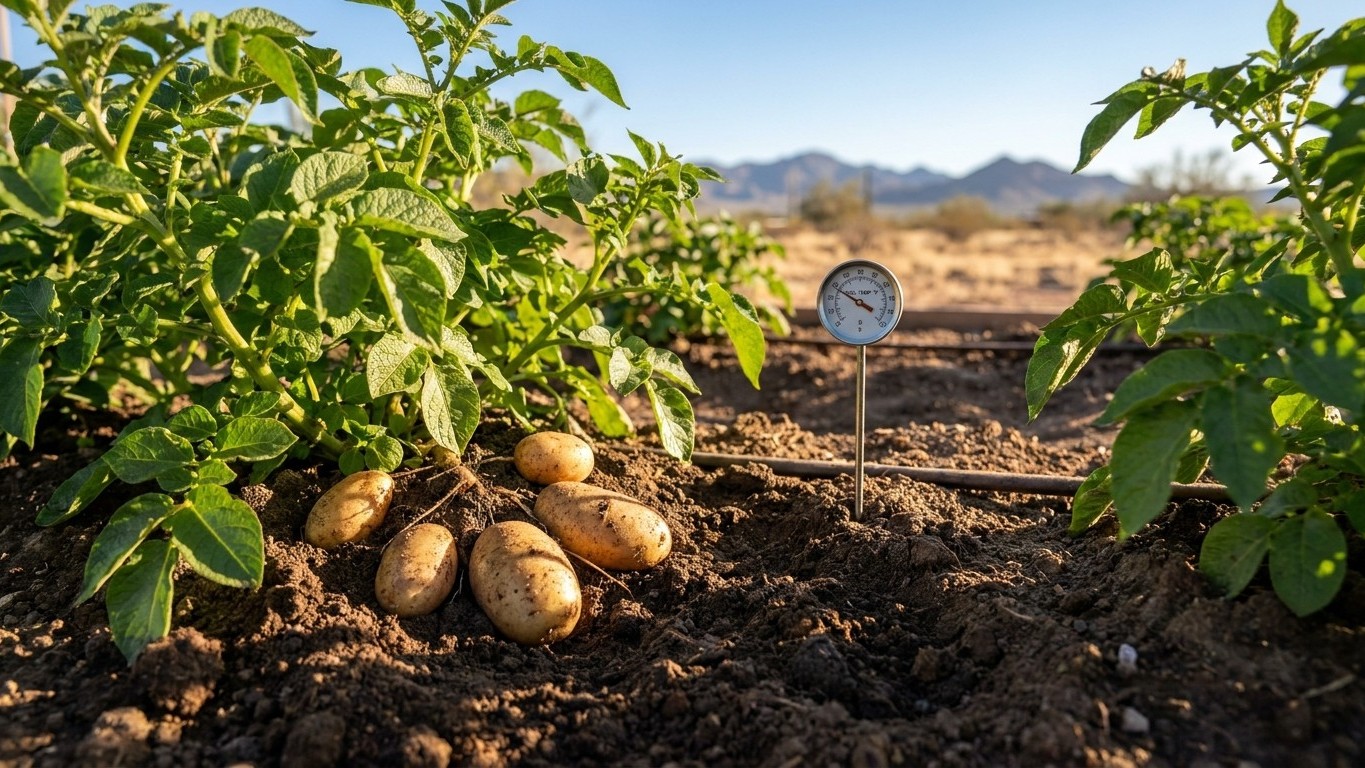

For most Indiana gardens, the best sweet potatoes are quick-maturing, orange-fleshed varieties such as Beauregard and Georgia Jet. Compact bush types like Vardaman suit small beds and containers. Longer-season and specialty types can work in the southern counties, but the risk climbs the farther north you garden. Summers here are warm enough for the crop, though the season has little slack.
The short answer for Indiana
Pick early-maturing, orange-fleshed varieties for Indiana and treat anything slower as a gamble north of Indianapolis. Sweet potatoes go in the ground as slips (rooted cuttings), so the clock starts at transplanting, and it starts late because the plants stall in cool soil.
The frost dates show how much room there is. At the Indianapolis reference station, NOAA’s 1991-2020 normals put the last spring 32°F freeze between April 9 and April 21. That range is the 30-70% probability band for a freeze around those dates. Purdue adds that a roughly 10% chance of a 32°F event remains after the published spring date. The first fall freeze falls between October 21 and October 30. Slips cannot go out on those April dates, because sweet potatoes want warm soil. The usable season is therefore much shorter than the gap between the two frost dates. The When to Plant Sweet Potatoes in Indiana guide covers the timing in detail.
Heat is less of a problem. Indianapolis averages 14.6 days a year at or above 90°F, which makes for a warm summer without the long scorching stretches of the Deep South. Sweet potatoes handle that well, and the vines usually run hard once July arrives. What limits the crop is how many warm weeks the roots get to fatten before cold returns.
Which sweet potato types fit Indiana?
The table sorts common choices by type. Varieties change in the seed catalogs, so match the type even if a particular name is sold out.
| Type | Examples | Fit for Indiana |
|---|---|---|
| Early, orange, moist flesh | Beauregard, Georgia Jet | Best bet statewide, including the north |
| Orange, firmer flesh, good keeper | Covington | Reliable in central and southern Indiana |
| Bush or compact vine | Vardaman | Good for small beds, raised beds and containers |
| Purple skin, white dry flesh | Japanese types such as Murasaki | Worth trying in the south, riskier in the north |
For the full growing routine, from slips to curing, see Growing Sweet Potatoes in Indiana.
What will not work here
Slow varieties planted in late spring will not finish in northern Indiana. A crop that goes in once the soil warms and has to be dug before the late-October frost leaves little margin for a variety that needs a long run of hot weather. In a cool summer, the roots stay thin while the vines keep growing.
Why do long-season sweet potatoes fail in northern Indiana?
Southern Indiana runs earlier in spring and later in autumn than the north by a fortnight or more. A slow variety that finishes in Evansville can run out of season near the Michigan line. Frost blackens the vines, and roots left in cold, wet soil lose quality fast. Slips planted by the April frost dates fail because the ground is cold, and the plants sit without growing.
Grocery-store roots are a poor shortcut too. You rarely know the variety, and so you cannot know its season length. Buy certified slips of a named early variety instead.
Does Indiana’s summer rain cause problems for sweet potatoes?
It can. The reference station gets about 12.6 inches of rain across June, July and August, and 43.6 inches over the year. June brings 4.95 inches and July 4.42, so the early growing weeks can be wet. August is the driest summer month at 3.2 inches. In clay soil, a wet June means roots sit in saturated ground, and they can rot or come out misshapen. Tight spacing makes it worse, because crowded vines hold humidity and stay wet after storms. Give plants room and plant on raised ridges or beds that drain.
The same inch of rain behaves differently on different soils. Sand lets it through within the day, while clay holds it for a week. A sandy bed can need water every few days in a dry August, and a fixed once-a-week schedule will leave it short. Hot days near 90°F speed evaporation, and rain that comes as a single thunderstorm mostly runs off rather than soaking in. A straight-sided can set in the garden tells you what actually fell on your plot.
What changes across Indiana
Indiana does not have one growing zone. Under the USDA Plant Hardiness Zone Map (2023 edition, built on 1991-2020 normals), the state spans 5b to 7a. That map rests on one variable, the average annual extreme minimum temperature, so it describes winter cold. Sweet potatoes are grown as annuals and killed by frost, which makes season length matter more than the zone number. Still, the zone spread tracks the real difference between north and south. There is no single answer for the state, and Indianapolis is only a reference point.
In the north, the margin is thin. Choose the earliest types, such as Georgia Jet or Beauregard. Warm the bed before planting by laying black plastic over it. Keep a row cover or old bedsheets ready for a late cold snap, particularly if you set slips out early. Compact bush types such as Vardaman are easier to cover and cheaper to protect. Plan on digging on the early side of the Indianapolis fall range, since the north gets its first frost sooner.
Farther south, the season stretches by a fortnight or more at both ends. That gives you room to try Covington or a purple Japanese type, and to plant a bit earlier once the soil warms. The same advice about draining the bed holds, because heavy clay shows up in parts of the south and center of the state. Some soils in the northwest and southwest are sandy and drain quickly, so those beds need more frequent watering.
To find where your garden falls, use the USDA Plant Hardiness Zone Map and search by ZIP code. Local conditions such as a slope, a hollow or a paved wall can shift your yard a half zone either way.
Where to check this for your own county
Purdue Extension is the place to confirm any of this. Every county has an extension office, and the staff there know the soils, frost pockets and weather patterns of your part of the state. Look up your county office and ask for three things.
- The local planting calendar for sweet potatoes, including when slips should go in around your county.
- Varieties that have been trialled or grown successfully in your county, which beats a catalog description.
- Where to buy certified, disease-free slips locally and when they usually arrive.
County Master Gardener volunteers, who work through the extension offices, can often tell you which varieties neighbors have grown well and which ones failed. A soil test through Purdue will also tell you about your soil’s nutrient levels. Sweet potatoes do well in modest fertility, and too much nitrogen gives big vines and few roots.
Statewide advice, including everything above, works as a starting point. A county recommendation beats it, because a county office is working from nearby gardens and local weather. If the two disagree, go with the county.
Checking this against your own garden
Your own observations outrank every date in the previous sections. Three things are worth watching, and none needs equipment.
Soil warmth by feel. Push your hand into the bed to planting depth in the morning. If the soil feels cool or clammy, wait. If it feels comfortably warm, like a mild day, the slips can go in. Try a few spots. A south-facing bed, a raised bed or a sandy patch will warm sooner than a low clay corner, which tells you where to plant first and where to hold back.
New leaves on the slips. After transplanting, healthy slips push out fresh leaves. If they sit pale and unchanged for weeks, the soil is likely too cool, or the spot gets cold wind. Moving the next planting to a more sheltered location will help.
Where frost hits first in fall. Note which part of the yard gets nipped first on the first cold morning. Low spots collect cold air, so frost shows up there before it does on higher ground. Next year you will know which bed needs covering first and which one can wait. Dig the whole crop before a hard freeze blackens the vines, and cure the roots somewhere warm and humid.
Common questions
Is Beauregard a good sweet potato for Indiana?
Yes. It is an early, orange-fleshed variety that produces reliably in short seasons, which suits most of the state. It is a common first choice for northern Indiana gardeners.
Can I grow purple or white sweet potatoes in Indiana?
You can, with more risk. Purple-skinned Japanese types tend to want a longer season, so they do best in central and southern Indiana. In the north, try a small trial row before committing a whole bed.
What is the best sweet potato for a raised bed or small space?
Bush types such as Vardaman have compact vines and take less room than the sprawling varieties. Raised beds also drain better and warm faster in spring, which helps in Indiana’s heavy clay.
When should I dig sweet potatoes in Indiana?
Dig before the first hard freeze. At the Indianapolis reference station, the first 32°F freeze falls between October 21 and October 30, and the north gets frost earlier. If frost blackens the vines, cut them back and dig soon afterward. Handle the roots gently, then cure them before storing.