
Plant sweet potato slips in Indiana from late May into early June, once the soil is warm and nights stay mild. Mid-June still works for quick varieties. The last spring freeze at the Indianapolis reference station falls between April 9 and April 21, but sweet potatoes need more than a frost-free bed. They need warm ground, and that arrives weeks later.
The short answer for Indiana
Set slips out between roughly May 20 and June 15. Southern Indiana can start at the early end of that window, and the northern counties are better off at the later end. That is more than four weeks after the April 21 edge of the last-freeze range, and the gap is deliberate. A bed can be frost-free in April and still be too cold for a tropical root crop.
What the frost dates actually measure
The April 9 to April 21 range comes from NOAA’s 1991-2020 Climate Normals for the Indianapolis station. It is a probability of a 32F freeze: the band where the odds of a freeze sit between 30 and 70 percent. Purdue adds a caution worth keeping in mind. Roughly a 10 percent chance of a 32F event remains after the published spring date. Anything tender set out on the early edge of the range needs a cover close at hand.
Fall works the same way. The first 32F freeze at the same station falls between October 21 and October 30, again as a 30 to 70 percent band. Indianapolis is the reference point. Southern Indiana runs earlier in spring and later in autumn than the north by a fortnight or more.
| Event | Indianapolis reference range | What it means for sweet potatoes |
|---|---|---|
| Last spring 32F freeze | April 9 to April 21 | Too early to plant. Soil is still cold. |
| Slip planting window | About May 20 to June 15 | Soil is warm and nights hold above the 50s. |
| First fall 32F freeze | October 21 to October 30 | Roots should be dug before this range opens. |
How much growing time do slips need?
Sweet potato slips are counted from transplanting, and most varieties need about 90 to 120 days in the ground. A slip planted after the last spring frost is ready when the leaves yellow and the roots have sized up. One planted June 15 with a 120-day variety lands near October 13, close enough to the first-freeze range that there is little room for a cool September. That arithmetic is why mid-June is the late edge, and why shorter-season types matter for later plantings. The The Best Sweet Potatoes to Grow in Indiana guide sorts varieties by days to maturity.
Roots should be dug before the first freeze blackens the vines, and ideally before the soil turns cold. A frost that kills the foliage does not kill the roots under mulch or soil, but cold ground and rot go together in storage. For the full growing cycle, see Growing Sweet Potatoes in Indiana.
What will not work here
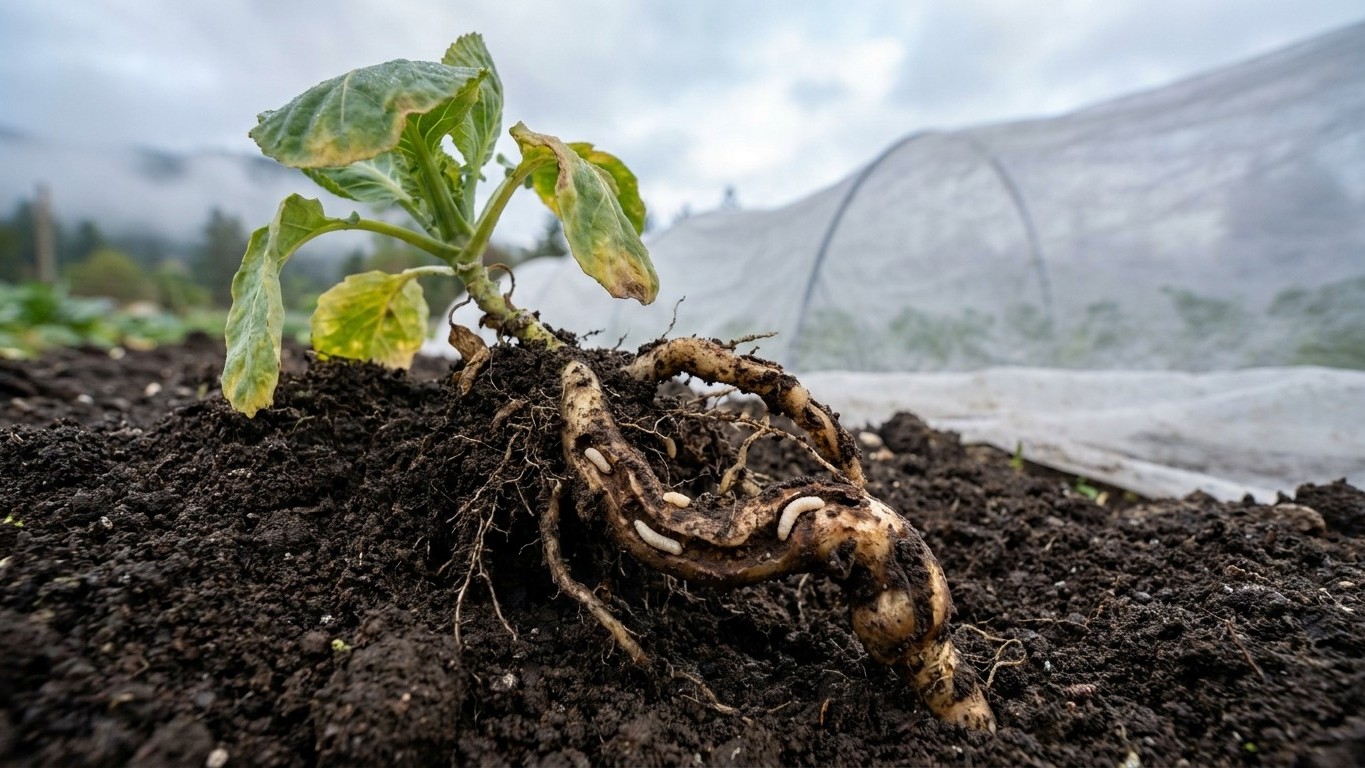
Planting on the last-frost date fails. A garden in central Indiana can be free of freezes by mid-April, but the soil is usually in the 50s then, and a slip set into it sits without rooting. Leaves yellow, growth stops, and the slip often rots in cool, wet ground. Treating sweet potatoes like tomatoes or peppers, which gardeners also set out soon after frost, is the common mistake. Sweet potatoes want soil comfortably warm, not merely unfrozen.
Planting late with a slow variety also fails. The window between a mid-June planting and the first freeze range of October 21 to October 30 is what the season allows. A 120-day variety set out June 15 uses nearly all of it, and roots stay small. The answer is to plant earlier inside the window or choose a variety that sizes up in 90 to 100 days.
Why heat is not the problem
Summer heat is rarely what defeats sweet potatoes here. The Indianapolis station averages 14.6 days a year at 90F or higher, which is a modest heat load. Sweet potatoes handle heat well and set roots best when summer nights stay warm. The shortfall in Indiana is early warmth, not midsummer heat. That is the reason black plastic mulch pays off in a cool May: it warms the soil before the weather does.
Water and soil can undo a good planting date
Summer rain at the reference station averages about 12.6 inches across June, July and August, out of 43.6 inches for the year. June brings 4.95 inches, July 4.42, and August 3.2, the driest of the three. That works out to a bit under an inch a week in August. A garden on clay holds that water for days. A garden on sand, such as the sandy ground found in parts of northern Indiana, may need watering every few days even in a wet June. These figures are normals for one station over 1991-2020, not a forecast. A rain gauge on the plot tells you what actually fell.
Wet clay is hard on roots. Heavy soil that stays soggy in late summer gives misshapen, cracked or rotted roots, and a big rain after a dry spell in September makes the cracking worse. Building ridges lets excess water drain away from the roots. Close spacing is the other humid-summer failure. Slips set close together produce a dense canopy that stays damp after storms, and a damp canopy is where fungal problems start.
What changes across Indiana
Indiana does not have one growing climate. The USDA Plant Hardiness Zone Map (2023 edition, based on 1991-2020 normals) places the state across zones 5b to 7a. That zone system rests on a single variable, the average annual extreme minimum temperature. It says something real about winters. It says less about when the soil warms in May, though the two tend to run together. There is no single planting date for the state, only a spread of about two zones’ worth of difference.
In the north, slips belong at the later end of the window. A reader in the northern tier should think of late May as the earliest and early June as normal, and should treat mid-June as the real edge. Shorter-season varieties, black plastic and low row covers over the first two weeks are all worth the effort. The first freeze comes earlier up there too, so the growing season shortens from both ends.
In the south, the window opens sooner. Southern Indiana warms earlier and holds its warmth later into autumn, which gives a gardener the room to plant around May 15 and try a longer-season variety. Hardiness zone 7a is found toward the Ohio River, and a long, warm fall there extends the digging period.
Where to check this for your own county
The county office of Purdue Extension is the best next stop. Every Indiana county has one, and the staff there know the local soils, the typical last-freeze dates, and the problems that turn up each year. A county recommendation beats a state one. The state planting window is built from a single reference station and leaves out many local differences.
Two things are worth asking for. The first is the local planting calendar, which will show when sweet potato slips are normally set out in your part of the state. The second is which varieties have been trialled in your county or a neighboring one. A variety that performs well in the southern tier may sit in cold soil for weeks in the north, and trial results show which ones actually size up in your soil and season.
Checking this against your own garden
Your own observations outrank every date on the calendar. Two are worth watching, and neither needs equipment.
- Soil warmth by feel. Push your hand 3 to 4 inches into the bed on a mid-morning in May. If it feels cool, wait. If it feels comfortably warm, like a bath that has sat a while, the bed is ready. A bed that warms early points to a sheltered, south-facing spot. One that stays cold longer is shaded, low, or heavy with clay.
- New leaves on the slips. After planting, a slip that puts out fresh leaves has rooted. If the leaves stay flat and yellow, the soil was too cold or too wet. That is a signal to cover the row, hold off watering, and wait for warmer nights.
Keep a notebook of the date you planted, the date of first new growth, and the first frost. After two seasons, those notes will beat any regional average, because they describe one yard.
The Moon calendar is a separate, older custom: see when to plant sweet potatoes by the moon, written as tradition rather than fact.
Common questions
Can I plant sweet potatoes in April in Indiana?
No. April 9 to April 21 is the range for the last 32F freeze at Indianapolis, and the soil is still cold well after that. Slips set out in April stall and often rot. Wait until late May unless you are in the south and the soil feels warm.
How late is too late to plant sweet potato slips?
Mid-June is the practical edge. Slips planted then have until the first freeze range of October 21 to October 30. That is enough for a variety that matures in 90 to 100 days, and tight for a 120-day one. After mid-June, yields drop.
Do sweet potatoes need a lot of water in Indiana summers?
Less than most vegetables. June, July and August bring about 12.6 inches of rain together, and August is the driest month at 3.2 inches. Sandy soil may need extra watering in dry stretches, while clay usually does not. Ease off watering in September, since a heavy soak late in the season can crack roots.
When should I dig sweet potatoes in Indiana?
Dig before the first freeze, which falls between October 21 and October 30 at the reference station and earlier in the north. Most plantings from late May or early June are ready from the first half of September on. If a frost blackens the vines before you get to them, cut the vines back and dig within a few days.