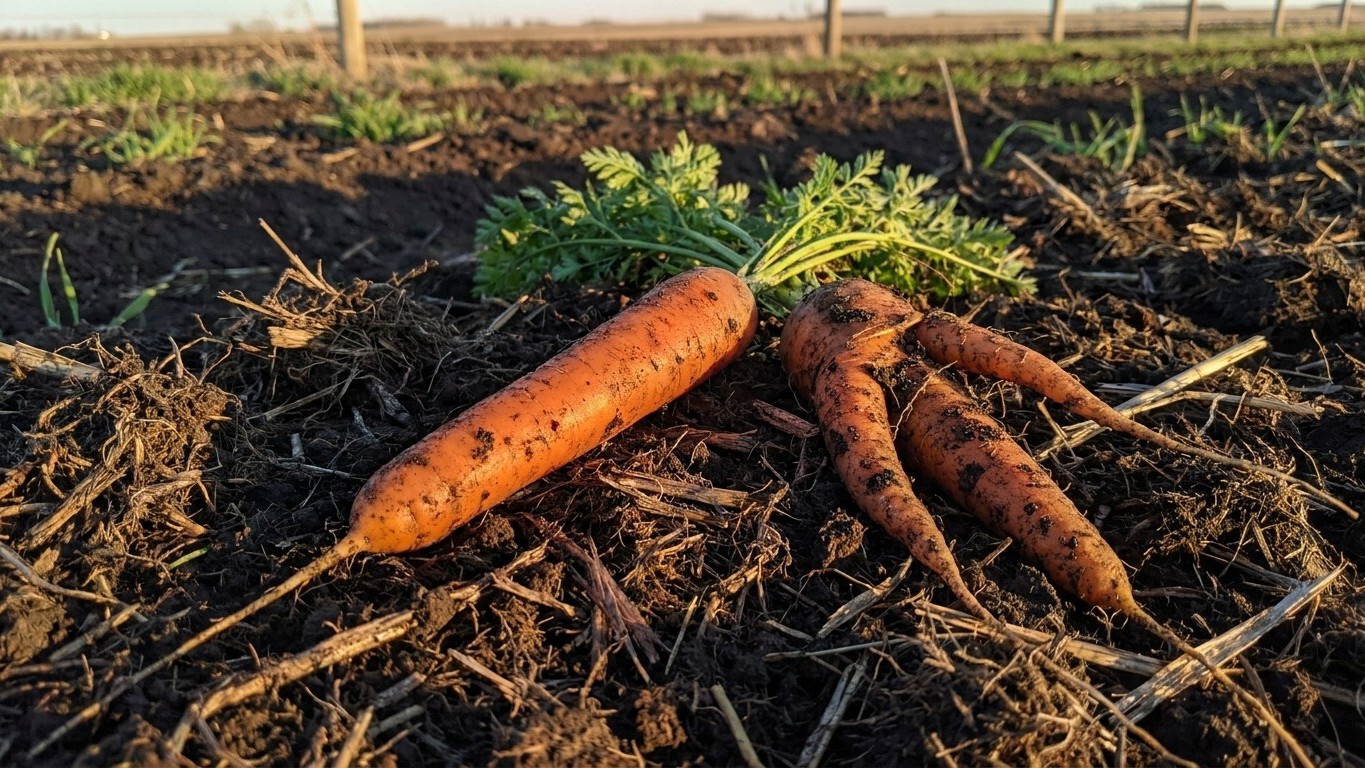

Pull carrots about 65 to 75 days after planting, according to Clemson Cooperative Extension. Seed packets often run 70 to 100 days, counted from the day the seed goes into the ground. Carrots are sown in place, so there is no transplant date to count from. Pull them when the shoulders at the soil line reach the width the packet describes. Then cut the tops off right away and chill the roots. A carrot stored with its leaves on lasts only about 10 to 14 days.
Keeping them, and for how long
The Home & Garden Information Center at Clemson Cooperative Extension states the storage target plainly: carrots go in at 33 °F with high humidity to prevent wilting. Everything else about keeping carrots follows from those two conditions and from one chore, removing the leaves.
What temperature and humidity keep carrots longest?
The number to write down is 33 °F. That is just above freezing, so it is far colder than a typical cellar, pantry or kitchen. Clemson’s own note on bunched carrots (plants with the tops still on) says they keep for about 10 to 14 days. Treat that as a storage life under ideal conditions. A warm spot shortens it, and a carrot held near 50 °F will sprout and go soft in a fraction of that time.
Humidity matters as much as temperature. A carrot root is mostly water, and dry air pulls it out through the skin. The root goes limp and rubbery long before it spoils. A closed container or a plastic bag with a few small holes holds in moisture while still letting the roots breathe. Brush off the loose soil first. Roots with chewed spots or tunnels, the kind of damage described in What Eats Carrot in West Virginia, and When, break down sooner, so cook those first and store only sound roots.
Why cut the tops off carrots before storing them?
The leaves keep drawing moisture out of the root after harvest. A carrot with its tops on keeps losing water through the foliage, and the root shrivels from the inside. That is why bunched carrots last 10 to 14 days while topped carrots can last for months, held cold and humid.
Cut the tops the same day you pull, close to the shoulder, leaving only a short stub. Do not set the pulled carrots in the sun or leave them in the garden cart while you finish the row. A few hours of warm air and attached leaves already take something off the storage time. If you want the greens for the kitchen, strip them off and use them in the next day or two.
Carrots left unwashed, topped and chilled give you the longest hold the method allows. Even then, check the container every week or two and pull out any root that has gone soft, since one bad carrot can spoil its neighbors.
Where in the house that actually is
Few rooms in a house sit at 33 °F with high humidity, so most homes have one real candidate and several poor ones. Think of each spot by what it does over a day and across a season.
- Refrigerator crisper drawer: the closest match for most households. A refrigerator holds a steady, low temperature, and the drawer, closed and lined with a bag, keeps humidity up. Some refrigerators run colder at the back, so keep the bag away from the rear wall.
- Unheated basement or cold room: can approach the target in the coldest months, but runs warmer through fall and in any year with a mild spell. It is also often damp, which helps the carrots but can invite mold on the container.
- Heated rooms, pantries and kitchens: too warm. Carrots here soften and sprout.
- Garage or porch: swings with the weather. A cold night can freeze roots, and a sunny day can warm them back up, and each cycle damages the texture.
A refrigerator can run colder than some crops tolerate, which is why it suits carrots but not tomatoes or squash. If your harvest is larger than the crisper drawer holds, a second spot in a basement may do part of the job, but check it before you commit the whole crop.
The check is simple. Leave a thermometer in the spot for two days and read it morning and evening. If the reading stays within a few degrees of 33 °F, load it up. If it drifts toward 50 °F or bounces between day and night, use the spot only for the carrots you plan to eat within a week, and keep the rest in the refrigerator.
How do you know carrots are ready to pull?
Count from the day you seeded, then confirm by looking. Clemson’s 65 to 75 days after planting and the 70 to 100 days printed on most packets describe the window, and the variety on your packet sets where in that range your row falls. Carrots sown in place never go through transplanting, so every day counts from seeding.
The quickest test is to brush the soil away from one shoulder. If the crown is about as wide as the packet describes and the color is deep, the root is ready. Pull a single carrot as a sample. If it is small, pat the soil back and wait a week. Carrots are forgiving about timing, and most rows can stand past ready without much harm, though roots left too long can turn woody or split after a heavy rain.
Fall carrots give you more room. Many gardeners leave them in the ground under a thick layer of straw or leaves and pull them as needed, before the ground freezes solid. The county extension office can tell you the local frost dates, and those vary a great deal between river valleys and ridgetops. The general rule of timing and storage is laid out in Growing Carrots in West Virginia.
Does West Virginia soil change how you pull carrots?
It can. The state soil, the Monongahela series, is an Ultisol, an old, heavily weathered and leached soil that is naturally acid and low in nutrients. Its surface layer is a loam to silt, about 27 percent sand, 18 percent clay and 54 percent silt, with roughly 3.0 percent organic matter and a surface pH of about 5.0, which is strongly acid. It is moderately well drained.
That is the soil chosen to represent the state, not the soil in every garden. West Virginia has hundreds of soil series, and river bottoms, hill country and any ground a builder has scraped or filled can differ completely. Use it as a starting point for what ground in this region tends to do.
Utah State University Extension says carrots want deep, sandy, well-drained soil rich in organic matter, and that heavy or rocky soil makes the root fork. A silt-heavy soil with little sand and moderate drainage tends to pack after rain, so roots can fork or snap when you pull. The fix is a raised bed or double digging with plenty of compost, rather than a different seed. The longer discussion is in Will Carrots Fork in West Virginia Soil?
To learn what your own bed is like, send a sample to your local county or provincial extension office. A shovel-deep hole after a heavy rain shows how fast water drains. A soil test through the county extension office gives you the pH. When harvest day comes, loosen the ground beside the row before pulling, so the roots lift without breaking.
Common questions
How many days from seeding until carrots are ready?
Clemson Cooperative Extension says to harvest carrots about 65 to 75 days after planting. Packets commonly list 70 to 100 days. Both counts start at seeding, since carrots are sown in place and not transplanted. Check the shoulders to confirm.
Can I store carrots with the tops on?
Bunched carrots keep for about 10 to 14 days at 33 °F with high humidity. The leaves draw moisture from the root, so cutting the tops off at harvest gives a much longer hold.
Can carrots stay in the garden into winter?
Many gardeners leave fall carrots in the ground under a thick mulch of straw or leaves and pull them as needed. Pull the rest before the soil freezes solid. The county extension office can give local frost dates for your valley or ridge.
Is a basement or garage cold enough?
Only if a thermometer says so. The target is 33 °F. A garage swings with the weather and can freeze roots on a cold night, and a basement is often too warm in early fall. Read the thermometer for two days before trusting either one, and keep the refrigerator drawer as your backup.