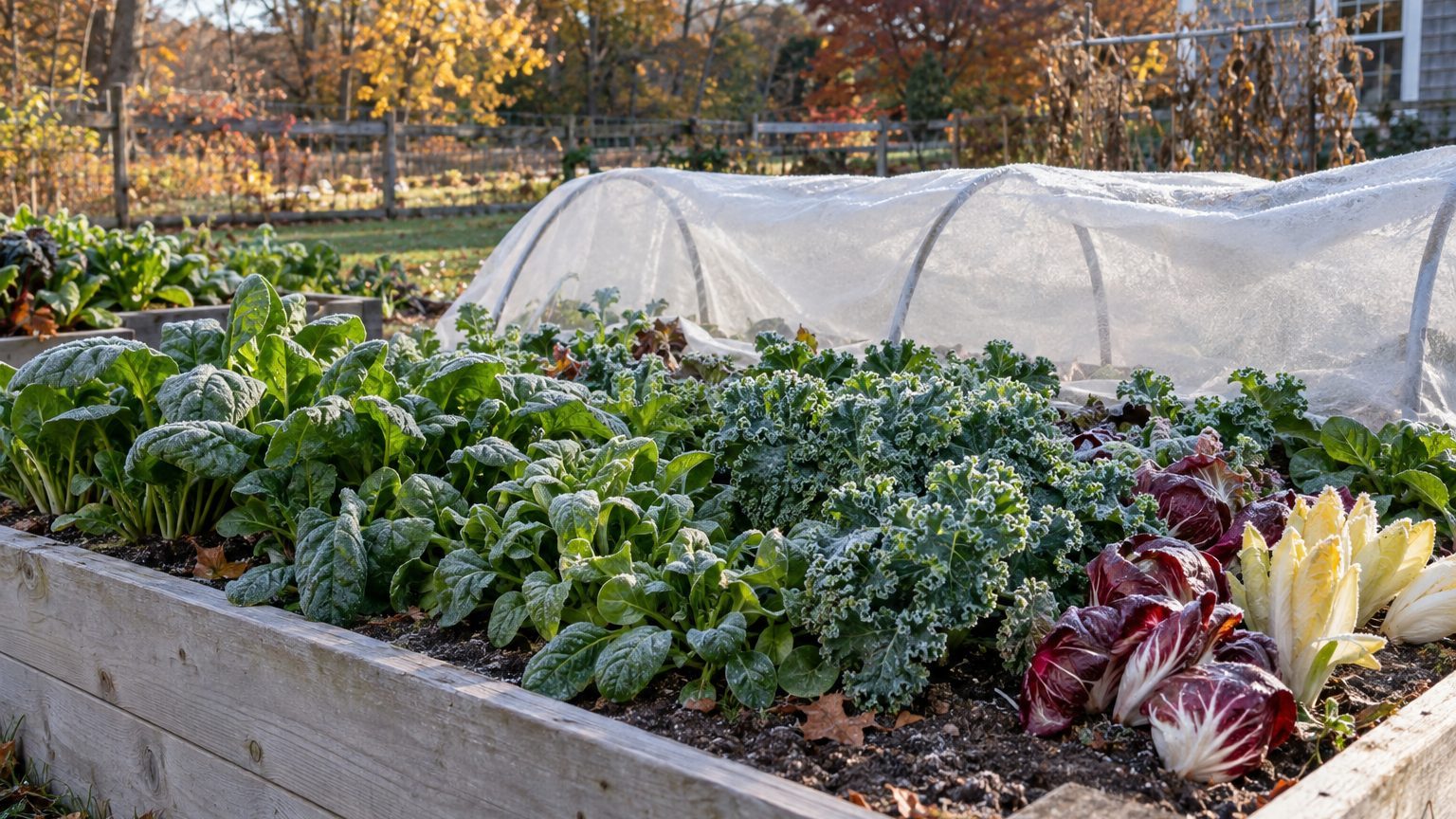

Lettuce quits when nights drop into the mid-20s °F, but a short list of other salad crops keeps going: mâche, spinach, claytonia, arugula, mizuna, tatsoi, young kale, and the chicories such as endive and radicchio. Sow them in late summer or early autumn, let them size up before the light fades, and cut leaves all winter. Where winter lows run hard, a row cover or cold frame carries them through.
The salads that take real cold

Lettuce is a fair-weather salad. Tender types turn to water-soaked mush after a few nights in the mid-20s, and even the sturdier heading and leaf types stall once the soil chills. Mustards, spinach, mâche, claytonia, kale, and chicories behave differently. Their leaves stay alive through hard freezes, and some keep producing all winter under a cover. Every crop below is grown from seed in beds, containers, or cold frames.
| Crop | How much cold it takes | How fast it grows | What it tastes like |
|---|---|---|---|
| Mâche (corn salad) | Among the hardiest; holds through well-below-freezing nights, often uncovered in moderate winters | Slow, small rosettes | Mild, soft, slightly nutty |
| Claytonia | Very hardy; takes single-digit lows, better with a cover | Slow to moderate | Mild, crisp, succulent |
| Spinach | Established plants take the low teens °F and colder under a cover | Moderate in fall, nearly still in midwinter | Sweet and tender after frost |
| Kale and collards (baby leaf) | Single-digit lows once established | Moderate | Mild cabbage flavor that sweetens in cold |
| Arugula | Light freezes, roughly the mid-20s °F; needs cover below that | Fast | Peppery, milder in cool weather |
| Mizuna and tatsoi | Teens °F with some protection | Fast | Mild mustard flavor, tatsoi softer and spoon-shaped |
| Endive, escarole, radicchio | Roughly the 20s °F; cover helps | Slow | Bitter, often mellower after cold |
Treat the cold figures as ranges. Wind, wet soil, and how settled the plant is all move them. A spinach plant with a full root system in dry soil handles a night that would flatten a seedling.
Which winter salad greens need a cover?
The fast growers are the first to go. Arugula, mizuna, and tatsoi have thin, quick leaves that bruise and brown when the temperature falls below the teens or low 20s, so they usually want protection once winter sets in. Mâche, claytonia, spinach, and kale are the ones most likely to stand in an open bed.
Covers come in three basic forms. Lightweight row cover fabric laid over hoops adds a few degrees. A low tunnel of plastic over hoops adds more. A cold frame, a bottomless box with a clear lid, holds the most heat and shelters the crop from wind. Stacking a fabric layer inside a tunnel or frame is a common way to cover a hard cold snap. Vent the plastic and glass on sunny days, because a closed frame heats quickly and invites rot.
Varieties matter more here than almost anywhere else in the garden, since a type bred for summer cuts will not behave like one selected for winter. Your state extension service publishes trial results for the varieties that have done well locally, and that list beats any general recommendation.
Sown in autumn, harvested through winter
The calendar for this family runs backward from what most gardeners expect. Seeds go in during late summer and early autumn, while soil is still warm enough to germinate them quickly. The plants then have the weeks of shortening days to build leaves. By the time growth slows, there should be a stand large enough to cut from.
Why does growth stop in midwinter?
Plants need light to keep growing, and once days fall below roughly ten hours, growth effectively stops. In the northern half of the country that window opens around November and lasts into late January. In the Deep South the shortest day barely dips below the line, so growth only slows. Temperature plays a part, but light sets the schedule. A covered bed at 50°F still sits nearly still when days are that short.
The practical meaning is simple. In midwinter you are harvesting what you grew in fall, and the plants are not making more. A bed that looks full in late November is a stored supply, and every leaf you cut is gone until days lengthen again. Crops that hold a rosette close to the ground, like mâche, claytonia, and spinach, keep their leaves in good shape while they wait. Taller crops like kale hold their stock on the stem.
When do you sow winter salad greens?
The date depends on latitude, and the margin for error is smaller than most people assume. A sowing that goes in too late never reaches cutting size before the light fails, and the bed produces little until spring. A sowing that goes in too early can bolt or turn tough before the cold arrives, particularly arugula and the mustards. A sensible habit is to sow in two or three small batches a couple of weeks apart. If one batch is too late or too soon, another carries the harvest.
Your state page gives sowing windows for your climate, and the season extension guides explain how a cover moves the window later. A cover buys time at both ends, allowing a later sowing to establish and a mature bed to keep producing through harder cold.
Once a bed is established, harvest gently. Take the outer leaves and leave the center of each plant intact. Pick in the middle of the day after leaves have thawed, since frozen leaves snap and bruise when handled. Water sparingly, in the morning, so leaves are dry before night. Wet foliage freezing on a cold evening does more harm than the cold alone.
Cold changes how they taste
A frost does more than test these plants. For several of them, it improves the flavor. Gardeners who grow spinach and kale through the fall know the pattern: the leaves taste noticeably sweeter after a few cold nights than they did in September.
Which greens get sweeter in the cold?
The mechanism is a defense. When temperatures drop, the plant converts stored starch into sugars. Sugars dissolved in the cell sap lower its freezing point, which protects the cells from ice damage. The same sugars give the leaf a milder, rounder flavor. The sweetening is strongest in spinach, kale, and collards, and mâche and claytonia show it too, though their flavor was mild to start with. Carrots and parsnips do the same thing underground, which is why roots are often left in the ground into winter.
Sweetening takes a few cold nights, not a single frost, and it fades if the weather warms for long. Picking after a stretch of cold, rather than after a warm week, gives the sweetest leaves.
Which ones just toughen?
Not every crop responds that way. Arugula, mizuna, and tatsoi survive cold well enough, but they do not gain much flavor from it. Their leaves thicken, growth slows, and older leaves can turn leathery after repeated freezes. The best leaves come from young plants and from the center of the rosette, while outer leaves that have been through several hard nights are better trimmed off.
The chicories fall in between. Endive, escarole, and radicchio are bitter by nature, and cool weather often softens that edge, though the result depends on the type and the weather. Some gardeners cover or tie the heads to blanch the inner leaves, which also tames the bitterness. A leaf that has frozen and thawed repeatedly looks glassy and limp, and it tastes flat rather than sweet. If it has turned to mush, compost it and move on to a healthier plant.
Why the answer changes with where you garden
Two dates decide what is possible in your yard. The first fall frost sets how late a sowing can still establish. The coldest winter low decides which crops stand open, which need a cover, and which do not manage at all.
What does the first frost decide?
Where the first frost arrives in early autumn, the sowing window for winter salads closes in late summer, and a gardener there has little room for a late start. Where frost holds off into November or later, the window runs longer. In the Deep South and along much of the Gulf and Pacific coasts, summer heat lingers into fall, so seed often goes in later than in the north, and winter becomes the best salad season of the year. Seeds of spinach and lettuce can refuse to germinate in warm soil, so gardeners in hot-summer regions often sow in a shaded spot or wait for cooler nights.
What does the winter low decide?
The coldest nights sort the crops. In regions with mild winters, most of this family stands in an open bed, and even lettuce can run through the season. Where lows dip into the teens or single digits, the hardiest crops (mâche, claytonia, spinach, kale) can often stand open, while the fast mustards and arugula want a cover. Where winters are severe, with long stretches of subzero nights, even the hardy crops need a tunnel or cold frame, and the coldest places call for a greenhouse. Snow is a help, since a layer of it insulates the bed better than most fabrics.
Start with your state page, which sets out frost dates and climate for your region, and then read the season extension guides on covers and tunnels. Your county extension office knows the local frost dates and which varieties have been trialled in your soil and weather. That advice will do more for a winter bed than any general rule.
Common questions
Can I grow winter salad greens without a cover?
In mild-to-moderate winters, yes. Mâche, claytonia, spinach, and kale are the crops most likely to survive in an open bed. Where nights fall below the teens, a row cover or cold frame improves the odds, and it keeps leaves cleaner and easier to harvest.
Do winter salad greens grow in containers?
They do well in them, with one caution. Soil in a pot freezes harder and faster than soil in the ground. Set containers against a south-facing wall, group them together, and move them into an unheated garage or porch on the coldest nights. Use a container deep enough to hold moisture, and keep watering light in cold weather.
Will they regrow after I cut them?
In fall, yes. Cut the outer leaves and the center keeps producing. In midwinter, with days under about ten hours, regrowth is very slow, so cut lightly and spread harvests out. Heavy cutting in the dark months can leave a plant without enough leaf to recover.
Why did my greens stop growing in December?
Short days. Below roughly ten hours of light, plants hold their size even when the bed stays above freezing. Keep harvesting from the stand you built in fall, and expect new growth to return as days lengthen in late winter. Next year, sow a little earlier so the bed reaches full size before the light drops.