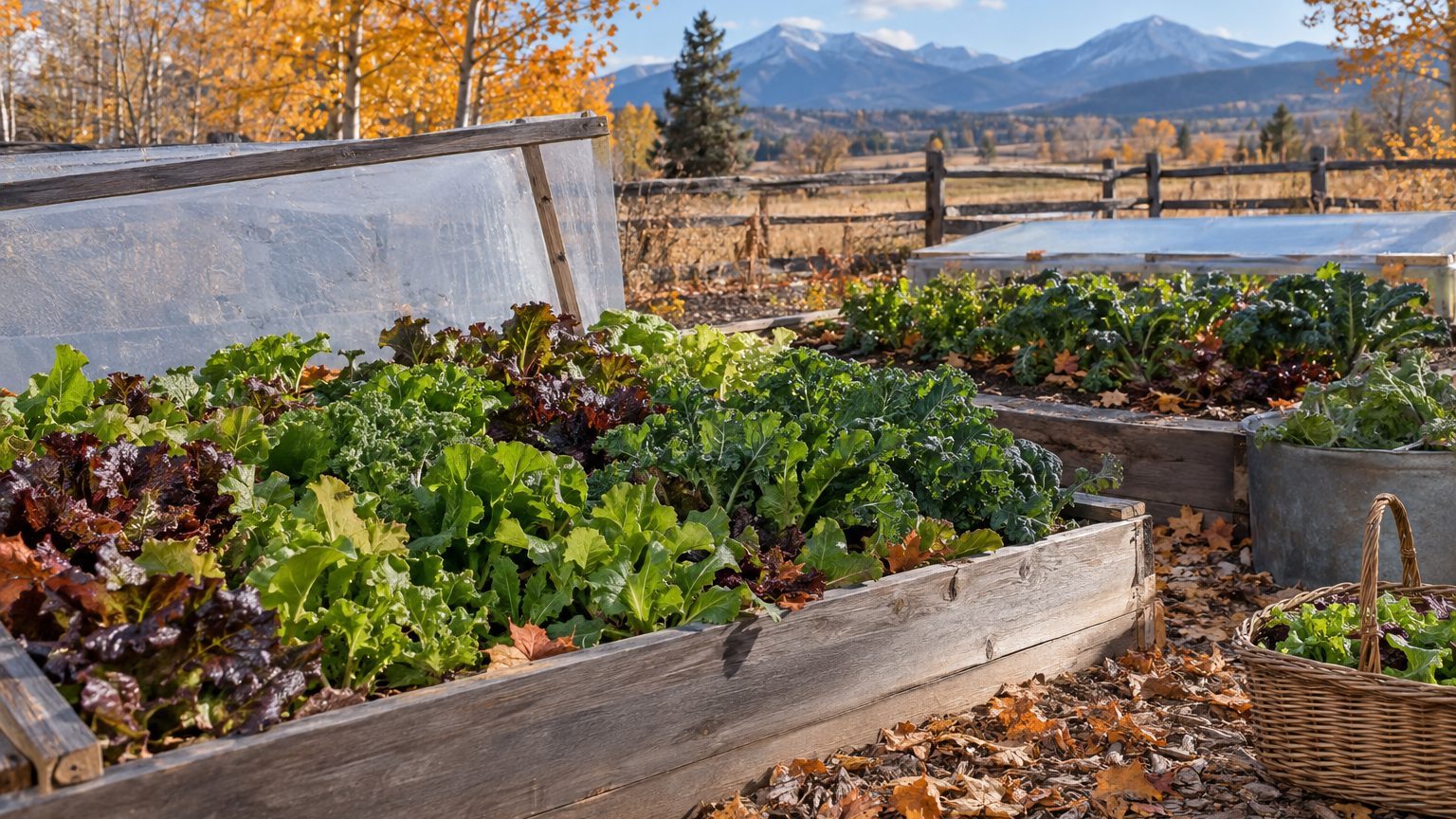

August sowing decides an Alberta winter salad bed, because hardy greens have to reach useful size while the light is still strong. Once autumn light fades they mostly hold rather than grow, so a seedling that is still tiny in October stays tiny until spring. Get your winter greens sown and up in the last stretch of summer, and have a cover ready to go over them before the hard freezes arrive.
When the soil is warm enough in Alberta

Environment and Climate Change Canada’s Canadian Climate Normals for 1981-2010 put the average last spring frost at the Calgary International A station on May 21. That is a mean date, and frost falls later than it in one year out of two, so read it as the middle of a window and never as a safe day. The station is in Calgary. Northern and upland districts of Alberta run weeks behind it, so look up the normals for the station nearest your garden before you plan around any of this.
The crop mix from Winter Salads: What Grows When Lettuce Will Not carries over, so the focus stays on what Alberta changes. Everything here is for beds and containers you tend yourself.
Why the frost date is only a proxy
A frost date tells you when the air stops dipping below freezing. It says little about the ground. Prairie soil in spring is cold and often wet, and it warms after the frost risk ends, not with it. Salad seed dropped into cold, soggy soil sits for weeks or rots. The soil sets the sowing day, not the calendar. Push a soil thermometer to seed depth first thing in the morning, when the reading is at its lowest, and compare it with the minimum germination temperature printed on the seed packet.
For a winter harvest, the sowing that matters most falls at the other end of the year. By late summer the soil is warm from months of sun, seed comes up fast, and the space left by early peas, spring lettuce or spinach is free. That is the bed you want, and the next section works out how far back from autumn frost to count.
What the hardiness zone does and does not tell you
Natural Resources Canada’s plant hardiness site, using 1991-2020 normals, places Calgary in Canadian zone 4a. Treat that as a Canadian figure only. The Canadian system draws on seven climate variables, and NRCan states there are no simple conversions to USDA zones. Its own comparison has zone 4a overlapping nine USDA zones, from 3a to 7a. A US catalogue that says a green is “hardy to zone 5” therefore tells you far less than it seems to.
Varieties are a separate matter.
How long the season lasts here
Set the two ECCC means side by side. The average last spring frost at the Calgary station is May 21, and the average first fall frost is September 16. Counting the days: 10 left in May, 30 in June, 31 in July, 31 in August and 16 in September comes to about 118 days, roughly 17 weeks. Both figures come from the 1981-2010 normals, and both are averages, so some years give you less than that and some more.
That is a short window. It decides how you use the ground more than it decides what you grow.
What 118 days allows
A tender summer crop such as tomatoes or squash can take most of those weeks by itself. Winter greens do better as a follow-on crop in a bed that an early crop has just left. Pull the spring lettuce, peas or early spinach in mid summer, rework the soil, and sow into that gap. The window has no room for a leisurely second attempt. If the first late-summer sowing fails, you probably will not get another that reaches size.
Work the sowing date out yourself. Take the days to maturity from the seed packet, and note whether the packet counts from sowing or from transplant, because catalogues differ and the figure shifts by a week or two with the season. Count back that many days from September 16, then move earlier again. Packet figures assume summer light, and growth slows as the days shorten. What you get is a range in late July or early August, not a single date, and a cool summer pushes it earlier still.
Transplant or direct sow
With so few weeks, a transplant can save time. A seedling started in a tray while the earlier crop finishes spends no bed days as a seed, and it goes out already several weeks along. The cost is the root check, the pause while roots recover from the move. Sturdy leafy types such as kale take it in stride. Small, quick greens such as mâche and spinach resent disturbance and are better sown where they will grow.
Whichever you choose, stagger the sowings by a week or two instead of putting everything in on one day. That way one dry spell or one early cold night cannot take the whole planting. Gardeners on the next stretch of prairie face a similar squeeze, and Winter Salads for Saskatchewan Gardens shows how the same problem plays out there.
Frost on September 16 does not end things, because the hardy types keep standing after it. What ends the growing is the light. A sowing that has not filled out by the time the light fades will only hold at whatever size it reached.
Heat and water in Alberta

Your own weather records are the better guide here. In a northern prairie climate, heat is rarely the main threat to a winter salad bed. Hot spells do happen, and a sowing made in a heat wave can bolt or germinate poorly, but the larger problems come from cold, light and a wet summer.
A cool, damp summer
A cool, wet summer brings slow growth, mildew, leaf spots and slugs. Crowded seedlings in damp air suffer most. Thin to the spacing on the packet, water at soil level in the morning so leaves dry before evening, and keep the bed clear of weeds that hold moisture at the base of the plants. Airflow does more than any spray, and a practice like this needs no product at all.
If the summer runs dry instead, keep the seedbed evenly moist until the seedlings are up. Late-summer sowings often fail because the surface crusts over in the sun.
Winter: the cold sorts the crops
Everything after September is decided by the cold. ECCC’s 1981-2010 normals for Calgary put the mean daily minimum of the coldest month at -13.2 °C. That is an average of the nightly lows, so individual nights fall well below it. It sorts the crops into three groups:
- Stand uncovered: the very hardy greens, which take frost and cold snaps in stride but stop growing.
- Need a cover: the middle group, which keeps its leaves in edible condition under row cover, a low tunnel or a cold frame.
- Cannot manage: tender lettuce, which turns to mush in a hard freeze even with modest protection.
Covers need watching. Chinook winds can lift southern Alberta temperatures within hours, and a closed cold frame in winter sun heats quickly. Vent it on mild days and close it again toward evening, or the plants sweat, soften and rot. Water the bed well before the ground freezes, then leave it alone until a thaw.
Light and the first frost
The average first fall frost of September 16 tells you when the growing year starts to close. Hardy greens tolerate that frost, but the shortening days cap what any sowing can reach. What you cut in winter is mostly what grew before the light gave out, so take the outer leaves and leave the growing center of each plant intact.
Which winter salads suit Alberta
A short season favors the earliest and fastest types, sown in the gap that an early crop leaves. A cold winter favors the very hardy leafy greens. A damp summer makes disease tolerance the first thing to check, since mildew on a small seedling in September rarely recovers. Here is how the types compare, by general cold hardiness and by how they fit an Alberta plan.
| Type | General cold tolerance | Fit for Alberta |
|---|---|---|
| Mâche (corn salad) | Very hardy | Direct sow, stands with light cover |
| Claytonia | Very hardy | Direct sow, tolerates low light |
| Spinach | Hardy | Direct sow, cover for reliable winter leaves |
| Kale | Hardy | Transplants well, a strong cover-free candidate |
| Arugula and mustard greens | Moderate | Fast, but want a cover for winter cutting |
| Lettuce | Tender | Autumn cutting only, not a winter crop |
A variety that thrives in another province or state may sulk or bolt here.
Where the variety names come from
Ask Alberta Agriculture and Irrigation what has been trialed in your region, and check with local seed suppliers and garden clubs, whose members have grown these greens through real winters. Ask about cold tolerance, bolting and mildew in a wet summer, and ask which sowing dates worked. A recommendation from someone in your own district carries more weight than any catalogue claim.
Gardeners in the humid East weigh these choices differently, with disease resistance first on the list. Winter Salads for New Hampshire Gardens shows how far the priorities shift when winter cold matters less and summer moisture matters more.
Common questions
Can I grow winter salad in Calgary without a greenhouse?
Yes, with the hardy types and a cover. Row cover, a low tunnel or a cold frame is enough for spinach, kale and mâche. Growth largely stops in the darkest months, so you are cutting from plants that reached size in autumn, not growing new leaf in January.
Does the Calgary frost date apply to Edmonton or Lethbridge?
No. The May 21 and September 16 means come from the ECCC station at Calgary International A and describe that spot only. Other Alberta towns differ, sometimes by weeks, so find the normals for the station closest to you. Note also that Canadian normals here cover 1981-2010.
Why did my covered greens rot in the middle of winter?
Trapped moisture is the usual cause. A sealed cover during a chinook thaw holds warmth and humidity, and leaves soften and rot. Vent the cover on mild days, keep the plants dry, and avoid watering under cover unless the soil is clearly dry.
How much can I keep cutting from one planting?
Take only the outer leaves, and leave the center of each plant to keep working. Because growth slows sharply as the light fades, a bed cut hard in late autumn recovers slowly. Spread your cutting across the whole planting instead of stripping a few plants bare.