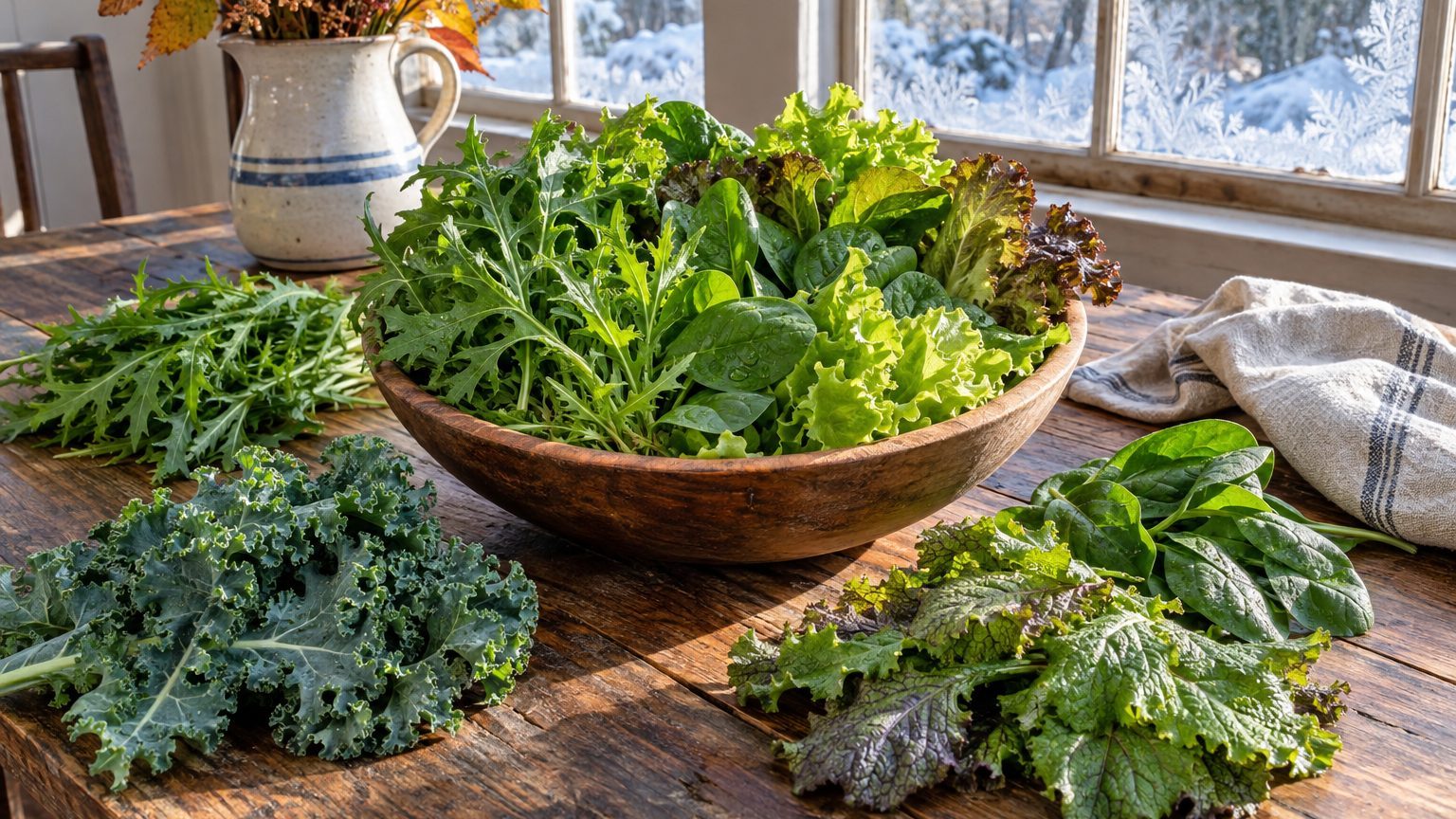

For a New Jersey winter salad bed, choose the hardy leaf greens: spinach, mâche, claytonia, kale and the mild mustards such as mizuna and tatsoi. Tender lettuces and heading chicories earn a spot only if you can cover them. The state spans USDA zones 6a to 7b, and Newark’s coldest month averages a daily minimum of 25.5°F, which sorts the greens quickly.
The short answer for New Jersey
Which winter salad greens handle New Jersey cold best?
A 25.5°F mean daily minimum means that in the coldest month, the average night at the Newark reference station sits well below freezing. Leaves of spinach, mâche, claytonia and kale tolerate that. Their sap carries enough sugar to resist ice damage, and they simply stop growing and wait. Tender lettuce leaves freeze, turn glassy, then collapse into slime once they thaw.
Under a layer of row cover or in a low tunnel, the hardy group keeps producing through most New Jersey winters. Without cover, spinach and mâche still survive in most years but give you far less to pick.
How do you choose winter salad varieties by type?
The Newark reference station sees its last 32°F freeze between March 29 and April 6 and its first fall freeze between November 4 and November 16 (NOAA 1991-2020 normals, the 30-70% probability band). Suburban and rural gardens usually freeze later in spring and earlier in fall, often by one to two weeks, and more at elevation. For you, the fall window for growing a full-size plant is shorter than the reference dates suggest.
| Type | Cold tolerance | Best use in New Jersey |
|---|---|---|
| Mâche, claytonia | Very hardy | Cut-and-come-again harvests all winter, with or without light cover |
| Spinach, kale | Hardy | Fall sowing, steady picking, regrowth in late winter |
| Mizuna, tatsoi, arugula | Moderately hardy | Fast fall crops, best under cover once nights turn hard |
| Lettuce, endive, escarole | Tender to moderate | Fall harvest before hard freezes, or in a cold frame |
| Radicchio and other heading chicories | Moderate | Fall harvest if sown early enough to head |
For the full list of crops and how they fit together, see Winter Salads for New Jersey Gardens.
What will not work here

Which winter salads fail in New Jersey?
Head-forming crops sown late fail first. A radicchio or a butterhead lettuce needs weeks of steady growth to fill out. If it goes in after the first fall freeze window of November 4 to 16 (earlier in the suburbs and countryside), the plant stalls at seedling size and sits there until spring. Fall days at New Jersey’s latitude shorten fast, and from roughly mid-November into late January there is too little daylight for much growth at all. Whatever size a plant reaches by then is mostly what you will harvest from.
Unprotected baby lettuce is the second casualty. With coldest-month nights averaging 25.5°F, a bed of tender leaf lettuce without cover will not make it through January. Even the hardier mustards get ragged when a hard freeze arrives with no cover.
Why does a closed cold frame fail in New Jersey?
Cold is only half the problem. New Jersey winters swing between deep freezes and mild, wet, sunny days. A closed cold frame on a bright day in the 50s can overheat well past what any lettuce likes, and it traps moisture around the leaves. Damp air with stagnant, mild conditions invites gray mold and downy mildew, and tight spacing makes it worse. Prop the lid open on sunny days, and give plants enough room for air to move between them.
Early sowing has its own trouble. Spinach and lettuce seed often will not sprout well in warm late-summer soil, so a sowing made in a hot spell can come up thin and patchy. Wait for the soil to cool, or shade the bed and water it daily until seedlings emerge.
In rural parts of the state, deer and voles also move in once other food runs short. Row cover held down with soil or boards keeps out deer in the short term, but voles tunnel under it. Check the bed for runs and chewed crowns after a snowfall.
What changes across New Jersey
How much does winter vary across the state?
No single answer covers the state. USDA hardiness zones here run from 6a to 7b (2023 map, built on 1991-2020 normals). That map rates the average annual extreme minimum temperature, so it describes how cold the worst night gets, and says little about how long cold lingers or how wet the winter feels. Still, a spread of that size is plenty to change what you do.
Cooler gardens, including the northwestern highlands and higher ground generally, sit at the colder end. There, assume the hardy group only, add a second layer of cover for the coldest stretch, and sow earlier in fall, since the freeze comes sooner. Mâche, claytonia and spinach do well in these beds. Heading chicories and lettuce are a fall crop and not much more.
Near the coast and in the south, winters are milder, and the first freeze arrives later. Gardeners there can often stretch lettuce and mustards deeper into winter under cover and keep picking longer. Salt wind, however, can scorch exposed leaves, so a low windbreak helps. Sandy ground drains well and warms fast, though it also cools fast on clear nights.
Look up your own location on the USDA Plant Hardiness Zone Map rather than guessing from the county name. A town can span two zones, and a sheltered yard near a south-facing wall often behaves like a half zone warmer. If you are planning dates, When to Sow Winter Salads in New Jersey shows how to adjust.
Where to check this for your own county
Where can you find a county planting calendar and variety trials?
Start with Rutgers Cooperative Extension, the state’s land-grant extension service. New Jersey has a county office, and the staff there know how local frost, soil and wet spells behave. Look for two things on the site: a vegetable planting calendar written for your part of the state, and any variety trials of leafy greens run in your county or the nearest one.
The calendar matters because dates shift by weeks between northern and southern New Jersey. The trial results matter because a variety that looks hardy on a seed packet can still fail in your local mix of wind, damp and soil. If trial data are missing for a crop, call the county office and ask which winter greens local growers have had success with.
A county recommendation beats a state one every time. Everything here is the state version, built on a reference station at an airport, so treat it as a starting point. Suburban and rural yards generally freeze later in spring and earlier in fall than the reference figures, often by one to two weeks. Your county office can say how much that shift applies where you live.
Master Gardener volunteers attached to county extension offices can also answer questions about specific pests and soil conditions. Many offer soil testing, which tells you pH and nutrient levels before you commit to a bed.
Checking this against your own garden
What should you watch in your own yard?
Three observations outrank every date above.
- Soil by hand. Push your hand two inches into the bed. Soil that feels cool but not cold means seed will still germinate and seedlings will root. Compare a bed against a south wall with one in open lawn. If the wall bed feels noticeably milder, that is your warm spot for the tender crops.
- First frost on the grass. Walk your yard at dawn after the first clear, calm night. Where white frost shows first marks your frost pocket, and where it never forms marks the safest bed for lettuce and chicory.
- First true leaves. The first pair of leaves on a seedling are seed leaves. The second pair, the true leaves, show that roots are working. Seedlings with two true leaves before the days shorten usually overwinter well. Ones still stuck at seed leaves are late, and need cover or a place in the cold frame.
Keep a note of each date for a season or two. Your own record soon beats any published window.
Common questions
Can lettuce survive a New Jersey winter outdoors?
Seldom without cover. Coldest-month nights average 25.5°F at Newark, and tender lettuce leaves freeze at that level. In a cold frame or under row cover, hardier lettuce types can last into early winter. Spinach, mâche and claytonia are better bets.
What is the hardiest winter salad green?
Mâche and claytonia handle the coldest nights of the group, with spinach and kale close behind. All four keep their leaves through freezes and resume growth when light returns in late winter.
Do I need a cold frame or row cover?
For the hardiest greens, cover is optional but increases yield. For mustards, arugula, lettuce and chicories, cover makes the difference. A simple low tunnel of hoops and fabric protects them for little cost.
How late can I sow winter salads in New Jersey?
Sow early enough that plants reach harvest size before mid-November, when growth nearly stops. Spinach and mâche sown later can still overwinter as small plants for a late-winter picking. Use the sowing calendar and your county office to set dates for your area.