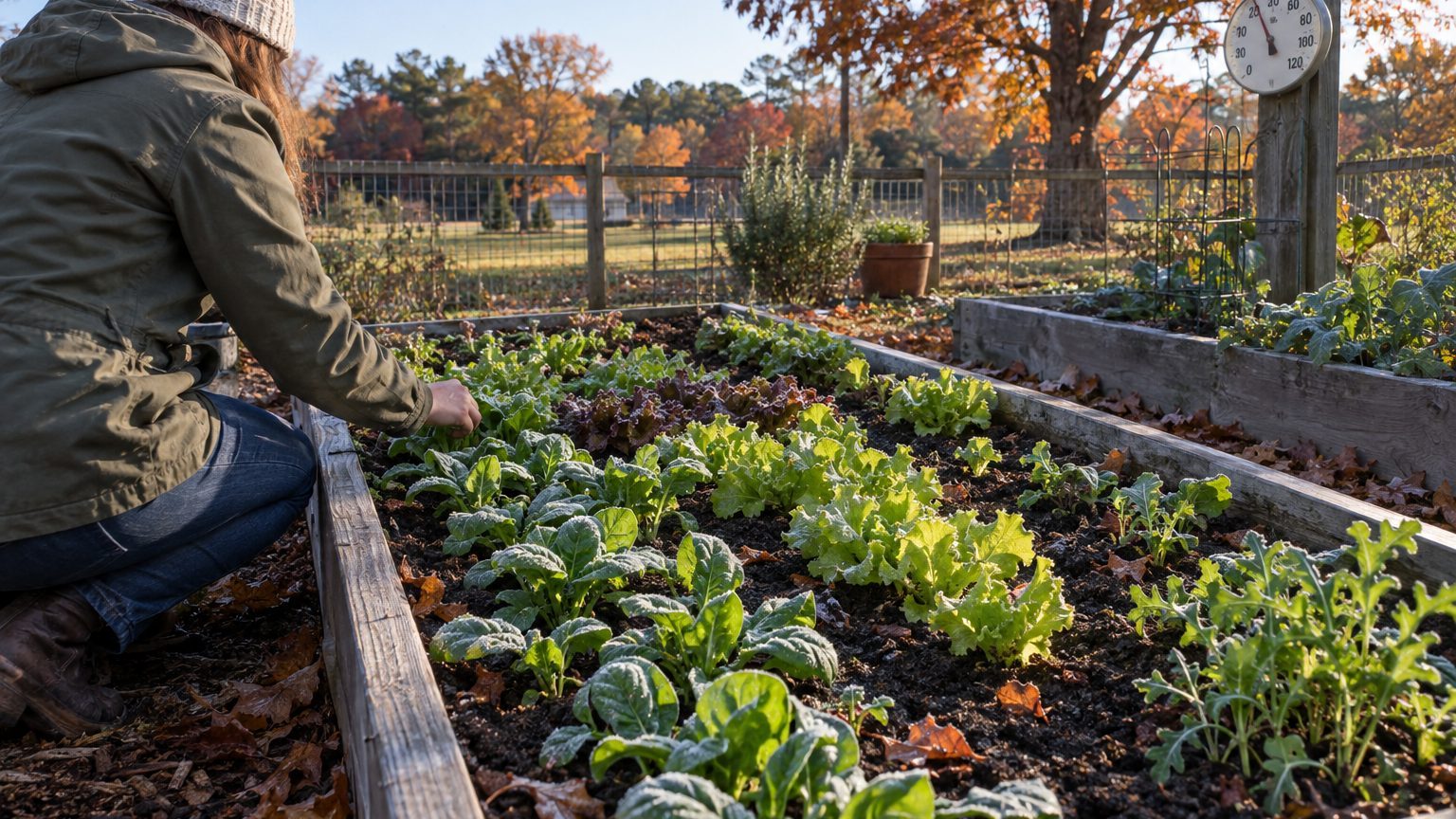

In New Jersey, sow most winter salad greens outdoors from late August through September, then keep sowing the hardiest types under cover into October. The goal is a plant with several true leaves before the first fall freeze. At the Newark reference station that freeze arrives between November 4 and November 16. Gardens outside the city run colder and earlier, so treat these dates as a starting line.
The short answer for New Jersey
Count backward from early November. NOAA’s 1991-2020 climate normals for Newark put the first fall freeze at November 4 to November 16 and the last spring freeze at March 29 to April 6. Both ranges describe the same thing: the band where the chance of a reading of 32°F or lower sits between 30 and 70 percent. Early in the band a freeze is less likely than not, and by the end of it a freeze is more likely than not.
Those are airport figures for one reference city. Suburban and rural gardens usually see the last spring frost one to two weeks later and the first fall frost one to two weeks earlier, and hills run further behind. A garden in the northwest corner of the state may be looking at a freeze in mid-October while Newark is still frost-free.
Winter salad crops differ in how much growing they need before the days shorten, so the windows differ by type. The table gives typical outdoor sowing windows for a reference-city garden. Push the dates earlier if you are inland or on higher ground.
| Type of green | Outdoor sowing window | Notes |
|---|---|---|
| Spinach, mâche, claytonia | Early September to early October | Hardiest group; tolerates hard freezes once established |
| Arugula, mizuna, tatsoi, baby kale | Late August to late September | Quick to cut, leaf quality drops in repeated hard freezes |
| Leaf lettuce for baby leaves | Late August to mid-September | Needs cover once nights reach the 20s |
| Radicchio, endive, head lettuce | Late summer, earlier than the rest | Slowest to size up; hard to finish in a cold frame after October |
| Any hardy green under row cover or in a cold frame | Through October | Late sowings give small plants that hold through winter and grow again in late winter |
Packet days to maturity count from sowing for all of these, since they are seeded straight into the bed. Many baby-leaf greens can be cut in a month to six weeks of mild fall weather, but the packet gives the real number for each variety. For the choice between varieties, see The Best Winter Salads for New Jersey. The broader picture of the season is in Winter Salads for New Jersey Gardens.
What will not work here

The mean daily minimum of the coldest month at Newark is 25.5°F. That means ordinary winter nights fall into the 20s, and colder nights are common. Hardy greens such as spinach, mâche and claytonia shrug that off. Tender lettuce and most Asian greens in an uncovered bed do not, and they turn to mush after a few hard nights.
Sowing in November fails for a different reason. Growth in the beds slows to a crawl. A seedling that has only its seed leaves in mid-November will sit there until late winter, and it may not survive the 20°F nights. Greens sown in late September make real size before the light fades. Greens sown in late October mostly do not, unless they are under cover.
The opposite mistake is sowing too early. New Jersey summers are hot and humid, and lettuce seed often will not germinate when the soil is warm, so an early-August sowing on bare ground gives patchy, slow stands. If the weather is still hot in late August, water the bed first, shade it with a board or cloth until seedlings show, and sow in the evening. Where late-summer nights are warm, spinach is especially fussy and is better held until September.
Humidity also rules out tight spacing. Warm, damp autumn weather feeds downy mildew and leaf rot, especially on crowded lettuce under a cover with no airflow. Thin seedlings to the spacing on the packet and vent cold frames on mild days, even in November. Row cover should be lifted when the weather is wet and the temperature is above freezing.
Finally, planning from Newark’s dates alone fails in the northern and hilly parts of the state. A gardener there who waits until mid-September to sow quick greens, because the airport says the freeze is two months away, can run out of fall. Add a week or two of margin on the front end and treat the airport dates as the earliest the freeze is likely to hold off, not as the typical date for every yard.
What changes across New Jersey
New Jersey spans USDA hardiness zones 6a to 7b under the USDA Plant Hardiness Zone Map 2023. That is four half-zones, and the zone system is built on one thing, the average annual extreme minimum temperature. There is no single answer for the state. The spread between the cold end and the mild end is wide enough that two gardeners can follow the same advice and get different winters.
In general, the colder zones lie in the north and at elevation, and the mildest lie toward the coast and the southern part of the state. A reader in the hills sows earlier, usually by a week or two, and relies more on row cover or a cold frame from October on. Growth stops sooner there, and a late planting simply stays small. Near the coast, the first freeze comes later and winter lows are milder. Hardy greens can stay productive longer, and a late-September sowing can still make a useful crop.
Zones tell you about winter cold, so they are the right guide for how much protection a crop needs in January. They say little about when to sow in September, which is governed by the first fall frost and by how long the soil stays warm. Use the zone for hardiness and the frost date for timing.
To find which zone your garden is in, look up your ZIP code on the USDA Plant Hardiness Zone Map. Microclimates inside a single yard can differ, so a south-facing wall and a low frost pocket may behave like different places.
Where to check this for your own county
The state extension service is the next stop. In New Jersey that is Rutgers New Jersey Agricultural Experiment Station (NJAES), the land-grant extension program, which runs county offices across the state. Start with the vegetable growing guidance, and look for the office covering your county.
Two things are worth looking for. The first is the local planting calendar for fall and winter vegetables, which gives sowing dates adjusted to your county’s frost pattern instead of the airport’s. The second is the list of varieties trialled in your county. A trial tells you which spinach held up through a cold January, which lettuce bolted early, and which Asian greens survived the humid weeks of September. That kind of local result is worth more than a general recommendation.
A county recommendation beats a state one, and the dates and windows above are the state-level reference. A county extension agent or Master Gardener volunteer can tell you if frost typically arrives earlier in your valley or later near the shore, and can suggest adjustments the statewide numbers cannot.
If your county office has a seasonal vegetable calendar, compare it with the table above. Where the two differ, follow the county calendar. If you have notes from previous years, add them to your reading of it.
Checking this against your own garden
Your own observations outrank every date here. Three are worth tracking each fall, and none need equipment.
Soil warmth by feel. Push your hand a couple of inches into the bed in the morning. If the soil feels warm, like a sun-heated stone, wait on lettuce and spinach, since the seed may not germinate. If it feels cool and damp, the bed is ready. Beds that cool earlier than your neighbor’s tell you your microclimate runs cold.
First true leaves. After the seed leaves, a seedling puts out its first true leaves, which have the shape of the adult plant. Note the date they appear and compare it with the first freeze. Seedlings that have grown true leaves before the cold sets in are in good shape. If yours reach that stage only in December, sow earlier next year.
First frost damage. The first night that blackens basil, zinnias or tomato vines marks your real first frost. Compare it with the Newark range of November 4 to November 16. A date two weeks earlier means your garden follows the colder pattern, and your whole sowing calendar should shift. In spring, the first flower stalks on spinach tell you that the season has turned and it is time to cut and move on.
Common questions
When is it too late to sow winter salads outdoors in New Jersey?
Outdoors without protection, sowing after about the end of September gives small plants that struggle through winter. Under row cover or in a cold frame, hardy greens can be sown through October and will hold small until growth resumes in late winter.
Can I sow winter salads in August?
Late August works for quick greens like arugula and mizuna, and for baby lettuce if you keep the seedbed cool and moist. Early August is usually too warm for good lettuce germination.
Do I need a cold frame or row cover?
Spinach, mâche and claytonia often survive without protection. Lettuce and Asian greens do much better under cover, since winter nights regularly drop into the 20s at the reference station.
Which frost dates should I use?
Use the Newark range, November 4 to November 16 for the first fall freeze, as a reference only. Most suburban and rural gardens get frost one to two weeks earlier, so adjust to your own county and check with Rutgers extension.