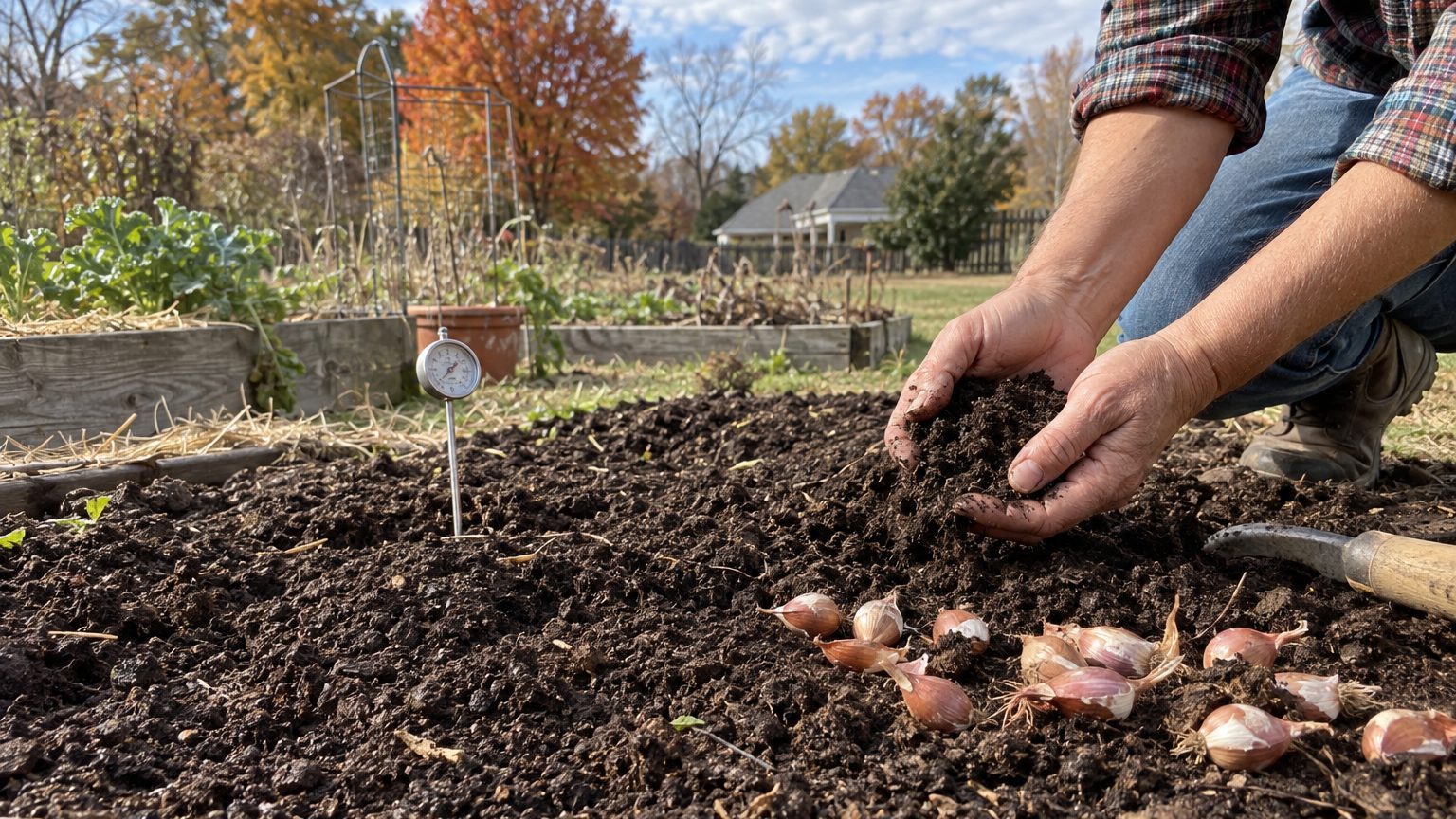

In Alabama, shallots can go in during autumn or in late winter and early spring, and the soil decides the date more than the calendar does. The mild winters here favor autumn planting. A spring planting works as a fallback where drainage is poor or winters bite harder. For the full crop cycle, start with Growing Shallots: One Bulb In, a Handful Out.
When the soil is warm enough in Alabama
The last spring frost at the reference station falls between March 19 and April 3. That comes from NOAA NCEI 1991-2020 Climate Normals, the 32°F freeze probabilities (30-70% band), station USW00003856. A frost date is a probability, not a promise, so a late freeze after April 3 can still happen in any given year.
That station sits at an airport. Suburban and rural gardens typically see the last spring frost later than the reference figure, often by one to two weeks, and more at elevation. Check your own county before you pin a date to your calendar.
Now the part that matters more. Frost is a proxy. Shallots respond to the soil, not the air, and the soil warms after the frost risk ends, not alongside it. A garden can pass its last freeze and still hold cold, soggy ground that stalls roots and invites rot. Plant when the bed crumbles in your hand instead of smearing, and push a soil thermometer in rather than trusting the date. Your Alabama Cooperative Extension System office can tell you the soil temperature it advises locally.
Spring planting versus autumn planting
A spring planting means working the bed as soon as it dries enough to dig, not waiting for April. Because the frost window runs into early April, early plantings should expect a cold snap and tolerate it. Shallot foliage handles light frost better than most gardeners expect. Waterlogged soil is the bigger hazard.
Autumn planting is the other path, and the mild winters here make it workable. The mechanics, from setting depth to mulching, mirror what garlic growers do. This site has a garlic section with national pages on autumn planting, curing, storage and allium rotation, and those pages cover the shared practice so this one doesn’t repeat it. Shallots differ in a few ways. Sets are smaller than garlic cloves, so they sit shallower and dry out or heave more easily. Each set also multiplies into a cluster, so spacing matters more than it does for a single-clove crop.
Rotation follows the same rule as garlic: keep shallots off ground that held onions, garlic or leeks recently, because the diseases they share linger in the soil.
How long the season lasts here
The first fall frost at the same station arrives between November 2 and November 16, again from the NOAA NCEI 1991-2020 normals, 32°F freeze probabilities (30-70% band). With both ends in hand, the arithmetic is simple. The frost-free stretch depends on which ends you pair.
| Pairing | From | To | Days between |
|---|---|---|---|
| Earliest last frost, earliest first frost | March 19 | November 2 | 228 |
| Latest last frost, latest first frost | April 3 | November 16 | 227 |
| Shortest case | April 3 | November 2 | 213 |
| Longest case | March 19 | November 16 | 242 |
So the reference figure is roughly 213 to 242 days. Rural gardens that see the last frost one to two weeks later and the first one one to two weeks earlier can lose a month or so from both ends combined. Treat the table as a ceiling, not a guarantee.
What does that length allow? A window this long does not force a single sowing. A first planting can go in at the earliest workable moment, and a second can follow weeks later to stagger the harvest. Those timings are mapped out in the succession sowing guide on this site. Transplanting also makes sense in a long window. Starting seed-grown shallots indoors and setting them out costs weeks, but you have weeks to spare, so the root check before planting out (white, healthy roots, no browning) is worth the effort.
Compare that with a place where the window is brief. Growers in Growing Shallots in New Brunswick get one sowing and little margin, so every week lost to a slow transplant counts. Alabama gardeners have the luxury of an early start and a backup.
The limit in Alabama is rarely how many frost-free days are available. It is where those days fall relative to summer heat, which brings us to the next problem.
Heat and water in Alabama
The verified figures for this page do not include a count of days above 90°F or a summer rainfall total, so I won’t quote either. What can be said honestly is that Alabama summers are hot and humid, and an allium crop sitting in the ground through that stretch faces two enemies at once. Heat pushes bulbs to finish, and humidity feeds fungal disease on the foliage and the neck.
The winter figure is the one on file. The mean daily minimum of the coldest month is 33.1°F at the Huntsville reference station (NOAA NCEI Climate Normals 1991-2020). That is an average low, not a record low, and individual nights dip well below it. Still, it tells you that the ground here rarely locks into a long hard freeze. The USDA Plant Hardiness Zone Map (2023) places Alabama in zones 7a to 9a, a territory-wide range, so the colder uplands and the warmer south differ.
Why the winter low favors autumn
Where ground freezes hard and stays wet, autumn-planted sets rot or heave, and spring is the safer call. A mild winter changes that. Autumn-planted shallots get a head start on roots, then put on top growth early and tend to produce the larger, earlier bulbs that autumn planting is grown for. They can also finish before the worst of the summer heat arrives, which is the real appeal here. Gardeners in Growing Shallots in Arkansas face a similar Southern tension between wet winters and hot summers.
The catch is water in winter, not cold. Heavy clay that sits wet through the cool months can rot sets as surely as a northern freeze. Raised beds or ridged rows help, and so does a loose mulch that insulates without smothering. If your bed stays soggy for days after rain, hold the sets until late winter instead.
Gardeners at the 7a end, in cooler, higher ground, should be readier to fall back on spring. Those in the warmer south can lean harder on autumn.
Harvest, curing and storage
Humidity matters most at the end. Shallots need dry weather to cure, and a wet stretch in early summer complicates it. Cure them somewhere shaded, airy and dry, never sealed in plastic. Before you store anything, inspect each bulb. A soft neck or a moldy base ends the question, and that bulb goes in the compost, not the pantry. A bulb that looks firm is not proof it is sound, so check by feel and smell too, and I won’t promise a keeping time. Curing and storage rules shared with garlic are covered in the garlic section of this site.
Which shallots suit Alabama
This page names no varieties, and that is deliberate. A variety recommendation only means something if it was trialled in conditions like yours, and the cultivar data this page can verify does not cover Alabama. A name pulled from a catalog would be a guess dressed as advice. The reliable source is the Alabama Cooperative Extension System, whose county offices and publications reflect what has actually been grown in the state.
What this page can do is reason from the facts it holds, and sort by type. Three features of Alabama steer the choice.
- Humidity points to disease resistance first. In a humid climate, foliar and neck diseases are the main risk, so ask suppliers and extension agents which types hold up under damp conditions.
- Heat favors airflow and root shade. Give bulbs wider spacing, keep weeds down, and mulch lightly so the soil around the roots stays cooler. Types that form tight clusters crowd each other, so thin them if the foliage stays damp.
- Earlier types finish ahead of summer. Alabama’s frost-free window is long, but the aim is to bulb up before the hottest weeks, so earlier-maturing types suit autumn planting.
Planting stock matters too. Multiplier shallots grown from sets are the usual route for home gardens, while seed-grown types start cheaper in labor but need the transplant care described earlier. Buy from sources that sell disease-free stock, and avoid grocery-store shallots, which may be treated to stop sprouting or carry soilborne disease into your beds.
When you call your county extension office, ask three things: which types have been trialled nearby, whether autumn or spring planting works better for your soil, and what planting dates they advise. Take your own frost experience with you, since the airport figures here run a week or two off what most rural gardens see.
Common questions
Can I plant shallots in the fall in Alabama?
Yes, and the mild winter makes it the usual choice for larger, earlier bulbs. The coldest-month mean daily minimum at the Huntsville reference station is 33.1°F. Poorly drained soil is the main risk, since wet beds can rot sets over winter. If yours holds water, plant in spring.
What is the last frost date for shallots in Alabama?
At the reference station (USW00003856), the last spring frost falls between March 19 and April 3, per NOAA NCEI 1991-2020 normals. Rural gardens often see it one to two weeks later, so check your county. Soil condition matters more than the date.
How do I know a shallot is safe to store?
Inspect it. A soft neck or a moldy base means discard it, and a firm look alone does not prove it is sound. Cure bulbs in a shaded, dry, airy place, and sort them again as you use them. For shared curing practice, see the garlic section of this site.
Which shallot variety should I buy?
Ask the Alabama Cooperative Extension System for the types trialled near you. This page does not name varieties because it cannot source Alabama trial results. Choose for disease resistance, airflow tolerance and earlier maturity.