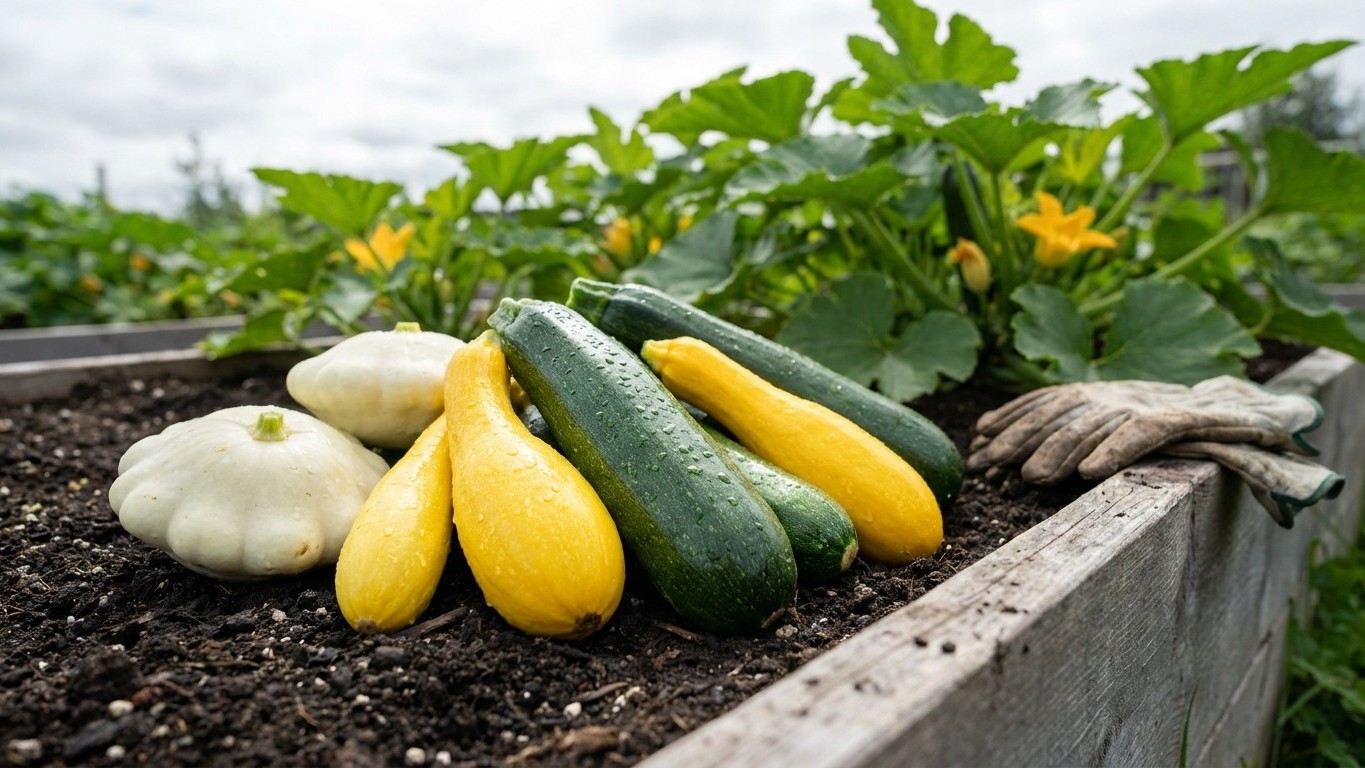

Fast-maturing bush types win in Alaska: bush zucchini, yellow crookneck, and pattypan squash outperform anything vining or slow to fruit. With roughly 143 frost-free days and summers that never hit 90°F, the varieties that succeed are the ones bred to flower early and finish fast, not the ones bred for long hot growing seasons in other states.
The short answer for Alaska
Anchorage’s frost data, drawn from the 1991-2020 climate normals at station USW00026451, puts the last spring freeze between May 3 and May 12 and the first fall freeze between September 22 and October 1. That’s a working season of about 143 days, and that number is what should drive every variety choice on this page. It isn’t a long window by national standards, but Alaska compensates with something few other states have: nearly around-the-clock daylight in June and July, which pushes photosynthesis and growth rates well beyond what the day count alone suggests.
The second number that matters is heat, or the near-total absence of it. The reference station records zero days a year at or above 90°F. Summer squash doesn’t need tropical heat to produce, but it does need consistent warmth to set fruit reliably, and a summer with no heat spikes at all means the plant has to do all its flowering and fruiting in a narrower comfort band. That favors compact, early-yielding types over anything bred to ramp up production during a long hot stretch.
Put those two facts together and the decision by type looks like this: bush zucchini, selected for early maturity, is the safest bet because it commits its energy to fruit rather than vine length. Yellow crookneck and straightneck squash follow close behind, usually running a week or so later to first harvest but tolerating the cool nights just as well. Pattypan and scallop types come third, not because they fail, but because many strains take a bit longer to size up, leaving less margin if the season runs short.
| Type | Relative pace | Fit for a 143-day season |
|---|---|---|
| Bush zucchini | Fast | Best fit |
| Yellow crookneck/straightneck | Fast to medium | Good fit |
| Pattypan/scallop | Medium | Workable, less margin |
| Vining or heirloom trailing types | Slow | Poor fit |
None of this replaces starting the plants right. In a season this short, the real advantage isn’t the seed packet, it’s the head start given indoors before transplant, which the next section explains in terms of what actually goes wrong when that step gets skipped.
What will not work here
Long-season vining summer squash, the kind bred to sprawl and keep producing through a four-month hot summer, simply runs out of runway here. Add up transplant shock recovery, the slower vine establishment, and a fruiting window that needs to close before late September, and there isn’t enough of the 143-day season left for a plant that expects 65 to 100 days from seed. These varieties aren’t defective. They’re built for a different climate, and Alaska’s frost dates make that mismatch obvious by August.
Heat-hungry hybrids run into a quieter version of the same problem. Many summer squash lines sold nationally were selected in regions that regularly clear 90°F, and their flowering rhythm assumes that kind of heat load to trigger strong, sustained fruit set. With zero days a year reaching 90°F at the reference station, those plants can grow plenty of leaf and still lag on fruit, producing a handful of squash where a cool-adapted variety would have delivered a steady supply.
Direct-seeding is another common failure point, especially outside the mildest coastal pockets. Squash seed germinates poorly in soil below roughly 60°F, and given the frost dates here, that soil temperature threshold often isn’t reliably met until well after the average last freeze. Seed sown straight into cold May ground tends to sit and rot rather than sprout, burning precious weeks the plant doesn’t have to spare. Starting indoors three to four weeks ahead and transplanting under row cover sidesteps this, which is exactly why it’s the standard recommendation across the Interior and colder boroughs.
Watering mismatched to the rainfall pattern causes trouble too. June averages only 1.02 inches of rain, the driest month of summer, and that’s precisely when young transplants are establishing root systems and are least able to tolerate a dry stretch. By August the pattern flips, with rainfall climbing to 2.93 inches, and gardens still watering on a rigid summer schedule can end up with wet soil, slow-draining beds, and the start of powdery mildew on crowded plants. The fix isn’t a fixed schedule at all. It’s checking soil moisture directly and adjusting as the month-to-month rainfall shifts from 1.02 inches in June to 1.82 in July to 2.93 in August.
What changes across Alaska
Alaska’s official hardiness range runs from zone 1a to zone 8a under the USDA Plant Hardiness Zone Map, and that’s not a rounding error, it’s one of the widest zone spreads of any state in the country. The frost dates and heat figures used above come from Anchorage, which sits toward the milder end of that range and is one of the more forgiving places in Alaska to grow anything at all. That single reference point cannot stand in for the whole state, and this page won’t pretend otherwise.
Move into the Interior, around Fairbanks and the boroughs stretching toward the Arctic Circle, and the growing season contracts hard, with colder soil, a later effective start date, and less buffer before fall frost arrives. Move toward the milder maritime pockets of the Southcentral coast or parts of Southeast Alaska, and conditions can edge toward that 8a end of the range, with a longer window and gentler nights that make even some medium-paced varieties workable. Altitude compresses the season further almost anywhere in the state, since cold air pools in valleys and higher ground cools faster once the sun angle drops in September.
Given that spread, there is no single frost date or heat figure that fairly represents “Alaska” as a whole, and treating Anchorage’s numbers as universal would do a disservice to gardeners in Fairbanks, Juneau, or the Mat-Su Valley alike. This page can only speak to the mild reference case. Anyone gardening outside Anchorage should treat the frost window and season length here as one data point, not their own local reality, and check the USDA hardiness zone map directly for their specific location before committing to a variety.
Where to check this for your own county
Alaska organizes local government by borough rather than by county, but the same principle applies: the state-level picture on this page is a starting point, not a substitute for what your local Cooperative Extension office has already tested in your specific conditions. The University of Alaska Fairbanks Cooperative Extension Service is the land-grant resource for the whole state, and it maintains local offices and publications tuned to specific regions rather than one blanket calendar for all of Alaska.
Two things are worth pulling from that resource before finalizing a variety list. The first is the local planting calendar for your borough or nearest extension office, which will reflect actual frost patterns and soil-warming timelines for your specific ground rather than the Anchorage station used here. The second is any variety trial data extension agents have published for summer squash performance in your region, since these trials often surface which specific cultivars have actually produced well locally, information a national seed catalog has no way to know.
A borough-level recommendation from your local extension office will always outrank the state-wide answer given on this page, for a simple reason: it accounts for your actual elevation, your actual frost dates, and your actual soil, rather than the single reference station this page relies on. Think of this page as the reasonable starting framework, and the extension office as the correction for wherever your garden doesn’t match that framework.
Checking this against your own garden
Every date and figure above is a regional average, and no average has ever grown a squash plant. Your own garden will tell you more than any calendar, provided you know what to look for and check it directly rather than trusting the calendar alone.
Start with the soil itself. Push a finger a few inches into the bed where you intend to transplant, and if it feels cold to the touch rather than merely cool, the ground likely hasn’t crossed that germination-friendly threshold yet, regardless of what the calendar says the date should be. This single check catches the exact problem described earlier, seed or transplants going into ground that looks warm enough on paper but isn’t warm enough in practice.
Watch for the first male flowers once plants are established. They typically appear before the female flowers that actually set fruit, and their arrival is a real-time signal that the plant has accumulated enough warmth to shift into reproductive mode, a more reliable marker than counting days since transplant.
Finally, track how quickly true leaves develop after the seedling stage. Fast, sturdy true-leaf growth suggests your particular spot, whether it’s a raised bed against a south-facing wall or an open plot in a low frost pocket, is running warmer and faster than the regional average. Slow true-leaf development suggests the opposite, and that your own microclimate may need the more conservative, faster-maturing varieties discussed above even if the regional dates suggest otherwise.