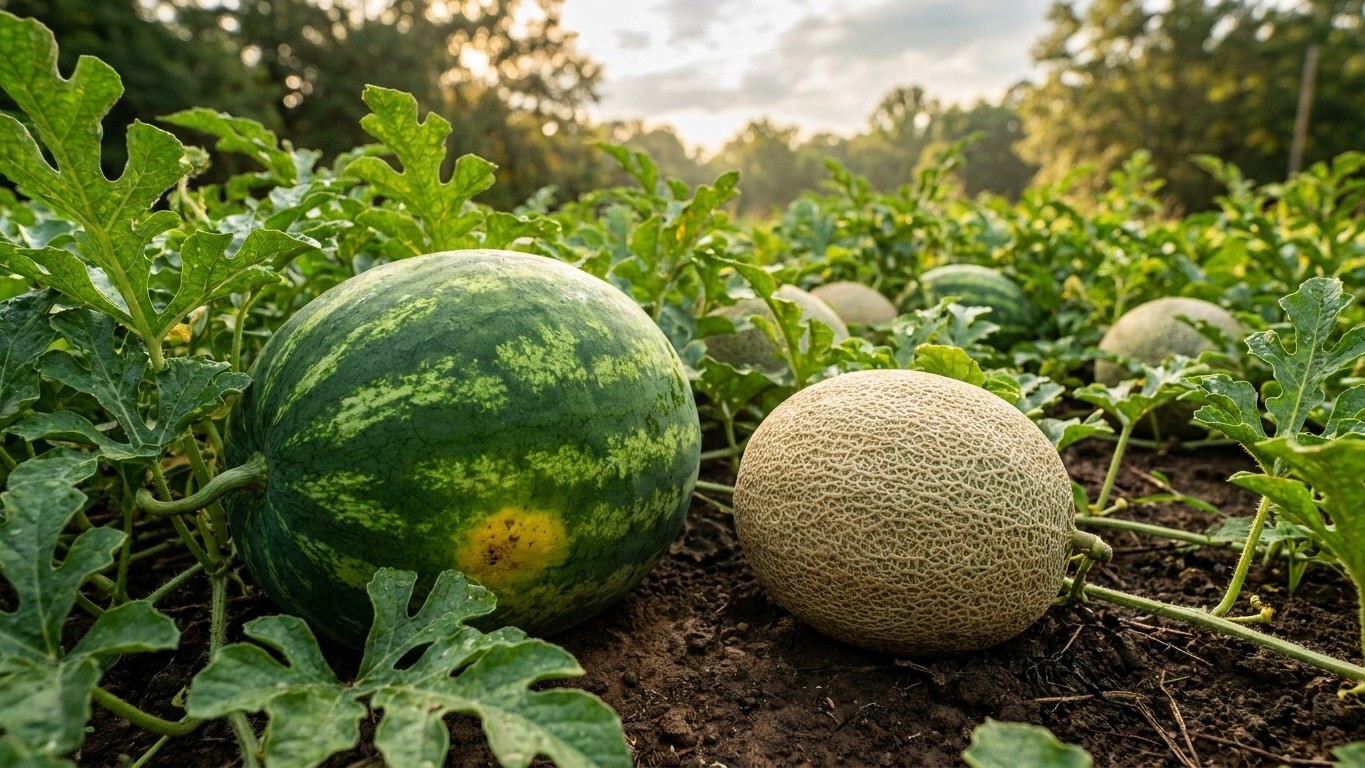

Skip the encyclopedia of melon cultivars and go straight to type: fast-maturing cantaloupe and muskmelon types for a spring planting that beats the worst of the heat, watermelon for gardeners with room and patience for its longer heat-loving run, and honeydew only where you can keep water coming reliably. Slow, cool-climate specialty melons are the ones to skip in the low desert.
The short answer for Arizona
Arizona’s low desert doesn’t run on a frost calendar the way most of the country does. NOAA’s 1991-2020 normals for the Phoenix reference station show a 32F freeze in only 6 of 30 spring seasons, and the frost-free season is listed at 365 days. That number isn’t a typo. It means the thing that decides whether a melon variety succeeds here isn’t the last frost date at all. It’s heat load, and the region carries a lot of it: 168.9 days a year reach 90F or higher at that same station. That’s nearly half the calendar spent at or above a threshold where pollen viability drops and fruit set gets unreliable.
So the decision by type looks different here than it does almost anywhere else in the country. Cantaloupe and other short-season muskmelon types are the safest starting point because they can be sown, grow, flower, and finish fruiting inside the cooler window before the deep summer heat load shuts pollination down for weeks at a stretch. Their shorter path from seed to harvest is an asset in a place where the clock isn’t frost, it’s degrees.
Watermelon types sit in a different category. They tolerate heat better than cantaloupe once established, and a long hot stretch that stresses a muskmelon vine won’t necessarily stop a watermelon vine cold. But they need more space, more time, and more sustained water. A watermelon planted too late to finish its fruit-fill before the hottest 90-plus-day stretch is a vine that sits there producing leaves and no melons.
Honeydew and other slower-ripening melon types are the ones to plant with your eyes open. They ask for a longer stretch of moderate warmth than the low desert reliably gives before the heat load climbs past what pollinators and fruit set can handle. That doesn’t rule them out everywhere in the state, but in the hottest low-desert gardens they’re the higher-risk choice, not the default one.
What will not work here

The clearest failure mode in Arizona melon growing isn’t a frost problem. It’s timing a slow variety against a heat load of 168.9 days a year at 90F or above. A melon type bred for a long, mild growing season in a cooler climate doesn’t get that season here. It gets a narrow spring window and then a wall of sustained heat that stalls fruit set for weeks. Plant that type too late in spring and it spends its ripening stretch fighting conditions it was never built for, not finishing early enough to dodge them.
Watering on a weekly schedule is the second common failure, and the rainfall numbers explain why. Summer rain across June, July, and August averages only about 1.9 inches combined, and June itself averages just 0.02 inches, essentially nothing. A once-a-week watering habit that works fine in a state with real summer rain leaves an Arizona melon bed bone dry for days at a stretch during exactly the period when 90-plus-degree heat is pulling moisture out of the soil the fastest. Melons are shallow-rooted and thirsty at fruit-fill; a gap that long during a heat run this consistent is enough to cost the crop.
Counting on rain to carry germination or early growth doesn’t work either. With July and August each bringing under an inch (0.91 and 0.93 inches respectively) and June contributing almost nothing, whatever rain does arrive tends to come as a single thunderstorm cell rather than steady soaking rain. On sandy low-desert soil that water moves through fast and doesn’t linger the way it would on clay. A garden plan that assumes summer showers will fill in the gaps between waterings is a plan built on a number that doesn’t exist here.
What also won’t work is applying a planting calendar built around frost dates, the way you might for a state with a real spring freeze. Arizona’s low desert had a 32F freeze in only 6 of 30 years on record. Building a melon schedule around “weeks after last frost” in a place where frost barely happens most years just wastes the only calendar tool that actually matters here, which is the heat load, not the cold.
What changes across Arizona
Arizona is not one growing climate, and the hardiness zone range makes that plain. The USDA Plant Hardiness Zone Map, built on 1991-2020 average annual extreme minimum temperatures, places parts of the state anywhere from zone 4b up to zone 10b. That’s one of the widest spreads a single state can show, and it means a melon-growing plan built around the Phoenix numbers cited above doesn’t automatically travel to the rest of the state.
The low desert, where the Phoenix reference station sits, runs toward the warm end of that range, and its defining problem is the heat load already described: 168.9 days a year at 90F or above, essentially no reliable frost, and a growing season that’s bounded by summer heat rather than cold. Move north or up in elevation toward the state’s high country and the picture reverses. Those areas sit toward the cold end of Arizona’s 4b-10b spread, and they do freeze hard, on a real frost calendar with a genuine last-frost and first-frost date each year, closer to the pattern most of the country plans around.
That gap matters for melon choice specifically. A gardener planning around a warm-end zone can lean on the fast-maturing types discussed above and time everything to dodge the worst of the mid-summer heat. A gardener at the cold end of Arizona’s range is working with a shorter frost-free window and cooler summer temperatures, which shifts the calculation back toward a more conventional frost-based planting timeline and away from a heat-load-driven one.
The right move is checking the USDA Plant Hardiness Zone Map for your specific location before assuming either version of this state’s climate applies to you.
Where to check this for your own county
Everything above describes Arizona at the state level, anchored to one reference station’s normals. That’s useful for understanding the mechanism, heat load rather than frost, but it isn’t a substitute for what your own county’s extension office has already worked out for gardeners planting in your specific conditions. The University of Arizona Cooperative Extension is the place to go next.
Two things are worth pulling from your county’s extension resources specifically. First, a local planting calendar. Because the low desert’s limiting factor is heat rather than frost, county-level guidance can tell you the actual spring window your area works with before the fruit-set-stopping heat arrives, something a statewide frost date simply can’t do here. Second, look for any list of melon varieties the extension office has actually trialled in your county. Local trial results account for microclimate effects a state-level page can’t, things like elevation, soil type, and how many of those 90-plus-degree days your specific area experiences compared to the Phoenix reference station.
A county recommendation beats a state one every time, because it’s built on conditions closer to your own garden. The state-level picture is useful for understanding why the low desert plays by heat-load rules instead of frost-date rules, and why the state’s 4b-10b hardiness range means no single answer fits everywhere. But it’s a starting point, not a finish line. The extension office covering your specific county has already done the narrower work.
Checking this against your own garden
None of the numbers above, not the 168.9 days above 90F, not the 4b-10b zone spread, not the summer rainfall totals, replace what your own plot tells you directly. Three simple checks matter more than any date.
Soil warmth by feel is the first. Melon seed germinates poorly in cold soil regardless of what a calendar says, and a bed in full sun against a south-facing wall warms up well ahead of an open, exposed bed even a short distance away. If the soil feels genuinely warm to the hand a couple of inches down, that’s a better signal than any regional average.
The first flush of male flowers is the second. Melon vines typically produce male flowers before female ones, and a strong early show of male blooms tells you the plant has settled into active growth. It’s not the finish line, since fruit set depends on female flowers opening and getting pollinated, but it’s a real signal that your particular vine, in your particular microclimate, is on schedule.
The appearance of the first true leaves, the ones that look like an adult melon leaf rather than the rounded seed leaves the plant starts with, marks the point where the plant has moved past its most fragile stage. A vine that’s slow to push true leaves in a spot you expected to be warm is telling you something about that specific location, shade you didn’t account for, a cold pocket, soil that’s holding water and staying cool, that no state or county average could have warned you about in advance.