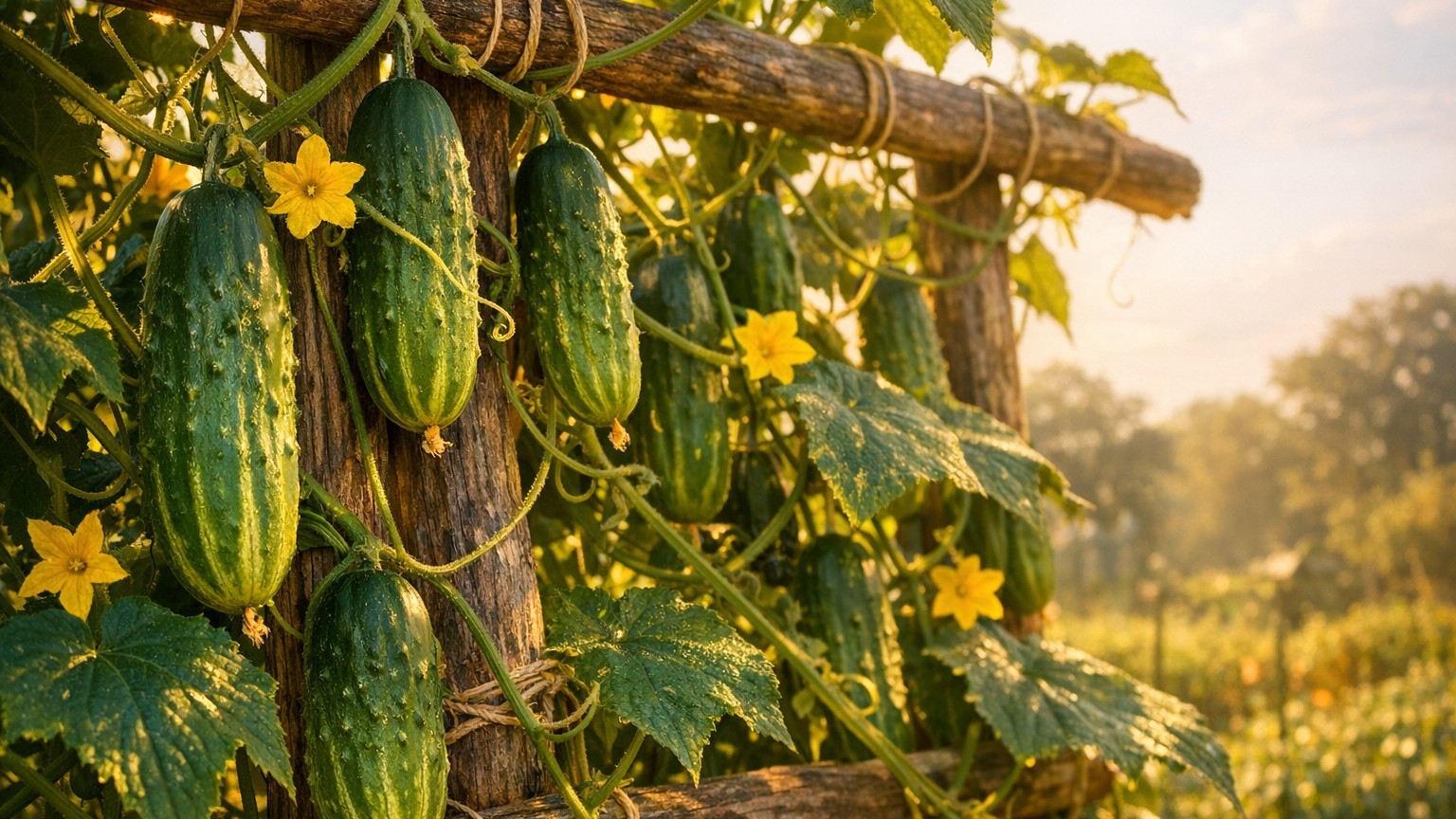

Arkansas gardeners get one advantage most of the country doesn’t: a frost-free season long enough to grow two full rounds of cucumbers in a single year. The best choice by type is a parthenocarpic or burpless slicer for continuous production, a compact bush pickling type for small beds, and a trellised vining type wherever summer humidity runs high. Which one wins depends on your space and your patience for staking.
The short answer for Arkansas
Start from the calendar. NOAA’s 1991-2020 normals put the last spring 32F freeze between March 12 and March 28, and the first fall freeze between November 7 and November 20, at the reference station used for these figures. That’s a frost-free window stretching from roughly 224 days in a conservative year to as much as 253 days in a generous one. Few vegetables reward that kind of length better than cucumbers, which mature fast and can be sown twice: once after the spring frost risk clears, and again in mid-summer for a fall harvest that finishes before the November freeze arrives.
The heat load changes the decision, though. The reference station averages 69.2 days a year at or above 90F, and cucumber pollen doesn’t perform well once daytime highs sit in that range for stretches. Flowers can abort, fruit can turn bitter, and vines stall. That pushes the recommendation toward parthenocarpic types, which set fruit without pollination and keep producing through the worst of the heat, and toward burpless slicers bred for hot climates rather than short-season northern strains.
Space and airflow decide the rest. A small raised bed favors a compact bush pickling type that doesn’t need a trellis. A garden with room to build one benefits from a vigorous vining type trained upward, which keeps foliage drier during Arkansas’s humid summer months and cuts down on the fungal pressure that thrives at ground level.
| Type | Best fit | Main advantage in Arkansas heat |
|---|---|---|
| Parthenocarpic slicer | Continuous harvest, containers | Sets fruit without pollinators during heat stress |
| Bush pickling | Small beds, raised beds | Compact, easier to manage without support |
| Trellised vining | Open garden with vertical space | Better airflow, lower disease pressure |
No cultivar name belongs on this page. The University of Arkansas Cooperative Extension Service runs its own variety trials county by county, and that’s where a real name should come from, not a general state-level article.
What will not work here

Long-season, slow-maturing types are the first casualty. Even with a frost-free window pushing 250 days in the warmest parts of the state, a cucumber that needs an extended stretch of mild weather to finish runs straight into the 69.2 days of 90F-plus heat that Arkansas summers deliver. Vines that are still setting fruit in late July often just stop, and what does set tends to turn bitter under sustained heat stress.
Watering on a weekly schedule is the second failure point. Summer rainfall across June, July and August averages about 10 inches total, and August, the driest month, drops to just 3.16 inches. Combined with 69-plus days of 90-degree heat driving evaporation, a once-a-week soak leaves cucumbers, which are roughly 95 percent water and shallow-rooted, running a moisture deficit for days at a time. That deficit shows up as bitter fruit and blossom drop before it shows up as wilted leaves.
Tight spacing at ground level is the third. Arkansas summers aren’t just hot, they’re humid, and a rain event followed by several sticky days keeps foliage wet longer than it does in a drier climate. Cucumbers planted close together on the ground, without a trellis lifting leaves into moving air, are exactly the setup that lets powdery mildew and downy mildew take hold. Once mildew establishes on a humid-summer planting, it rarely reverses; it only spreads.
Planting too early carries its own risk, separate from cold damage. Cucumber seed germinates poorly in cold soil, and pushing a sowing date ahead of the frost-free window in hopes of beating the heat usually just means a slow, uneven stand that never catches up to a properly timed one.
What changes across Arkansas
Arkansas is not one garden, and the USDA Plant Hardiness Zone Map makes that plain: the state spans zone 6b to 8a, a spread built on average annual extreme minimum winter temperature. That’s a real difference in how the season opens and closes from one end of the state to the other, even though the frost-free window figures above describe a single reference station.
A gardener in the higher, cooler parts of the state, generally the Ozark region toward zone 6b, should expect a later practical planting date and a fall crop that needs to finish sooner, since a shorter effective season there compresses both ends of the calendar. A gardener toward the warmer end, zone 8a territory in the south and the Delta, generally gets more room on both sides: an earlier spring start and a fall planting that can go in later and still beat the freeze.
There’s no single planting date that fits both ends of that spread, and this page won’t pretend there is. The zone range itself is the evidence: two and a half hardiness zones inside one state is not a rounding error, it’s a genuinely different growing situation. Anyone trying to pin down exactly where their own property falls on that map should use the USDA’s own Plant Hardiness Zone Map tool rather than guess from a regional description.
Where to check this for your own county
The University of Arkansas Cooperative Extension Service is the authority this state-level page defers to. That’s where a county-specific planting calendar lives, built from local data rather than the single reference station cited throughout this page.
Two things are worth looking for once there. First, the county-level vegetable planting calendar, which translates the statewide frost-date range into an actual recommended sowing window for a specific county, whether that’s in the Ozark highlands or the Delta lowlands. Second, the variety trial results extension agents publish after testing cucumber types under local conditions, humidity, disease pressure and all, over real growing seasons. That’s the closest thing to a locally proven answer to “which cucumber,” and it’s the one this state-wide page deliberately does not attempt to replace.
A county recommendation beats a state one every time, for a simple reason: this page is built from a single reference station’s climate normals, useful for describing the state’s general pattern but blind to the specific microclimate of any one county. Extension offices adjust for local elevation, soil type and past disease pressure in a way a statewide summary can’t. Treat this page as the starting orientation, and the county extension office as the fact-check.
Checking this against your own garden
Every date and figure above describes an average. The actual garden in front of a reader, on a given week, outranks all of it, and three simple observations confirm or override the calendar.
Soil warmth by feel is the first. Cucumber seed wants soil that’s warmed past the point of feeling merely thawed, closer to comfortably warm to the bare hand a few inches down. If the soil still feels cool or damp-cold at that depth, the frost-free date on the calendar has arrived but the soil hasn’t caught up yet, and seed sown into it will simply sit and rot rather than germinate.
The first flush of male flowers is the second. Cucumbers typically produce several male flowers before the first female flower, the one with the tiny swollen bulge behind the petals, appears. Seeing male flowers only means fruit is still days away; seeing the first female flowers open means pollination, or fruit set on a parthenocarpic type, is about to start in earnest.
The first true leaves are the third. The initial pair of leaves on a cucumber seedling are rounded seed leaves, not the plant’s actual foliage. The jagged, characteristically cucumber-shaped true leaves that follow are the sign the seedling has moved past its most fragile stage and is establishing a root system able to handle the heat and uneven rainfall this state delivers most summers.