
Vancouver’s growing season runs roughly 237 days from the average last spring frost to the average first fall frost, one of the longest windows on this site’s Canadian pages. But the same station records zero days a year at or above 90°F. That pairing, long but cool, is what should drive variety choice more than any calendar date: pick summer squash bred to set fruit in mild heat, not the varieties built for a Southern summer.
The short answer for British Columbia
Start with the math. The mean last spring frost at Vancouver Int’l A is March 18, the mean first fall frost is November 10. Counted out, that’s about 237 frost-free days on average, which puts coastal BC among the longer growing windows this site tracks anywhere in North America. But length isn’t the whole story. Summer squash sets fruit fastest and most reliably with real heat behind it, and this station logs an average of 0.0 days a year at 90°F or above. No heat spikes at all, most years. That’s the number that should decide what goes in the ground, more than the frost dates do.
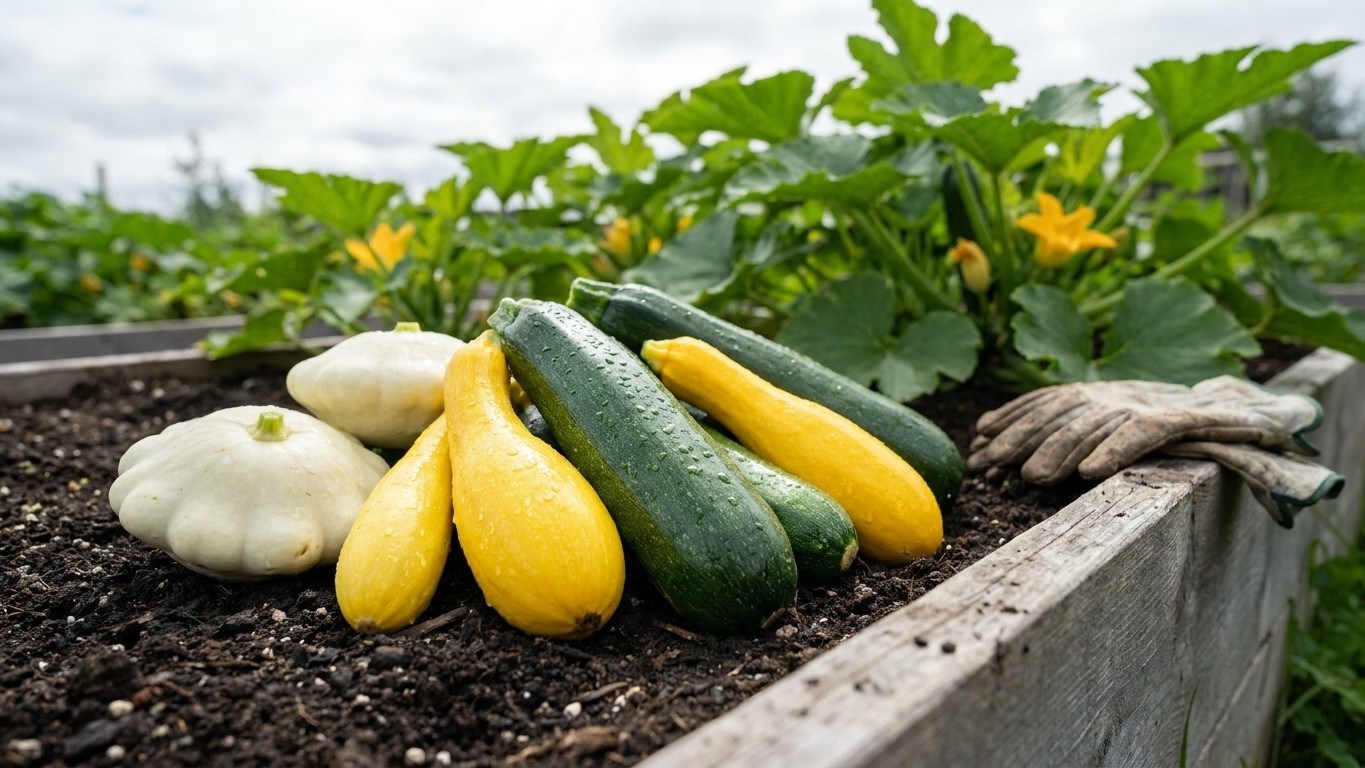
Zucchini types handle this pairing best. They set fruit at moderate soil and air temperatures, don’t stall out waiting for a heat spike, and can use the long window to push out a second and third flush of fruit through a mild summer. Straightneck and crookneck types, which lean on warmer soil to germinate quickly and set fruit fast, tend to sit sluggish for the first several weeks here, then catch up only once the season is well underway. Patty pan and scallop types fall in the middle: workable, but slower to size up than they would in a hotter interior climate.
| Squash type | Fit for coastal BC’s long, cool season |
|---|---|
| Zucchini | Strong. Sets fruit without a heat run, uses the long window well. |
| Patty pan / scallop | Workable. Slower to size than in hotter regions. |
| Yellow crookneck / straightneck | Weakest. Wants warmer soil and more heat to get moving. |
None of this means crookneck or straightneck can’t be grown here. It means they’ll be the last squash into full production and the ones most likely to disappoint a gardener expecting a fast first harvest. If the goal is reliable, early, repeat-picking squash on this coast, zucchini types are the safer bet by a wide margin, and that call comes straight from the region’s own heat numbers, not from a general rule about squash.
What will not work here
The clearest failure mode on this coast is choosing a variety selected for a hot, short-shoulder climate and expecting it to perform the same way here. Varieties bred and trialled where 90°F days are routine often rely on that heat to trigger fast fruit set and rapid sizing. Planted into a season that averages zero days that hot, those same varieties can sit for weeks with plenty of leaf growth and few fruit, then finally start producing well after a Prairie or interior BC garden growing the same variety would already be harvesting steadily. The plant isn’t sick. It’s just waiting for heat that, most years, doesn’t come.
The second failure is tight spacing. Summer squash’s classic disease is powdery mildew, and it thrives in exactly the conditions this coast supplies even without heavy summer rainfall: cool nights, damp marine air, and foliage that doesn’t dry out quickly between waterings. The summer rainfall total itself is modest, about 5.0 inches across June, July and August, with July the driest month at 1.4 inches. That’s not a wet summer by rainfall alone. But squash planted close together in a bed, with leaves overlapping and airflow blocked, will hold humidity around the plant regardless of how little rain actually falls, and mildew moves through a cramped planting fast once it starts.
The third failure is treating the mean frost dates as a safe planting rule. March 18 is an average, not a guarantee. In roughly half of all years on record, the last frost at this station falls later than that date, sometimes well later. A gardener who direct-sows tender squash the week of March 18 every year is planting into real frost risk about half the time. The same caution applies at the other end of the season: November 10 is a midpoint, not a promise, and a warm fall can push harvest weeks past it, or a cold snap can end it weeks early.
Finally, this page’s numbers come from one station, Vancouver Int’l A, on the immediate coast. A garden in interior BC, at elevation, or in the north of the province is working with a shorter, colder season than these figures describe, and a squash strategy built around a 237-day coastal window will not transfer there without real adjustment.
What changes across British Columbia
British Columbia is not one climate, and this page cannot pretend it is. The hardiness zone figure available for this page, 9a, applies to the Vancouver reference station and the mild Pacific coast around it. It says nothing reliable about the Okanagan, the Kootenays, the Peace River region, or anywhere at real elevation, all of which sit under very different conditions within the same province. Natural Resources Canada is explicit that its zone system doesn’t translate simply even within itself: a single Canadian zone, 4a, spans nine different USDA zones once you cross the border, because the Canadian system is built from seven climate variables at once rather than one. That’s a measure of how much ground a single zone number can cover, and BC’s own geography, from ocean coastline to interior plateau to mountain passes, covers a comparable spread on its own.
What that means in practice: a gardener on the immediate coast, close to the conditions this page describes, can plant with reasonable confidence in the zucchini-first approach above. A gardener in interior BC is very likely working with a shorter frost-free window and colder soil in spring, which pushes further toward the fastest-maturing zucchini types and away from the slower crookneck and straightneck varieties this page already flags as marginal even on the coast. A gardener at any real elevation should assume the season starts later and ends earlier than the dates on this page, by a margin that isn’t estimated here.
This page will not tell an individual reader which zone their own property falls into, because that number depends on local elevation, slope, and distance from water in ways a provincial page can’t see. Natural Resources Canada’s own plant hardiness map, built from the same 1991-2020 normals cited above, is the tool built to answer that question for a specific municipality, and it’s the right next stop for anyone trying to place their own garden inside this province’s real range.
Where to check this for your own county
Everything above is provincial. British Columbia’s Ministry of Agriculture and Food, reachable at gov.bc.ca’s agriculture and seafood section, is the source built to narrow it down to a specific county or regional district, and that narrower answer will beat this page’s every time.
Two things are worth looking for once there. The first is a local or regional planting calendar, since a Fraser Valley calendar, a Vancouver Island calendar, and an Okanagan calendar will not agree with each other on when to set out squash, and none of them will match the Vancouver Int’l A dates used on this page exactly. The second is any list of squash varieties actually trialled by growers or extension staff in that specific region. A variety that performs well in provincial trials broadly can still underperform in one particular valley’s microclimate, and a county-level trial record catches that in a way a province-wide page cannot.
This page exists to give a starting frame built on the best single-station data available for the province, the same way every territorial page on this site does. It is not a substitute for a local recommendation, and it isn’t meant to be. Extension services exist precisely because a province, or a state, is too large a unit to give one growing calendar that fits every garden inside it. Treat this page as the wide-angle view, and treat the provincial ministry’s local material as the closer, sharper picture once it’s available for the specific county in question.
Checking this against your own garden
Every date and average on this page describes a weather station, not a specific yard. The garden itself will always give better information, and it does that through three signs worth watching rather than any instrument most gardeners keep on hand.
Soil warmth by feel is the first. Summer squash seed germinates poorly in soil that still feels cold to the back of a hand pushed a few inches down, no matter what the calendar says about the average frost date having passed. If the soil still feels cool and damp rather than faintly warm on a sunny afternoon, that’s a sign the local microclimate, shaded by trees, low-lying, close to water, is running behind the general pattern for the area, and waiting another week or two will do more for germination than any date on this page.
The first flush of male flowers is the second sign. Squash plants typically produce a run of male flowers before the female flowers, which carry the tiny swelling at the base that becomes the fruit, start appearing in real numbers. Seeing plenty of male flowers but few or no females for a couple of weeks isn’t a problem to fix. It’s the plant’s own reading of the current conditions, often meaning it’s still waiting for a bit more sustained warmth before it commits to fruit.
New true leaves are the third. The first true leaves, the ones shaped like the plant’s mature foliage rather than the rounded seed leaves, showing up quickly and a healthy green rather than pale or slow to appear, is one of the clearest signs a garden’s actual conditions are running ahead of, or behind, the averages this page describes.