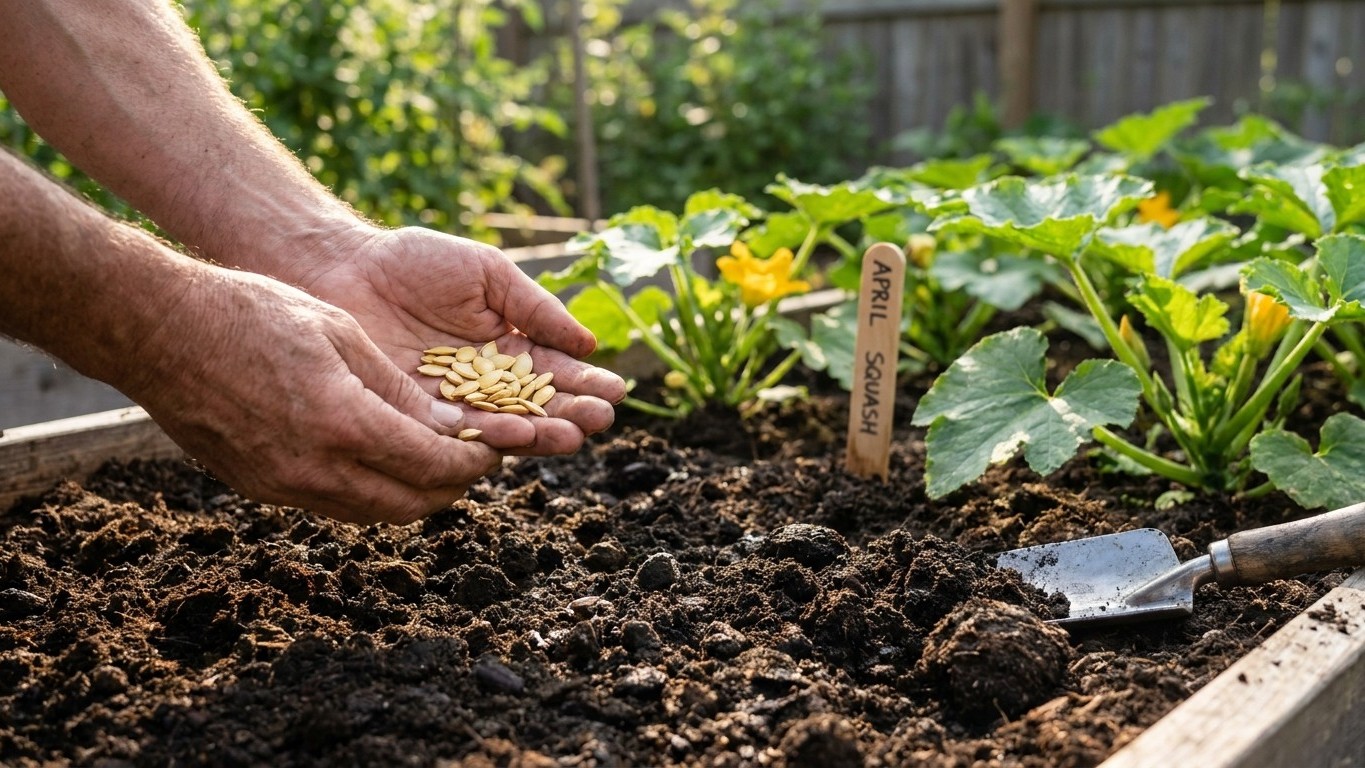

Along the California coast and across the southern half of the state, summer squash has no frost-based planting window at all: the constraint is heat and water, not cold. In the Central Valley, the foothills and anywhere near the Sierra, frost still rules the calendar the way it does in most of the country, so the “right” week to sow depends entirely on where in California you’re standing.
The short answer for California
Start with the frost record itself, because it tells you something unusual. At the coastal and southern California reference station, NOAA’s 30-year climate normals show zero days at or below 32°F across three decades, and the frost-free season is listed as a full 365 days. That’s not a rounded estimate, the standard freeze-normal calculation couldn’t even produce a spring or fall frost date, because there wasn’t one to compute. For a gardener in Los Angeles, San Diego, or most of the immediate coast, that means summer squash isn’t waiting on a last-frost date. It can go in the ground whenever the soil has warmed enough to germinate the seed, which for squash generally means soil that’s stopped feeling cold to the touch in early morning, not a calendar square.
That single fact, though, only describes one climate inside a state that spans USDA hardiness zones 5a through 11a. A zone 5a reading exists somewhere in California’s mountains, and it sits on the same map as a zone 11a reading near the coast. Those two places are not gardening in the same season, let alone the same month. So the honest short answer splits in two: if you garden along the frost-free coast or in the frost-free south, your squash calendar is governed by soil warmth and summer heat, not frost dates, and you can treat the “no freeze in an average year” figure as license to plant early and often. If you garden in the Central Valley, the foothills, or at any elevation with real winters, that frost-free figure does not apply to you at all, your zone freezes, and your last-spring-frost and first-fall-frost dates are the ones that matter for timing a sowing.
This page can’t hand you a single date because the state itself doesn’t have one. What it can tell you, reliably, is which constraint you’re solving for. Frost-free California gardeners are solving for heat stress and irrigation. Frost-zone California gardeners are solving for a shorter window bookended by real freezes. Knowing which category you’re in matters more than any specific week on a calendar, and that split runs through every section below.
What will not work here
Watering summer squash on a once-a-week schedule is the most common way to lose a planting in frost-free California, and the rainfall data explains why. At the coastal reference station, June, July and August together average about 0.1 inch of rain : 0.08 inches in June, 0.04 in July, and 0.0 in August, the driest month of the year with no measurable rain at all in a typical year. That’s not a dry stretch between storms; it’s a summer with functionally no rain to lean on. A squash plant that depends on weekly rainfall anywhere else in the country is depending on nothing here. Gardeners who transplant advice from a wetter state, “water deeply once a week”, routinely watch their plants wilt by midweek, because there’s no rain filling the gap between waterings the way there would be in a region getting even an inch a month.
The reference station also shows 2.4 days a year reaching 90°F or higher, which sounds mild, and along the immediate coast, it genuinely is. But that number describes the coastal station specifically, not the state. It’s a useful reminder that “California” is doing a lot of work as a label: a coastal garden with only a couple of 90°F days a year has a very different heat load than an inland or valley garden, even though both fall inside the same state-level hardiness range of 5a-11a. Squash grown right at the coast rarely faces the blossom drop and pollen sterility that heavy heat causes, but the same crop a short drive inland can face a much harder summer. This page can’t assign you a heat number it doesn’t have data for; it can only tell you that the coastal figure is not a safe stand-in for an inland or valley garden.
Close spacing is the other trap, though it plays out differently depending on where you are. In the near-zero humidity of a dry coastal or southern summer, tight spacing mostly costs you airflow and vigor. Inland, where irrigation keeps humidity higher around the leaves even without rain, the same tight spacing invites powdery mildew, the fungal problem that shows up on summer squash almost everywhere it’s grown. Either way, the fix is the same: give plants more room than a rainier climate’s seed packet suggests, because California’s dry air won’t rinse mildew spores off crowded leaves the way rain does elsewhere.
What changes across California
A hardiness range of 5a to 11a is not a typo, it’s six full zones inside one state’s borders, and it means there is no single “California planting date” that means anything without knowing which end of that range you’re on. Zone 11a, the warm end, describes places that essentially never freeze; zone 5a, the cold end, describes places with winters closer to the northern Rockies than to Los Angeles. A planting calendar built around the frost-free coastal station is simply wrong for a zone 5a mountain garden, and a calendar built around a cold mountain frost date would waste half the coastal growing season telling a Southern California gardener to wait for a frost that isn’t coming.
The practical shift is directional and elevational, not tied to a single line on a map. Gardeners farther north in the state, and gardeners at higher elevation regardless of latitude, should expect a later last-spring-frost, an earlier first-fall-frost, and a compressed window in between compared with the frost-free figures cited above. That compression is exactly what a shorter hardiness zone number signals: less time between frosts means less margin for a slow-maturing squash variety, and less room to recover from a bad transplant. Coastal and southern gardeners, by contrast, are working from the opposite problem, plenty of frost-free time, but a summer heat and rainfall pattern (that 0.1 inch across three months) that punishes anyone who isn’t irrigating consistently.
This page won’t tell you which of those two Californias your garden sits in, because a state-level hardiness range can’t do that job. What it can tell you is that the spread is real and large enough that a neighbor’s planting date three counties away, or three hills up, may not apply to your yard at all. Checking your own position on the current USDA Plant Hardiness Zone Map is the only way to know which half of this state’s advice actually belongs to you.
Where to check this for your own county
The state-level facts here come from a single reference station and a statewide hardiness range, and both are averages. Your county’s cooperative extension office works from something narrower and more useful: local trial data, local frost records, and a planting calendar built around your actual growing conditions rather than a station that may be a hundred miles and two climate zones away. For California, that’s the University of California Agriculture and Natural Resources system, at ucanr.edu.
Once there, look for two things specifically. First, the local planting calendar for your county or region : UC ANR’s county offices publish timing guidance tuned to their own frost patterns and heat loads, which is exactly the granularity this state-level page can’t offer. Second, look for the varieties that have actually been trialled in your county’s extension programs. Summer squash varieties bred for a long, mild coastal season don’t necessarily perform the same way in a Central Valley heat spike or a foothill frost pocket, and county-level trial notes will say which types have held up locally, something no statewide figure can tell you.
A county recommendation beats a state recommendation every time there’s a conflict between the two, and there often will be one, given how much California varies from one hardiness zone to the next. This page is deliberately the state-level view: the frost-free reference data, the statewide zone range, the summer rainfall pattern. It’s meant to explain the mechanics behind the calendar, not to replace the specific dates your county extension office has already worked out from decades of local observation. Treat this as the “why,” and your county’s page as the “when.”
Checking this against your own garden
No climate normal, including the ones cited above, knows what your particular yard is doing this week, and squash itself will tell you more than any date on a page like this one. Three signals are worth tracking by hand, literally.
Soil warmth by feel is the first and most direct check. Push a finger a couple of inches into the bed in the morning before the sun has heated the surface. If it still feels cold rather than cool, squash seed will sit and rot rather than germinate, regardless of what the calendar says about frost-free days. A bed that feels merely cool, not cold, is usually ready.
The first flush of male flowers is the second signal, and it’s easy to misread. Squash plants typically produce male flowers before female ones, so an early wave of blooms with no fruit forming isn’t a failure, it’s the plant confirming it has enough warmth and daylight to flower at all, which is itself useful information about your specific microclimate compared with a neighbor’s.
The appearance of true leaves, the second set that looks like the adult plant’s foliage rather than the rounded seed leaves, is the third marker. True leaves showing up quickly and looking vigorous, rather than pale or stalled, tells you the combination of your soil, your water schedule and your particular patch of California is working together, which is the only confirmation that actually matters once the seed is in the ground.