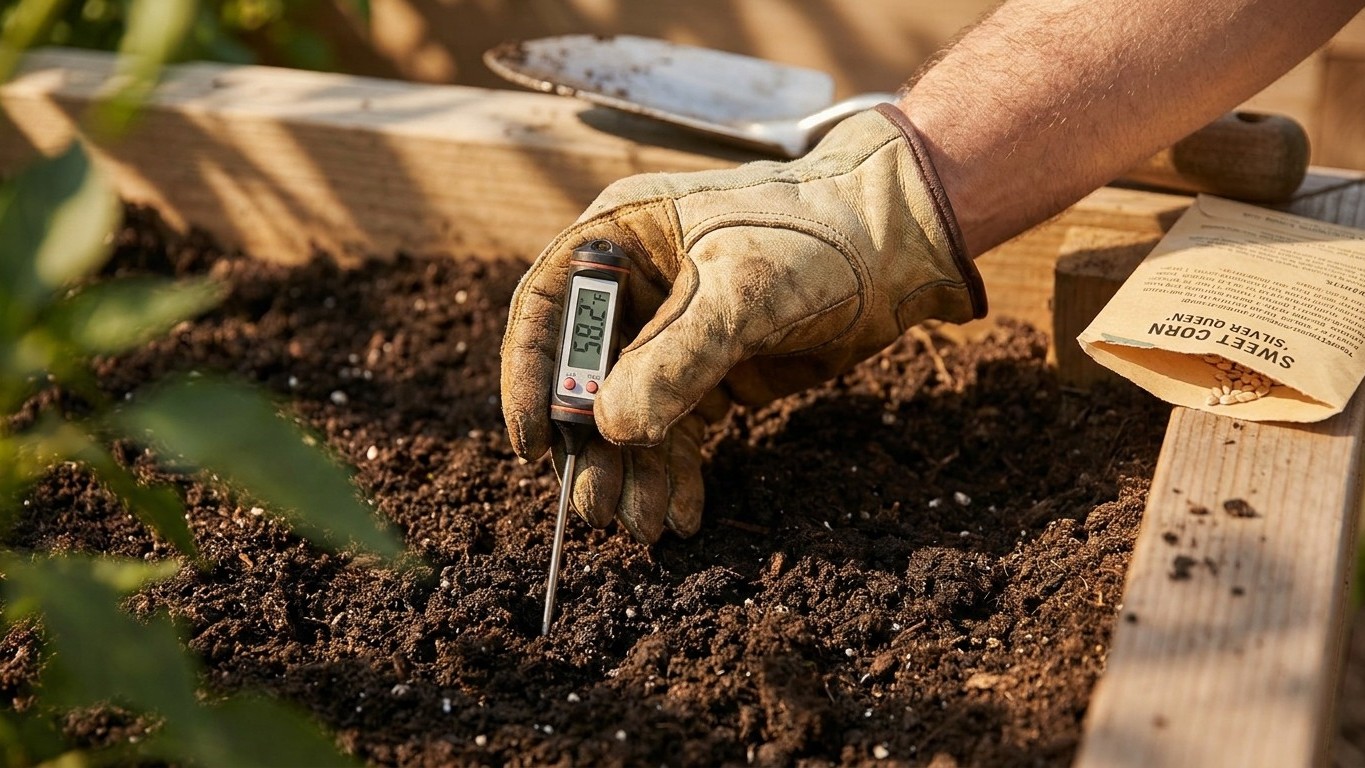

Sweet corn in Connecticut goes in the ground once the soil itself reads at least 60 F, and that threshold lands well after the last spring frost, not on it. Frost risk here fades between April 2 and April 12 depending on location, but soil warmth is a separate clock. From that soil-warm date, the 60 to 90 days sweet corn needs fit comfortably in most of the state before the first fall frost arrives.
The short answer
Soil doesn’t warm on the same schedule as the air. A yard can sit well past its last frost risk and still hold soil in the low 50s, especially in clay ground, shaded beds, or low spots where cold air pools overnight. That gap between “frost is over” and “soil is actually warm” is the single most common source of confusion for gardeners planting sweet corn in Connecticut.
The state’s last spring frost, based on NOAA climate normals from the coastal Bridgeport station, falls between April 2 and April 12. That’s the mildest reading in Connecticut. Inland and northwest areas run behind that window on both ends, meaning frost risk lingers later into spring there and returns earlier in fall. Soil warmth above 60 F typically shows up weeks after frost risk clears, not the same week, and the only reliable way to know is a soil thermometer pushed a couple inches into the bed, checked at the same time of day over a few readings rather than trusted to a single warm afternoon.
Connecticut does bring real summer heat once the season turns. The state averages 6.2 days a year at 90 F or hotter, based on NOAA climate normals from the same Bridgeport reference station. That heat load matters here because it’s what pushes soil past that 60 F mark and keeps it there, and it’s what drives the fast, even germination sweet corn needs once conditions are right. Cold, wet soil below 60 F does the opposite: seed sits, rots, or comes up patchy.
Once soil clears 60 F, the math on season length works in the gardener’s favor almost everywhere in the state. The first fall frost, again per NOAA normals, arrives between October 28 and November 10 along the coast, with inland and northwest locations seeing it sooner. Even counting the weeks it can take soil to catch up after the frost-free date opens, there’s still a wide stretch of calendar between a warm-soil sowing and that fall frost window, plenty for a full 60 to 90 day cycle in the milder parts of the state. The margin narrows the further inland and north a garden sits, which is exactly the question the next section works through.
Does a late variety fit here?
A 60-day variety
A short-season sweet corn built around a 60-day cycle from planting has plenty of room in Connecticut, coastal or inland. Even accounting for soil that’s slow to warm past 60 F in a shaded or heavy-clay garden, sowing well into late spring still leaves a wide cushion before the first fall frost shows up anywhere in the state, October along the coast, sooner but still weeks away inland. That cushion is what makes a 60-day type the safer bet for a first planting, and it’s also what allows a second or third sowing a couple weeks apart, since there’s calendar to spare for more than one round.
A 90-day variety
A 90-day sweet corn asks for more of that window, and the fit depends heavily on where in Connecticut the garden sits. Along the coast, where the last spring frost clears earliest (April 2) and the first fall frost holds off longest (into November), there’s enough stretch in the calendar for a 90-day type sown as soon as soil reads 60 F. Inland and in the northwest hills, the picture changes. Last frost lingers later there, soil takes longer to reach 60 F in ground that’s naturally cooler and slower to drain, and the first fall frost arrives sooner than the coastal range suggests. Stack those three factors together and the season simply compresses from both ends. A 90-day sweet corn sown late because the soil was slow to warm can end up racing an early inland frost with little margin left. Plainly: a late, 90-day variety is a reasonable choice for the mildest coastal gardens, but it does not reliably fit inland or northwest Connecticut, where a shorter-season type is the safer call.
What goes wrong here
- Soil sown too cold. Seed goes in based on the calendar or the last frost date rather than an actual soil reading, and it sits in soil still under 60 F. The kernels rot, germinate unevenly, or come up weeks late and stunted. The remedy is simple and requires no guesswork: check soil temperature directly with a thermometer at planting depth over several days before sowing, and hold off until it reads a consistent 60 F rather than working backward from the frost date.
- A variety too late for the season. A 90-day type gets planted in an inland or northwest garden where the frost-free window is shorter on both ends, and the crop is still standing when frost arrives. The remedy is matching maturity length to location: shorter-season types for inland and northwest gardens, and reserving longer 90-day varieties for the mildest coastal spots where the extra weeks of frost-free calendar actually exist.
- Sweetness lost to timing, not climate. This one has nothing to do with soil or frost. When standard (su), sugary-enhanced (se), and supersweet (sh2) types tassel and shed pollen at the same time nearby, cross-pollination dulls the sweetness of the supersweet ears specifically. No isolation distance solves this on its own, since the real issue is timing, not spacing. The remedy is staggering planting dates so the different types don’t tassel in the same window, or growing only one type in a given season, and keeping any planting in blocks of three or more rows rather than a single thin row, since block shape is what gives corn’s wind-blown pollen a fair chance to reach the ears it should.
Common questions
Does “60 F soil” mean the forecasted air temperature? No. It means the actual temperature of the soil itself, measured a couple inches down at planting depth, ideally checked over a few days rather than a single reading. Air temperature forecasts and soil temperature can diverge by weeks in spring, especially in shaded or heavy soil.
Can I just count forward from the last frost date instead of testing soil? That’s the mistake this climate punishes most. The last frost date (April 2 to April 12 per NOAA normals) marks when frost risk fades, not when soil is warm enough for corn. Soil above 60 F typically comes later, and using the frost date alone as a planting trigger is a common reason seed rots or germinates unevenly.
How many plantings can I fit in one season? With a shorter, roughly 60-day type, the wide gap between soil warming past 60 F and the first fall frost (October 28 to November 10 along the coast, sooner inland) leaves enough calendar for more than one sowing spaced a couple weeks apart, particularly in coastal and central parts of the state.
Does the coast really have it easier than inland Connecticut? Based on NOAA normals, yes, on both ends of the season. Coastal ground clears its last frost earliest and holds off its first fall frost longest, while inland and northwest areas see frost linger later in spring and return sooner in fall, which is exactly why longer-season sweet corn is a safer bet near the coast than further inland.