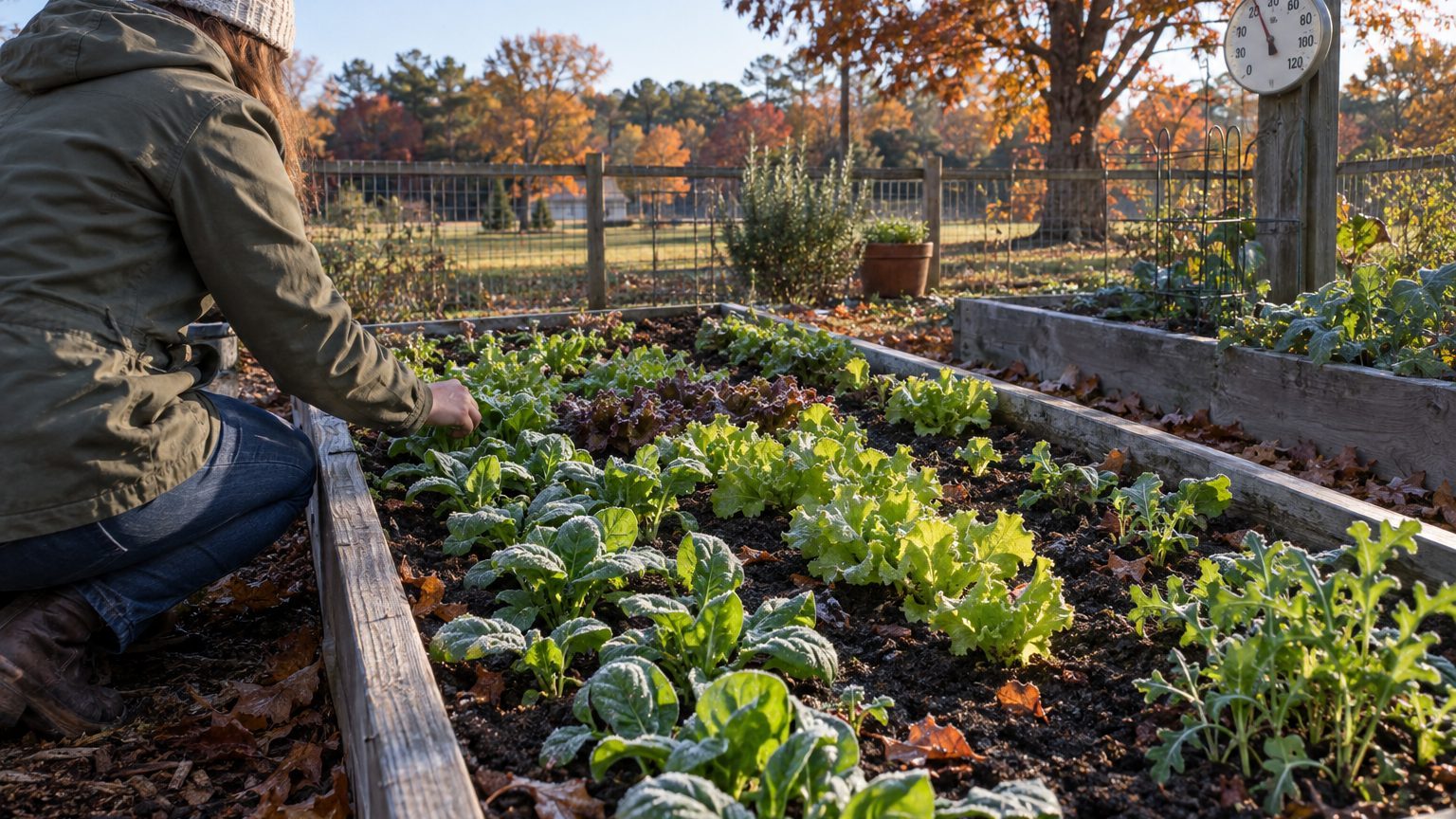

Sow winter salads in Connecticut from late summer into early fall, finishing before the first hard freeze. At the Bridgeport reference station, the odds of a 32°F freeze in fall reach the 30-70% band between October 28 and November 10. Spring sowing opens around April 2 to April 12 on the coast. Inland gardens run earlier in fall and later in spring. For the full crop-by-crop picture, start with Winter Salads for Connecticut Gardens.
The short answer for Connecticut
Work backward from the freeze window, not forward from the calendar. A winter salad needs to be most of the way to size before cold and short days stall its growth, so the sowing date is set by how long the crop takes to mature, counted back from late October.
The dates deserve a precise reading, because they are not deadlines. They come from NOAA’s 1991-2020 Climate Normals for the Bridgeport station (USW00094702), and each one marks a stretch where the chance of a 32°F freeze falls in a 30-70% band. they describe odds of a freeze, not a day it will happen. Some years the first freeze lands before the window, some years after.
| Reference point (Bridgeport station) | Window, 32°F freeze probability in the 30-70% band |
|---|---|
| Last spring freeze | April 2 to April 12 |
| First fall freeze | October 28 to November 10 |
Here is how to turn that into a sowing date. Find days to maturity on the seed packet. Those numbers assume warm-season growth, and in fall plants slow down as days shorten, so allow generously more time than the packet says. Then count back from October 28, the early edge of the window, rather than from November 10. Quick baby-leaf greens can go in later than anything meant to grow to full size, so a few sowings spaced over several weeks give you a safety net.
Spring works on the same logic in reverse. Cold-tolerant salad greens do not wait for the last freeze to pass, since a light freeze is not what stops them. On the coast, the April 2 to April 12 window is a useful marker for when the garden is waking up, and the seedbed workable. Beds under a cover can start earlier still.
One caution about the source. Bridgeport sits on Long Island Sound and is the mildest part of the state. Treat these dates as the most generous version of the calendar, not the average of the state.
What will not work here
Sowing at the freeze date will not work. By the time the first fall freeze arrives, anywhere from October 28 to November 10 at the coast, a seed sown that week has no real chance of becoming a harvest. Seeds may germinate, but seedlings will sit small and stalled through winter. Some may survive to resume growth in spring, which is a different crop plan than the one you wanted.
Borrowing the coastal dates inland fails too. The Bridgeport window is the mildest in Connecticut, so a garden in the northwest hills that sows on the coastal schedule is already behind. Fall freezes arrive earlier there, which shrinks the growing time, and spring freezes linger later. The page does not have inland station figures, so it will not guess a number, but the direction is not in doubt.
Long-maturing salad crops are the next casualty. A type that needs a long stretch from sowing to a full-size plant leaves little room for error in a state where the freeze window opens in late October. Slow growers sown late simply stay small. In practice, the more days to maturity a variety lists, the earlier in the season it has to go in, and the more you should question whether it suits a Connecticut fall at all. The best winter salads for Connecticut sort this out by type.
Leaving tender lettuce unprotected through winter also fails. The mean daily minimum of the coldest month at Bridgeport is 24.4°F. That is an average of nightly lows, so some nights run well below it, and it describes the mildest part of the state. At those temperatures, hardy greens can hold on while soft, tender heading lettuces will not without cover. A low tunnel or cold frame changes the odds far more than a few days of sowing date.
What this page cannot tell you is how Connecticut’s summer heat, rainfall or humidity will treat your late-summer seedbed. Those figures are not among the verified facts here, so there is no claim either way. If seedlings sown in the warm part of the season dry out or damp off, that is a local lesson worth noting in your own garden.
What changes across Connecticut
No single answer covers the state. The USDA Plant Hardiness Zone Map (2023 edition, built on 1991-2020 normals) places Connecticut across zones 6a to 7b. That is four half-zones inside one set of borders, and the map is built on one variable only: the average annual extreme minimum temperature.
That variable matters, and it also leaves things out. The hardiness zone tells you how cold the coldest night of the year gets on average. It does not tell you how early the first fall freeze arrives, or how many weeks of growing time you have, which is the number that sets a sowing date. Two gardens in the same zone can have different frost windows. Use the zone as one clue, not as the calendar.
The coast sits at the warm end of the range, and Bridgeport, the reference city for this page, represents that end. Inland and in the northwest hills, the cold is more pronounced and the freezes come sooner in fall and later in spring. Elevation adds to this, since higher ground cools faster on clear nights.
If you garden in the north or on a hill, shift your plan in three ways:
- Sow earlier than the coastal window suggests, and favor fast-maturing types.
- Plan on cover from the start, such as a low tunnel or cold frame, rather than adding it after the first scare.
- Put the hardiest varieties in your coldest beds and keep tender ones for the most sheltered spot.
I will not tell you which zone you are in, because the page cannot see your address. Look up your location on the USDA Plant Hardiness Zone Map, then compare that result to the coastal reference above to judge how far you sit from it.
Where to check this for your own county
Your state’s land-grant extension service is the next stop. For Connecticut, that is UConn Extension. Look there for two things: a planting calendar written for your part of the state, and the varieties that have actually been trialled in your county rather than just sold there.
Calendars at extension services are usually built per crop, not per state, so search for the specific vegetable you are growing instead of a general “fall planting” page. When a crop has its own calendar, use that one over any general guidance. This page cannot confirm that UConn publishes a dedicated winter-salad calendar, so treat that as something to look for, and if you do not find one, ask the extension’s garden help line, if one is listed.
A county recommendation beats a state one, every time. A county office knows its local freeze patterns, its soils, and what growers nearby have seen fail. This page is the state-level one, built from a single coastal station and a statewide hardiness range. It gives you a sensible frame, and it will be least precise for gardens far from Long Island Sound.
When local advice and this page disagree, go with the local advice. The Bridgeport window is a starting estimate, and an extension office or an experienced neighbor will tell you how far to adjust it.
Checking this against your own garden
Your own observations outrank every date above. Three are worth watching, and none needs a gadget.
First, soil warmth by feel. Press your hand into the seedbed in the morning. In late summer, soil that stays warm to the touch is good for germination, while soil that already feels cool by mid-fall tells you the bed is losing heat early. A sheltered, south-facing bed holds warmth longer than a shaded or low spot, and that difference can be worth more than a week of sowing date.
Second, the first true leaves. After the seed leaves come the first real leaves, which have the shape of the mature plant. Watch how many days that takes after sowing. Quick appearance means the bed is warm enough to keep growing. If seedlings stall at the seed-leaf stage in your garden while a neighbor’s race ahead, your microclimate runs cooler, and next year’s sowing should move earlier.
Third, the first frost on your tender plants. Note the morning basil blackens or squash vines wilt. Compare that date to the Bridgeport window of October 28 to November 10. If your garden gets there days ahead, you have measured your own offset, and it is the most useful number you can write down.
Common questions
Can I sow winter salads in spring as well as fall?
Yes. Cold-tolerant greens can go in once the seedbed is workable. On the coast, the last spring freeze window runs April 2 to April 12, a useful marker, though not a barrier for hardy types. Inland gardens start later.
Do the Bridgeport dates apply to my town?
Only if you garden near the Sound. Bridgeport is the mildest part of Connecticut, so inland and northwest gardens should expect fall freezes earlier and spring freezes later than the dates given here.
Is a cold frame or tunnel necessary?
Not for every crop, but the mean daily minimum of the coldest month at Bridgeport is 24.4°F, and that is the mild end of the state. Cover widens your margin, especially for tender types and for any garden away from the coast.
What if I miss the sowing window?
Sow anyway, but choose quick baby-leaf types and add cover. Expect a smaller harvest. The window is a probability band of 30-70%, not a hard cutoff, so a late fall in a mild year may still reward you.