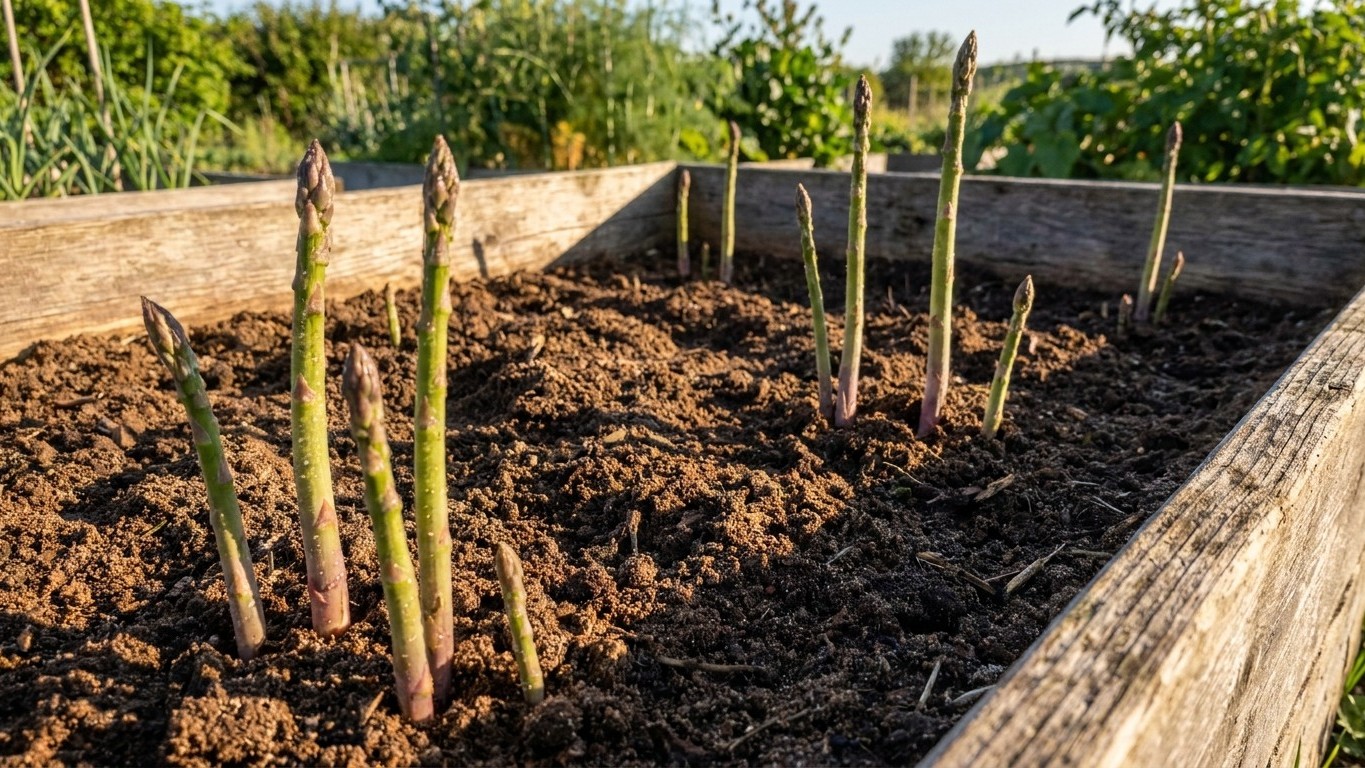

Yes, mostly. Asparagus asks for exactly one thing from its soil, good drainage, and Delaware’s official state soil, the Greenwich series, is described by USDA surveyors as well drained. A crown planted this spring can reasonably outlast a mortgage refinance, at least one roof replacement, and a kid’s entire run through elementary school. But a state soil is a label on a survey map, not a report on the dirt behind a particular house, and that gap is where a fifteen-year bed either holds or fails early.
The short answer
Utah State University Extension is blunt about asparagus: it will grow in most soils, and the one condition that actually matters is drainage. Nothing else about the plant’s soil chemistry is published by that source, no pH target, no fertility threshold. So the real question for any Delaware garden isn’t “is my soil good enough” in some general sense, it’s “does water move through it, or does it sit.”
The Greenwich series gives a useful reference point. USDA’s Soil Data Access records describe it as an Ultisol, an old, heavily weathered and leached soil type, with a surface texture that runs 48 percent sand, 9 percent clay and 43 percent silt, a loam-to-silt mix, and organic matter around 1.7 percent. That low clay share matters more than any other number here. Clay particles are what hold water in a soil and slow it down; a series built on roughly half sand and well under 10 percent clay has few of those particles, which is consistent with the “well drained” rating USDA assigns it. The surface pH is recorded at about 6.0, slightly acid, though that figure describes the mapped survey sample, not a fertilized, tilled, amended garden bed a few miles or a few counties away, and the asparagus source never sets a pH requirement in the first place, so there’s no target to compare it against.
Why the state soil is a starting point, not a verdict
Delaware, like every state, is mapped into hundreds of distinct soil series, not one. The Greenwich series represents a broad, commonly encountered ground type across the state, but it says nothing about a low spot near a drainage ditch, a compacted lot where a builder scraped the topsoil and filled with subsoil, or a patch of Delmarva’s flatter, poorly drained lowland pockets. An organic-matter reading well above 1.7 percent on a given lot, into the 20-percent range, would actually signal a natural peat or muck layer rather than a cultivated garden bed, another reason the mapped number and a worked bed rarely match exactly.
The practical test costs nothing: dig a hole about a foot deep after a rain, fill it with water, and time how long it takes to disappear. Standing water after several hours means the ground the plant will occupy for a decade or more doesn’t drain on its own. The fix isn’t complicated. A raised bed or mounded row, built up eight to ten inches above grade with amended soil, gives asparagus crowns the drainage the source insists on, regardless of what lies underneath. Given that this is the one crop on a home lot where the planting decision effectively can’t be undone for ten to fifteen years, that hour with a shovel before planting is cheap insurance.
Will the summer here water it for you?
Asparagus has a two-stage watering appetite. In the first two years after crowns go in, it wants 1 to 2 inches of water every other week. Once established, that eases to roughly once every three weeks. Delaware’s summer rainfall normals, measured at reference station USW00013781 over 1991-2020, let a gardener check that math against what actually falls from the sky rather than guessing.
- What the plant is asking for: in year one and two, 1 to 2 inches every other week works out to roughly two to four inches across any given month of summer, tapering to a single deep watering every three weeks by year three and beyond.
- June’s contribution: the normal is 4.67 inches for the month, which comfortably covers the every-other-week target on its own in an average year.
- July’s contribution: 4.41 inches, still close enough to the young bed’s requirement that supplemental watering may only be needed in a lighter-than-normal stretch.
- August’s contribution: the driest of the three at 3.98 inches, and this is where a first- or second-year bed is most likely to fall short of its every-other-week need, especially since summer rain often arrives as a single thunderstorm that runs off a lawn or garden bed rather than soaking in evenly across four weeks.
- What that means at the tap: across the full 13.1-inch summer normal, an established bed’s lighter every-three-weeks need is usually met by the sky with room to spare, but a young bed in its critical first two years should get a rain gauge check every August, since that’s the month where the seasonal normal and the plant’s actual schedule are most likely to drift apart.
These are 1991-2020 averages at one reference station, not a forecast and not a measurement of any particular yard. A rain gauge on the actual bed, checked weekly through the summer, is what turns this normal into a real watering decision.
When to put the crowns in
Crowns go into the ground in early spring, set into furrows about 8 inches deep. Delaware’s last spring frost, based on the same reference station’s 1991-2020 freeze-probability normals, falls somewhere around April 3 to April 14. That’s a mean date, not a guarantee, and it comes from an airport weather station; gardens further inland, at higher elevation, or simply away from a paved, heat-retaining site often see their own last frost run one to two weeks later than the station figure, so a quick check with local county records is worth the five minutes before crowns go into cold ground.
The furrow itself isn’t filled in all at once. Crowns are set at the bottom of that 8-inch trench and the soil is backfilled gradually over the course of the year, about two inches every other month, rather than covering the crown completely on planting day. That staged approach lets the emerging shoots keep reaching daylight as the furrow slowly closes around them.
Patience is the real cost of this crop. There’s no harvest at all in year one or two; the plant needs that time to build a root system strong enough to support cutting. Year three brings the first harvest window, about four weeks long. That window widens in following years, typically to six weeks and then to eight weeks as the crown matures. The stopping point each season isn’t a date on a calendar, it’s a visual cue: once most of the spears coming up are thinner than a pencil, cutting stops for the year and the remaining ferny growth is left to feed the crown for next season.
Utah State University Extension names four common varieties, sorted only by their reproductive type: Jersey Giant and Jersey Knight are all-male, while UC 157 F1 and Purple Passion are male/female varieties. The source doesn’t rank them by flavor, yield, or regional suitability, so there’s no published reason to favor one over another for a Delaware bed specifically; that decision comes down to whatever’s locally available. Seed is the other route into a bed, rather than crowns, though it asks for extra patience, typically a full season in a nursery row before the young plants are sturdy enough to move into their permanent furrow, pushing that year-three first harvest back accordingly.
Common questions
Does asparagus need acidic soil in Delaware? No pH requirement is published for the crop by Utah State University Extension, only good drainage. The Greenwich series carries a surface pH around 6.0 in USDA’s survey data, but that’s a mapped average for one soil series, not a reading from any particular garden. A simple soil test is the only way to know an actual bed’s pH.
How long until the first harvest? None at all in the first two years. The first cutting comes in year three, running about four weeks, then widening to roughly six weeks and eventually eight weeks as the planting matures over the following seasons.
Can asparagus go into clay-heavy soil? Only if it drains. A soaked-hole drainage test is the quickest check; if water stands for hours, a raised bed or mounded row built eight to ten inches above grade solves the problem without requiring the underlying ground to change at all.
Which variety is best for Delaware? None is specifically recommended. The only published detail distinguishing Jersey Giant, Jersey Knight, UC 157 F1 and Purple Passion is whether they’re all-male or male/female; no source data compares them on flavor, yield, or regional performance.