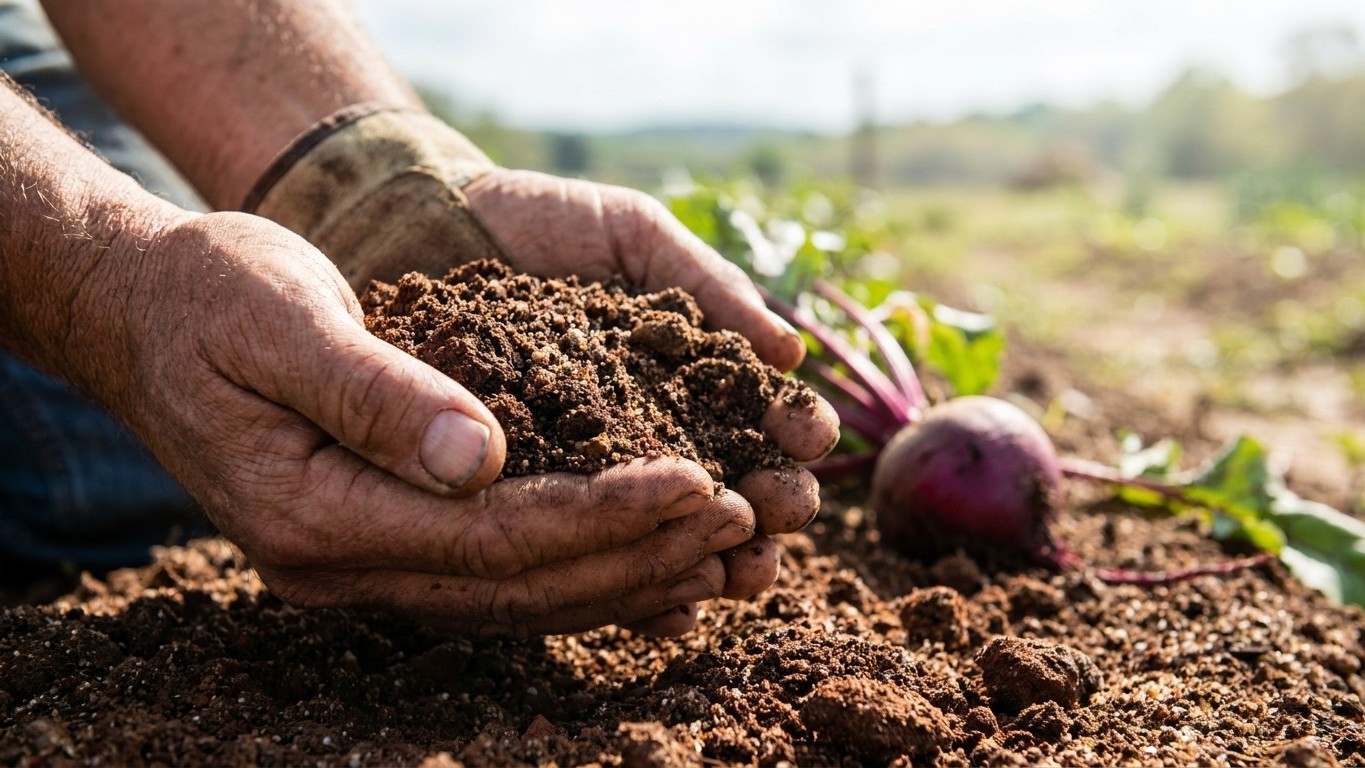

Delaware’s state soil, the Greenwich series, gives a beet root a mostly sandy, well-drained loam to grow through, but it starts out acid and thin on organic matter, so it’s a partial match at best. The bigger risk to a Delaware beet crop isn’t the ground itself so much as timing: what the taproot experiences in its first six weeks, and whether summer heat finds it dry. Here’s where the sourced numbers hold, and where they stop.
The short answer
The Greenwich series, translated for a root vegetable
Delaware’s official state soil, named by state law and tracked through the USDA NRCS State Soils programme, is the Greenwich series, an Ultisol. That word alone tells you something: Ultisols are old, heavily weathered, leached soils, naturally acid and low in nutrients by the time they’ve formed. The surface horizon of the Greenwich series runs 48 percent sand, 9 percent clay, and 43 percent silt, a loam to silty loam texture with a surface pH around 6.0, slightly acid. It’s classified well drained, and organic matter sits around 1.7 percent.
For a beet, that texture is mostly good news. A taproot pushing through a sand-heavy loam with only 9 percent clay meets little resistance, which matters more for beets than for shallow-rooted crops, since a beet that hits a compacted or clay-heavy layer forks or stalls. Well-drained also means the crown isn’t sitting in standing water after a storm, which beets don’t tolerate well. Where the Greenwich series falls short of what Utah State University Extension describes as an ideal beet bed (deep, sandy, well-drained soil rich in organic matter) is that last part: 1.7 percent organic matter is thin, and a natural surface horizon this low needs building up before it can feed a root crop through a full season.
Heat, woodiness, and the missing local number
The other half of the risk is heat. Utah State University Extension is specific here: temperatures above 85 F combined with water stress make a beet root turn woody, tough, and unpleasant to eat. Delaware summers reach past that threshold regularly, which is exactly why the six weeks right after sowing (covered next) matter so much for keeping the plant from ever reaching a heat-stressed, thirsty state later on. A precise count of how many days a year the reference weather station in this state passes 90 F isn’t part of the sourced figures on this page, so it isn’t reported here rather than guessed at. What is sourced is the mechanism: heat plus dry roots equals a woody beet, regardless of the exact day count.
None of this is a verdict on any one garden. Delaware, like every state, spans hundreds of mapped soil series, and the Greenwich series is a representative starting point, not a description of the dirt behind a specific house. A yard near a river, a filled lot, or ground a builder graded years ago can differ completely from the state soil’s numbers. Treat the Greenwich figures as a sense of what the region’s ground tends toward, then get an actual soil test for the numbers that apply to one particular bed.
The six weeks that decide it here
Beets are sown directly in place, never transplanted, and the standard guidance is to get seed in the ground 2 to 3 weeks before the last frost. For the Delaware reference station tracked by NOAA, the 1991-2020 Climate Normals put the last spring freeze probability window between April 3 and April 14. That means seed typically goes into the ground sometime in March for most Delaware gardeners following that guideline, putting the first six weeks of root development squarely in a Mid-Atlantic spring: a season known for swinging hard between stretches of dry, wind-exposed days and sudden heavy rain systems moving up from the Chesapeake and off the coast.
That swing is the point. Utah State University Extension is direct about the mechanism: water stress in the first six weeks after sowing causes the plant to bolt, sending up a flower stalk early instead of building a root worth eating. A beet doesn’t need a drought to bolt. It needs a dry stretch during exactly the window when it’s establishing, and a Delaware March or April, prone to alternating between dry spells and downpours rather than settling into one steady pattern, creates real opportunities for that dry stretch to land at the wrong moment. A gardener who sows and then walks away for two weeks during a dry snap is taking a real risk, even if the soil itself, sandy and well drained per the Greenwich series profile, seems forgiving.
The frost dates themselves come with their own caution. The April 3 to April 14 window is measured at one airport weather station, and NOAA’s own guidance on suburban and rural microclimates suggests gardens outside town typically see later last frosts and earlier first frosts than an airport reading, sometimes by one to two weeks, more at elevation. A gardener in a low-lying rural spot planting on the airport’s calendar could be sowing into a frost risk that hasn’t actually passed yet, which then compounds the water-stress problem: a frost-nipped seedling that’s also fighting a dry week has two different stressors working against root formation at once, not one.
What goes wrong here
- Bolting from an early dry spell. A dry week or two inside the first six weeks after sowing pushes the plant toward flowering instead of root growth, per Utah State University Extension. The fix is even, consistent moisture through that entire window, not just watering when the soil looks visibly dry, plus a light mulch layer that buys time between rain events common in a swinging Mid-Atlantic spring.
- Woody roots from summer heat. Temperatures above 85 F paired with a thirsty root turn the beet tough and fibrous. This is a separate failure from bolting, tied to later-season heat rather than early establishment, and the remedy is deep, infrequent watering through summer stretches rather than the light frequent watering that works for a seedling. Timing sowing so the root matures before the hottest run of the season also helps sidestep the overlap entirely.
- Thin natural organic matter. At roughly 1.7 percent organic matter, the Greenwich series surface starts out lean for a root crop that Utah State University Extension describes as wanting soil rich in organic matter. Work in composted organic matter ahead of sowing, capped at no more than 1 inch per 100 square feet, since over-amending a bed built on a naturally sandy loam can throw off the drainage balance that made the texture workable in the first place.
- Assuming the state soil is the yard’s soil. The Greenwich figures describe a representative surface horizon as mapped, not a worked garden bed, and a state contains hundreds of other series. A bed that’s been filled, graded, or sits in a river bottom can run far more clay-heavy or far more acidic than pH 6.0. A basic soil test before amending anything is the only way to know what’s actually there.
- Planting to the airport calendar in a colder pocket. The April 3 to April 14 last-frost window is a single station’s normal, and rural or low-lying gardens often run one to two weeks behind it. Sowing on that date in a colder pocket risks a frost hit right as the plant is also navigating its first six critical weeks of moisture management.
Common questions
Is the Greenwich series the soil in my Delaware garden?
Not necessarily. It’s the soil designated by state law as representative of Delaware, mapped by the USDA NRCS Soil Survey Geographic Database across eleven major components. A specific yard, especially one near a river, on filled ground, or graded by a builder, can differ completely. Use the Greenwich figures as a regional starting point and confirm your own bed with a soil test.
When should beet seed go into the ground in Delaware?
The general guideline is 2 to 3 weeks before the last spring frost. For the NOAA reference station covering this area, that frost typically falls between April 3 and April 14, but rural and suburban gardens often run one to two weeks later than that airport-based figure, so check local conditions before committing a date.
How do I know if my beets went woody instead of just growing slowly?
Woodiness shows up as a tough, fibrous texture when you cut into the root, and Utah State University Extension ties it specifically to temperatures above 85 F combined with a plant that was allowed to dry out. It’s a separate problem from bolting, which happens early and shows up as a flower stalk rather than a swelling root.
Do I need to test my own soil before amending it for beets?
Yes. The Greenwich series’ pH of about 6.0 and organic matter of about 1.7 percent describe a mapped surface horizon, not any individual garden bed. A soil test tells you the actual pH and nutrient status of your ground, which is the only reliable basis for deciding how much compost, if any, to work in ahead of sowing.