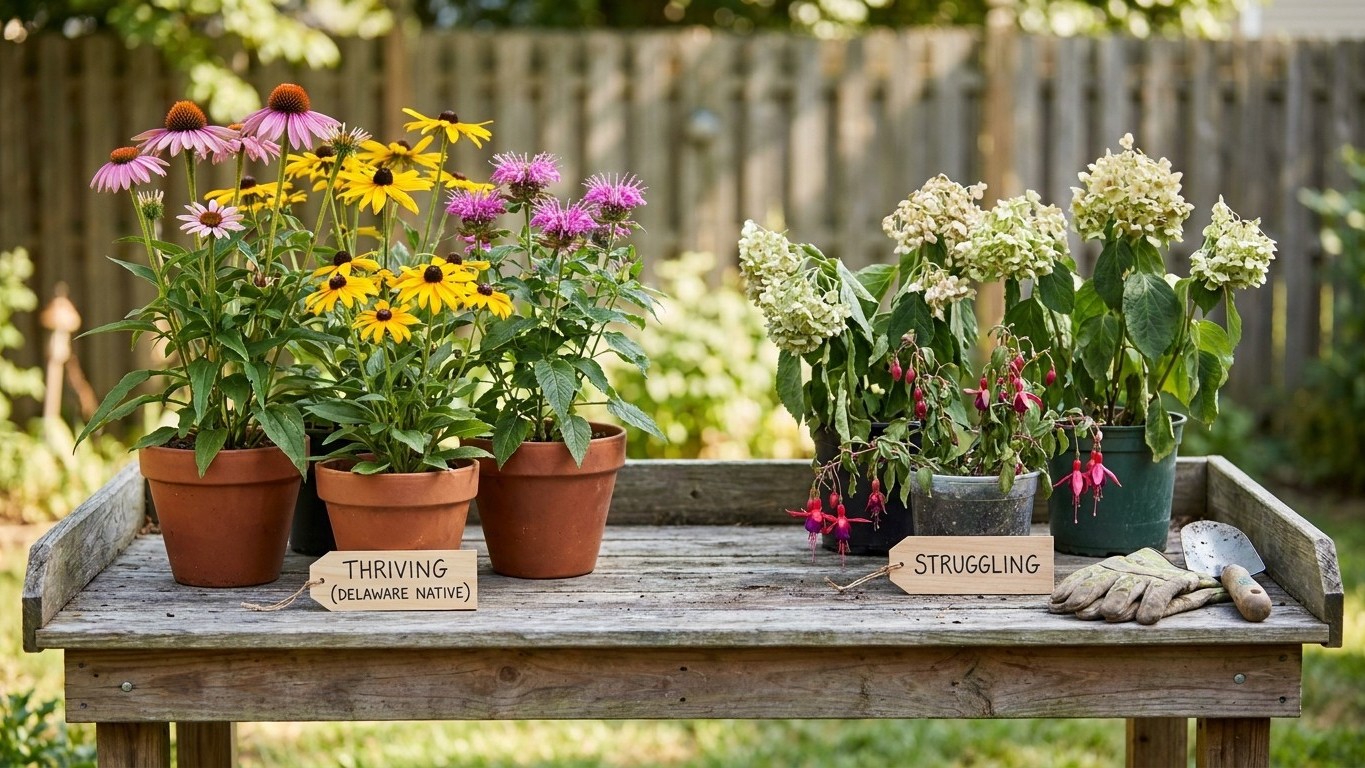

25.6°F is the average low of Wilmington’s coldest month, and that single number decides more about a Delaware flower bed than any amount of soil amendment. Sit outside through a stretch of teens some winters, then push through weeks of thick, humid heat without collapsing into mildew — that’s the double test every plant here has to pass. Most fail one half or the other. The ones that pass both, mostly daisies and mints, are the reason certain beds look effortless by August while others thin out.
What thrives in Delaware

Delaware’s growing conditions come down to two numbers. USDA’s 2023 Plant Hardiness Zone Map places the state at zone 7a-8a, meaning winter cold is moderate rather than severe. NOAA’s NCEI 1991-2020 climate normals put the average low of the coldest month at Wilmington at 25.6°F, and that’s the figure that actually decides which perennials survive without protection and which need mulch or a cold frame. Plants that do well here carry two traits at once: enough cold tolerance to sit outside into the teens some winters, and enough tolerance for long humid heat that they don’t collapse into mildew by August.
The families that carry both traits
Two plant families do most of the heavy lifting in a Delaware bed. Daisy relatives in the Asteraceae family, including coneflower (Echinacea purpurea), black-eyed Susan (Rudbeckia fulgida) and New England aster, winter reliably at 7a-8a and keep blooming through the muggiest stretch of late summer. Mint-family plants such as catmint (Nepeta) and salvia bring the same toughness, usually with silvery or fuzzy foliage that sheds excess moisture instead of holding it against the leaf surface, which matters more here than in a drier climate.
Humidity is the real filter
Wilmington’s 17.6 days a year above 90°F, per NOAA’s NCEI normals, arrive on top of humidity that rarely breaks overnight the way it does further inland. That combination punishes plants bred for dry heat and rewards ones bred for the Southeast. Powdery mildew and root rot, not winter frost, are what actually kill most plants in a Delaware garden in an average year. Gardeners in Florida deal with an even heavier heat load, and the same logic drives plant selection there too: see our guide to flowers that actually thrive in Florida for how that plays out at the extreme end of the humidity scale.
Zinnia and delphinium are two of the more common disappointments here. Zinnias tolerate the heat fine but their leaves fleck and spot with powdery mildew by mid-August most years. Delphiniums want a cool, relatively dry summer to hold their spikes upright, and Delaware simply doesn’t offer one most seasons.
Native plants worth the space
Plants that evolved in the mid-Atlantic and wider eastern US region arrive already matched to Delaware’s freeze-thaw winters and mildew-prone summers. A native perennial usually needs one season of regular watering to establish and then largely looks after itself, which isn’t true of nursery hybrids bred for uniform bloom size, many of which keep asking for fertilizer and fungicide for as long as they’re in the ground.
Plants that pull their weight for pollinators
Butterfly weed (Asclepias tuberosa) and swamp milkweed (Asclepias incarnata) are the only host plants monarch caterpillars will eat, so a bed without at least one milkweed species is a bed monarchs pass over no matter how many other flowers surround it. Both are native across the wider eastern US and tolerate Delaware’s summer humidity better than most imported butterfly-garden plants marketed for the same purpose.
Bee balm (Monarda didyma), cardinal flower (Lobelia cardinalis) and joe-pye weed (Eutrochium purpureum) round out a native planting aimed at pollinators rather than just color. Bee balm draws hummingbirds and bumblebees at once, cardinal flower’s red spikes are shaped specifically for a hummingbird’s tongue, and joe-pye weed’s late-summer flower heads are one of the last big nectar sources before frost. All three shrug off the wet spells and dry spells of a mid-Atlantic summer without the leaf scorch that hits many non-native perennials by August.
Black-eyed Susan (Rudbeckia hirta) and New England aster (Symphyotrichum novae-angliae) fill in around those anchor plants and stretch bloom from midsummer into fall, well past when most nursery annuals have gone leggy. None of these need staking, spraying or winter mulch at zone 7a-8a, which is the real saving once a bed is three years old and the maintenance list should be shrinking rather than growing.
Deep, well-established root systems are the actual mechanism behind natives needing less water, not some special drought-proof gene. A first-year butterfly weed needs the same regular watering as anything else while it settles in. By its second summer its taproot reaches moisture that a shallow-rooted annual never touches, and that’s the whole trick.
Match each native to the site it actually wants. Butterfly weed wants full sun and lean, well-drained soil, while cardinal flower and joe-pye weed prefer consistent moisture at the root and will sulk in a dry bed. Native doesn’t mean interchangeable, and putting a wetland plant in dry sand kills it about as fast as any imported hybrid would.
Perennials that come back

At zone 7a-8a, a wide range of garden-center perennials come back reliably year after year without any winter protection. Garden phlox (Phlox paniculata), daylily (Hemerocallis hybrids), peony, hosta, coral bells (Heuchera), Russian sage (Salvia yangii) and Shasta daisy (Leucanthemum x superbum) all winter through Delaware’s coldest month fine, since their catalogue hardiness typically starts at zone 3 or 4 and runs well past 8.
Reading a plant tag against your zone
The trick is comparing the tag’s printed hardiness range to 7a-8a before you plant, not after the first hard freeze kills something you thought was a perennial. A tag that lists a lower hardiness limit of zone 9 or higher means the plant is not reliably hardy here and should be treated as an annual, or grown in a container that comes indoors for winter. Catalogue days-to-maturity and hardiness figures are the same everywhere; they’re printed on the tag because they don’t change from one state to the next. What does change is whether Delaware’s actual winter low, 25.6°F on average at Wilmington per NOAA’s NCEI normals, falls inside or outside that plant’s stated range.
The table below shows how that plays out for a few common garden-center plants:
| Plant | Catalogue hardiness zone | Behavior at Delaware’s 7a-8a |
|---|---|---|
| Garden phlox (Phlox paniculata) | Zone 4-8 | Reliable perennial, dies back and returns each spring |
| Daylily (Hemerocallis hybrids) | Zone 3-9 | Reliable perennial, spreads and needs dividing every few years |
| Russian sage (Salvia yangii) | Zone 4-9 | Reliable perennial if soil drains well |
| Dahlia (Dahlia hybrids) | Zone 8-11 | Marginal, usually lifted and stored over winter |
| Tropical hibiscus (Hibiscus rosa-sinensis) | Zone 9-11 | Grown as an annual, or wintered indoors as a houseplant |
| Lantana (Lantana camara) | Zone 9-11 | Grown as an annual |
Dahlias sit right on the edge of that list. Some gardeners in the milder, coastal parts of the state overwinter them under a heavy mulch and get away with it most years, but that’s a gamble against 25.6°F, not a guarantee, and a hard cold snap will still take them.
Putting a border together
A border planned in layers reads as a designed bed rather than a collection of pots lined up by whatever bloomed first at the garden center.
Height and layering
- Back or center: joe-pye weed, Russian sage, tall garden phlox, hollyhock
- Middle: coneflower, black-eyed Susan, bee balm, daylily
- Front: catmint, coral bells, sedum, dwarf aster
Leave real gaps between new plantings rather than crowding them in tight. A perennial planted at its mature spread the first year looks sparse for one season and correct for the next ten, while one crammed in tight looks full for a year and then fights its neighbors for light and airflow, which is exactly the crowding that invites the powdery mildew already common in Delaware’s humid summers.
Timing the bloom and the season
Wilmington’s frost-free window runs from a last spring frost of April 3 to April 14 through a first fall frost of October 26 to November 7, per NOAA’s NCEI 1991-2020 normals. Gardens away from the airport reference station, especially inland or at any elevation, typically see frost arrive later in spring and earlier in fall, often by a week or two, so treat those dates as a starting point to check against your own county rather than a fixed calendar. Stagger bloom time deliberately: peony and phlox cover late spring, coneflower and bee balm carry midsummer, and aster and joe-pye weed take the border into fall, right up near that first frost window.
Repeating color instead of scattering it
Pick two or three colors and repeat them in drifts through the length of the border rather than planting one of everything. A single lantana here and a single zinnia there reads as clutter even if each plant is healthy. The same three colors showing up every few feet reads as intentional, and it’s the cheapest design fix available before you spend another dollar on plants. Gardeners in Missouri work with a much sharper freeze-thaw cycle each winter, which changes which perennials hold that repeated structure through to spring there; our guide to flowers that actually thrive in Missouri walks through how that shifts the plan.
Local help
The University of Delaware’s cooperative extension service publishes regional plant lists and trains Master Gardener volunteers who answer site-specific questions a general article can’t, from soil test results to which cultivar held up in a particular county last year. Check the extension service directly before making a big planting decision, especially near the edge of the state’s zone range. Find it at the University of Delaware Cooperative Extension, and see our other Delaware guides for more on planning around the state’s specific soils and seasons.
Common questions
Can I grow lavender in Delaware?
You can, but it struggles more from humidity than from cold. Lavender wants sharp drainage and low humidity around its foliage, so plant it in raised soil or gravel mulch rather than a low, moisture-holding bed, and give it more air space around each plant than the tag suggests.
Why didn’t my hydrangea bloom this year?
The two usual causes are pruning at the wrong time, which removes next year’s buds along with this year’s spent flowers, and a late spring cold snap damaging buds that had already started to swell. Wilmington’s last spring frost falls anywhere from April 3 to April 14 in an average year, and a warm early spell followed by one more freeze is enough to take out buds on the mophead types.
Is Delaware zone 7 or zone 8?
Both, depending on where you are. USDA’s 2023 Plant Hardiness Zone Map puts the state across a 7a-8a range, with the milder end generally near the coast and the cooler end further inland, so check your specific county rather than assuming one figure for the whole state.
Do I have to dig up dahlias every winter here?
Most gardeners do, since dahlias are only reliably hardy from about zone 8 up on the catalogue, and Delaware’s coldest month averages a low of 25.6°F at Wilmington according to NOAA’s NCEI normals. A heavy mulch in a sheltered, coastal spot sometimes gets them through, but lifting the tubers and storing them indoors is the safer bet most winters.
Related guides
- Flowers That Actually Thrive in Maryland, and the Ones That Struggle
- Flowers That Actually Thrive in Pennsylvania, and the Ones That Struggle
- Flowers That Actually Thrive in Florida, and the Ones That Struggle