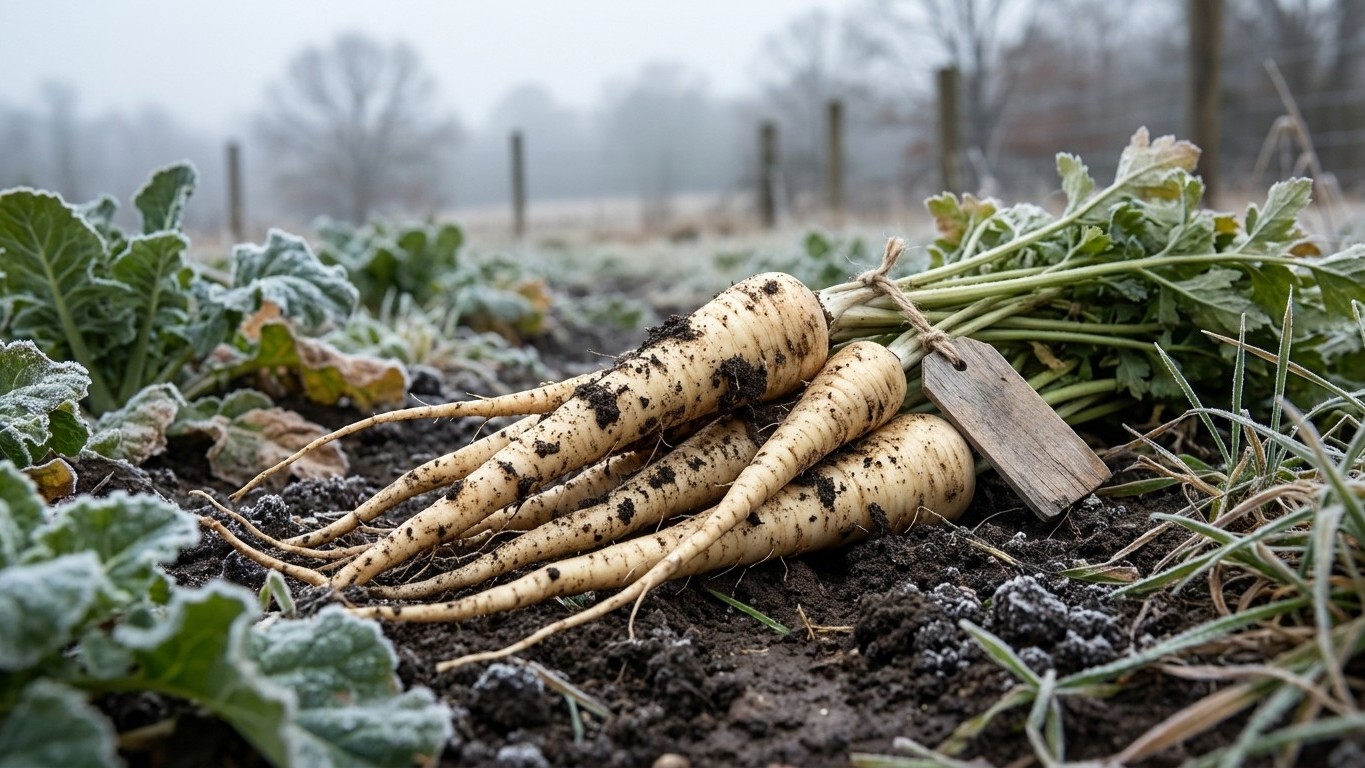

Yes, if you leave the roots in the ground long enough. Wilmington’s climate data puts the coldest month’s average nightly low at 25.6°F, cold enough for the frosty stretch parsnips need to convert stored starch into sugar. Delaware’s growing season also runs long enough to cover the 100 to 120 days parsnips take to mature. The catch isn’t sweetness, it’s timing: pull the roots too early, before frost has had weeks to work on them, and you’ll get a fine parsnip that never turns sweet.
The short answer
The question that actually decides this isn’t “how cold does it get on the worst night of the year,” it’s “does this place deliver several straight weeks of frosty weather.” A single hard freeze does almost nothing for a parsnip’s flavor. What triggers the starch-to-sugar conversion is sustained cold, the kind that sits on the ground for weeks and slowly stresses the root into converting its stored starch into sugar. That’s a frost exposure question, not a hardiness zone question, and the two get confused constantly.
Wilmington’s 1991-2020 climate normals, drawn from NOAA’s reference station data, put the mean daily minimum temperature for the coldest month at 25.6°F. That’s not a record low and it’s not a monthly average, it’s the typical low temperature on a typical night during the coldest stretch of the year. A number that far below freezing, repeated night after night across the coldest month, is exactly the sustained cold that parsnips need. It’s not a marginal case where you’re hoping for a lucky cold snap. It’s a climate that reliably delivers weeks of frost.
So the plant itself has no trouble growing here. Delaware’s soil and season support root development just fine, and that part of the equation was never really in doubt. The open question was always whether the state’s winters run cold enough, for long enough, to finish the job the growing season starts. With a coldest-month average low sitting nearly seven degrees under freezing, the answer leans clearly toward yes. This is a climate built for the second half of the parsnip’s story, the part that happens after the leaves have died back and the root sits quietly underground gathering sweetness from the cold.
None of this means every parsnip pulled from a Delaware garden will taste sweet. A root harvested in September, before frost has had time to do its work, will taste the same as one grown in a warm-winter state where sweetening barely happens at all. The climate here supports sweetening. Whether any individual crop actually sweetens comes down to when the gardener decides to dig.
Does the season fit?
- Start with the frost window. The reference data for the Wilmington station shows a last spring frost falling between April 3 and April 14, and a first fall frost between October 26 and November 7. Those dates come from airport weather station records, and suburban and rural gardens across the state typically see a later last frost and an earlier first frost, sometimes by one to two weeks, more at higher elevation. Check your own county before locking in a sowing date.
- Work backward to the sowing date. Parsnip seed goes in the ground 2 to 3 weeks before the last spring frost, sown directly where the roots will grow, since parsnips don’t transplant well. Against an April 3-14 frost window, that puts sowing somewhere in the second half of March for most Delaware gardens, a bit later for spots that historically frost longer into spring.
- Add the germination lag. Parsnip seed is slow. Expect 14 to 21 days before anything visible pushes through the soil. A late-March sowing might not show seedlings until mid-April, and that’s normal. Digging up the bed at day ten because nothing has sprouted just disturbs seed that hasn’t finished germinating yet.
- Count the 100 to 120 days from seeding, not from germination. That maturity clock starts the day the seed goes into the ground. A sowing in the second half of March puts full root maturity somewhere between late June and mid-July.
- Compare that against the fall frost date. Root maturity in late June or July leaves roughly three to four months of buffer before the first fall frost lands between October 26 and November 7. That’s a wide, comfortable margin, not a tight squeeze.
- Use that margin on purpose. Because parsnips hold well in cold soil, that extra buffer isn’t wasted time. It’s the window where the roots sit through repeated frosts and actually sweeten, so there’s no rush to harvest the moment they hit maturity size.
Put plainly, Delaware’s season fits this crop comfortably. The frost-free stretch is long enough to mature the roots well before winter, and the fall frost window arrives with enough lead time that gardeners can let the crop linger in the ground rather than racing a closing season.
What goes wrong here
- Forked roots from heavy or stony ground. Parsnips send a single taproot straight down, and anything solid in its path, compacted clay, buried rocks, an old root mass, splits that root into forks. Utah State University Extension recommends deep sandy soil for this crop, and where the native ground is heavy, double digging the bed to break up compaction well below the seed line before sowing.
- Forked roots from overwatering. This is a separate cause from heavy soil, and the two get lumped together too often. Excess water, even in loose ground, can push a taproot to split or branch as it searches for oxygen. Keep moisture even rather than heavy, watering enough to prevent drying out without saturating the bed.
- A season that runs out. This is less of a risk in Delaware given the wide margin between root maturity and first frost, but it still happens when sowing gets delayed well past the recommended window. Sowing in May instead of late March eats into that buffer fast, and a late-planted crop can still be immature when the first frost hits.
- Roots pulled before the cold has done its work. Delaware’s winters are cold enough to sweeten parsnips, but that only happens if the roots stay in the ground through several weeks of frosty weather. Harvesting in early fall, right after the roots reach size, skips the part of the process that actually builds sugar. Leave them in place, mulch if you want easier digging once the ground firms up, and harvest well after repeated frosts rather than at the first sign of maturity.
Common questions
Do parsnips need to be replanted each year to sweeten? No. Parsnips are grown as an annual crop from seed sown directly in place, and the sweetening happens to that same season’s root while it sits in the ground through fall frosts, not across multiple years.
Can I sow parsnip seed indoors and transplant it? Parsnips are sown directly where they’ll grow because the long taproot doesn’t handle transplanting well. Starting seed indoors and moving seedlings tends to produce the same forking problems as disturbed or rocky soil.
What if my parsnip seedlings haven’t emerged after two weeks? That’s normal. Germination takes 14 to 21 days, and parsnip seed is notoriously slow and sometimes uneven. Wait out the full window before assuming the sowing failed.
Does mulching help before harvest? Mulch doesn’t add sweetness, but it can keep the ground workable once the surrounding soil starts to freeze, making it easier to dig roots that are being left in place to sweeten through the frosty weeks.