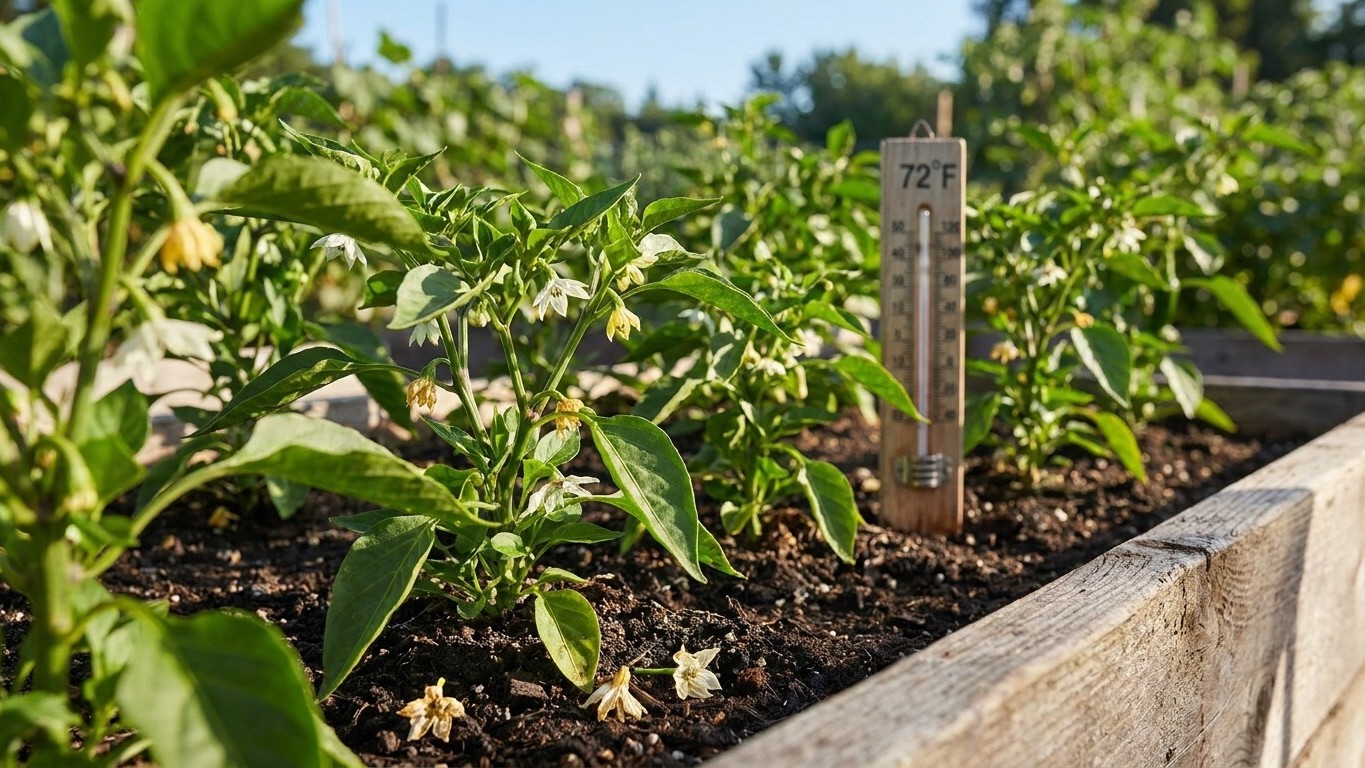

Start pepper seed indoors in Delaware from mid-February to early March, counting back 8 to 10 weeks from a transplant date in mid-to-late April, once soil hits 60 F and frost risk has passed. Delaware’s 17.6 days a year at or above 90 F push fruit set toward the hot-end failure more than the cold one, but nighttime lows still need watching on your own thermometer.
The short answer
Wilmington’s climate record puts the state at 17.6 days a year reaching 90 F or higher. That’s not a freak heat wave here and there, it’s close to two and a half weeks scattered across a typical summer, usually clustered in July and into August. For pepper plants, that stretch of heat matters more than the average temperature of the season, because pepper flowers can abort when daytime highs push past 90 F. A plant loaded with blossoms in mid-July can simply stop setting fruit for a week or two while the heat sits on the garden, then pick back up once temperatures ease.
That’s one edge of the problem. The other edge is cold, and it works in the opposite direction. Pepper fruit set also fails when nights drop below 55 F, which is a threat mostly at the start and tail end of the season rather than in the middle of summer. A transplant set out too early can sit through a stretch of 40-degree nights in April and simply refuse to flower properly even once the calendar says summer, because the plant’s early hormonal signals got scrambled by that cold snap.
Here’s the catch for Delaware gardeners: this site tracks days at or above 90 F for every state, because that figure comes from a published climate normal at a specific station. Summer night minimums don’t have that same kind of consistent public dataset at the county level, so no reliable number exists here to hand you. That means the cold-end risk isn’t something to guess from your latitude or from how cold January gets. Coastal Sussex County nights behave differently than nights inland in Kent or up near Wilmington, and elevation, tree cover and even how close you are to a paved lot all shift the number a few degrees. The only real fix is a thermometer in your own garden bed during the weeks after transplant, tracked for a season or two, so you know what your specific yard tends to do on a clear, calm night in late April or early May.
When to start seed here
The math is simple once you have your own transplant date locked in, and it works the same way whether you garden in Wilmington or Georgetown. Here’s how to build it out step by step.
- Find your last spring frost window. At the Wilmington airport station, the 32 F freeze probability puts the last spring frost between April 3 and April 14, based on NOAA’s 1991-2020 climate normals. That’s the reference-station number, not a statewide guarantee, and it comes from an open-field weather station instrument, not a shaded yard.
- Push that date later for a real garden. Suburban and rural gardens typically see their last frost land one to two weeks after the airport figure, and more if you’re at elevation or in a low-lying frost pocket. A garden outside Newark or Dover should plan on a window closer to mid-to-late April before frost risk clears.
- Wait for 60 F soil, not just frost clearance. Pepper transplants need soil at 60 F to take hold and grow, according to Utah State University Extension. Air temperature can feel warm on a sunny April afternoon while the soil six inches down is still cold from winter, so a soil thermometer pushed into the bed is worth more than a calendar guess.
- Land on a realistic transplant date. Combining frost clearance with soil warm-up, most Delaware gardens reach safe transplant conditions somewhere in the second half of April into early May, later near the coast where cool ocean air can slow soil warming, earlier in protected inland spots with sandy, fast-draining soil.
- Count back 8 to 10 weeks from that transplant date. If you’re aiming for a late-April transplant, that puts your seed-starting window in mid-to-late February. If your yard runs closer to an early-May transplant, back that up and you land in the first week of March.
- Adjust for your own county each year. Frost dates and soil warm-up shift year to year with weather patterns, so treat this arithmetic as a starting framework to recheck each spring rather than a fixed date to circle once and forget.
What goes wrong here
- Blossom drop during a July heat spell. Once daytime highs push past 90 F, which happens on average 17.6 days a year around Wilmington and likely more in a hot stretch further inland, flowers can drop before they set fruit. There’s no way to stop the heat, but afternoon shade cloth over the row and consistent deep watering reduce the stress that makes drop worse, and a plant that’s otherwise healthy will usually resume setting fruit once temperatures ease back below 90 F.
- Blossom drop from a cold snap at the other end of the season. Nights below 55 F, whether early in spring right after transplant or in a cool stretch in early fall, can stall flowering the same way heat does. Since summer night minimums aren’t published here at the county level, track your own garden with a min-max thermometer for a season so you know when your nights typically clear 55 F in spring and when they start dropping back below it in fall.
- Sunscald on fruit exposed to strong afternoon sun. Delaware summers deliver enough direct sun that fruit on a lightly leafed plant can develop pale, papery patches on the side facing the afternoon sun. Keep the plant’s own foliage as full cover rather than pruning it hard, and avoid ripping out nearby companion plants that were casting partial shade on the pepper bed.
- Blossom-end rot showing up as a dark, sunken patch on the fruit’s bottom. This isn’t a disease, it’s a calcium delivery problem usually triggered by uneven watering, a dry stretch followed by a heavy soak, or roots that can’t take up calcium fast enough during a hot spell. Keep soil moisture steady with mulch and a regular watering schedule rather than letting the bed swing between bone-dry and soaked, especially through those 90-plus-degree days.
Common questions
Can I direct-sow pepper seed outdoors in Delaware instead of starting indoors?
Direct-sowing is possible in theory, but Delaware’s transplant window already lands in the second half of April at the earliest, and pepper seed germinates slowly in cool soil. Starting indoors 8 to 10 weeks ahead gives the plant enough size and root development to make real use of the state’s growing season before nights turn cool again in fall.
How do I know when my own soil actually hits 60 F?
A simple soil thermometer, pushed 4 to 6 inches into the bed in the morning before the sun heats the surface, gives the most reliable reading. Air temperature and even a calendar date can both be misleading, since sandy soil near the coast warms differently than heavier inland soil.
Does the 35 to 45 days some sources mention for pepper fruit count from seeding?
No. That window runs from flowering, not from the day you sow seed or the day you transplant. It’s the stretch a fruit needs to develop and mature once a flower has actually set, which is a separate clock from the seed-starting timeline covered above.
What if a late-April frost hits my Delaware garden after I’ve already transplanted?
Cover transplants overnight with a lightweight cloth or bucket rather than leaving them exposed, since Delaware’s reference frost window of April 3 to April 14 is measured at an airport station and many yards, particularly in low-lying or rural spots, see frost linger later. Keep row cover on hand through the first half of May as a buffer against exactly this kind of late setback.