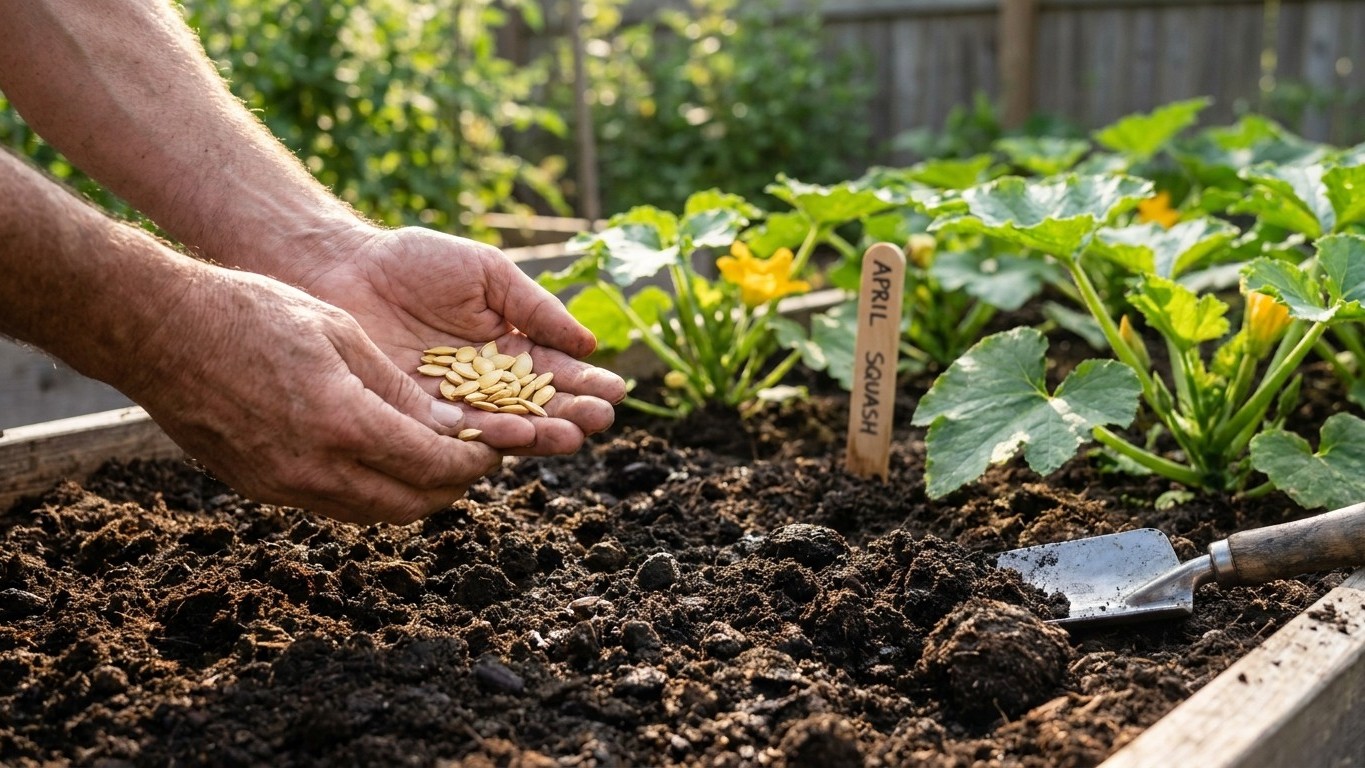

Florida’s answer depends entirely on where in the state you’re standing. In Jacksonville and the rest of the north, summer squash goes in after the last spring frost, typically February 16 to March 7. In central and south Florida, there’s effectively no frost to wait out, and the whole calendar flips: winter becomes the main growing season, and summer turns into the season to avoid.
The short answer for Florida
The frost data this page relies on comes from NOAA’s 1991-2020 Climate Normals at station USW00013889, the Jacksonville reference site. That gives a last spring frost window of February 16 to March 7, and a first fall frost window of November 26 to December 13. Those dates are not a promise. They mark the 30-70% probability band for a 32°F freeze, meaning there’s a real chance of frost on either side of that window, not a hard line you can plant against with total confidence.
For a gardener in Jacksonville or anywhere in that northern strip of the state, the practical move is to sow summer squash directly in the ground once the soil has warmed past that early-March mark, and plan a second round in mid-to-late summer for a fall crop that finishes before the November-into-December frost arrives. Squash is fast, usually 40 to 55 days from seed to first harvest, so there’s room for two full plantings inside that frost-free stretch.
South and central Florida don’t get to use this window at all. The frost dates above come from an inland site north of most of the peninsula, and three of the thirty years in that data set saw no measurable freeze whatsoever at that station. Push further south, into Orlando’s latitude or beyond, and frost stops being a planning factor. The growing calendar for summer squash there runs opposite to the northern pattern: fall through early spring is prime planting time, and the plants that would thrive in a Jacksonville June are the ones struggling by July in Tampa or Fort Myers.
This page doesn’t have county-level or south Florida frost data to offer, and it would be a disservice to borrow the north Florida window and apply it to Naples or Miami. The honest answer for the southern two-thirds of the state is: check the section below on your local extension office, because the frost-based math here simply doesn’t transfer.
What will not work here
Heat load is the real adversary in Florida, more than frost ever is once the calendar clears February. The Jacksonville reference station logs 73.2 days a year at or above 90°F. That’s not an average summer temperature, it’s a count of how many days the thermometer crosses a threshold where squash blossoms start dropping instead of setting fruit, where squash vine borer and squash bug populations explode, and where a plant that looked fine in May is fried by late July. Trying to run a single long summer planting straight through that stretch, the way a gardener in Ohio or Michigan might, is a losing bet in most of Florida.
Rainfall compounds the problem instead of solving it. Summer here isn’t dry, it’s wet and hot at the same time. Between June and August the reference station sees about 21.2 inches of rain, with June the wettest month at 7.6 inches and July the driest of the three at 6.77 inches. That combination of heavy afternoon downpours and near-constant heat is exactly what fungal disease needs. Powdery mildew and downy mildew spread fast when leaves stay wet and nights stay warm, and any planting scheme that crowds squash plants close together to save space is asking for a mildew outbreak by mid-summer. Wide spacing and good airflow matter more here than in a drier climate, because the rain isn’t the risk on its own, it’s rain sitting on foliage that never fully dries between storms.
A slow-maturing summer squash variety is also a poor match for this state. With a frost-free window in the north that’s real but not enormous, and a heat window in the south that shuts things down by early summer, a variety that needs 65 or 70 days to first harvest eats into the margin on both ends. Faster varieties that finish in the 40s give a gardener two full plantings where a slower one only allows for one, and finish before the worst of the heat load or the fall frost risk sets in.
What changes across Florida
USDA hardiness zones across Florida run from 8b to 11b, one of the widest spans of any state in the country. That range is built on a single measurement, the average annual extreme minimum temperature, and it stretches from the Panhandle and north Florida interior down through the frost-free tip of the peninsula. A range that wide means there is no single planting date that works for the whole state, and this page won’t pretend otherwise.
The frost data cited above comes from the Jacksonville area, which sits toward the cooler end of that zone range. A reader gardening near that latitude can use the spring and fall frost windows fairly directly. Move south into the 9b to 10a zones around Orlando and Tampa, and frost becomes rare enough that it’s barely worth planning around at all. Push into the 10b to 11b zones toward Miami and the Keys, and frost is effectively absent from the calculation entirely.
What actually shifts as a reader moves south isn’t just the frost risk, it’s which season is the growing season. North Florida still has something resembling a spring-into-fall vegetable calendar, bookended by real frost dates. Central and south Florida invert that: winter, when the punishing heat and the heaviest rain both ease off, becomes the reliable window for summer squash, while the hot months become the season to sit out or fight through with extra shade and water.
None of this tells an individual reader which zone their own yard falls into, and it shouldn’t try to. The USDA Plant Hardiness Zone Map is built precisely for that lookup, using an address or ZIP code to place a garden inside the correct band. Given how much distance separates 8b from 11b inside one state’s borders, checking that map is a more reliable first step than assuming a statewide date applies locally.
Where to check this for your own county
Florida’s extension service, delivered through UF/IFAS, publishes county-level guidance at sfyl.ifas.ufl.edu. That’s the address to use, not a guess at a county subdomain or a search engine’s best match. Each county office under that system tailors its planting calendar to local soil, local rainfall patterns and local frost risk in a way a statewide page like this one simply can’t.
Once there, two things are worth hunting down specifically. The first is the local planting calendar itself, which will break the year into planting windows for vegetables by region rather than by a single statewide date, and will usually flag whether a county falls into the frost-affected north or the frost-free south. The second is the list of summer squash varieties that have actually been trialled in that county’s growing conditions. Extension offices run variety trials precisely because a squash that performs well in the sandy soils and heat of one county can underperform in the heavier soils or slightly cooler nights of another, even within the same state.
A county recommendation will always beat a state one, because it accounts for local soil type, local disease pressure and local rainfall patterns that a statewide page has to generalize away. This page has done that generalizing on purpose, laying out the broad frost data, the heat load, and the rainfall pattern that shape summer squash growing across Florida as a whole. The finer-grained answer, the one that says exactly which week to plant in a specific county and which variety has actually done well there, lives with the local extension office and nowhere else.
Checking this against your own garden
Every date on this page is a regional average built from three decades of weather records, and every one of them can be overridden by what’s actually happening in a specific yard. Three signs are worth checking before trusting a calendar date over what the garden itself is showing.
Soil warmth by feel is the first and simplest check. Summer squash seed sits and sulks in cold soil rather than germinating well, so pushing a finger a couple of inches into the planting bed and feeling for warmth that’s held steady for several days in a row is a better signal than a calendar date, especially in a state where a sandy, south-facing bed can warm noticeably faster than a shaded or heavier-soiled one nearby.
The first flush of male flowers is the second thing to watch. Squash plants typically send out a wave of male blossoms before the female flowers that actually set fruit appear, and seeing that first round shows the plant has moved past establishment and into active growth, a useful confirmation that the timing worked for that particular spot.
The first true leaves, the ones that show the plant’s actual leaf shape rather than the rounded seed leaves it started with, mark the point where a seedling has shifted from surviving to growing. Seeing them appear quickly and vigorously after germination is a sign the local microclimate, not just the regional average, is cooperating. Seeing them stall or yellow is a sign worth acting on faster than any date on a calendar would suggest.