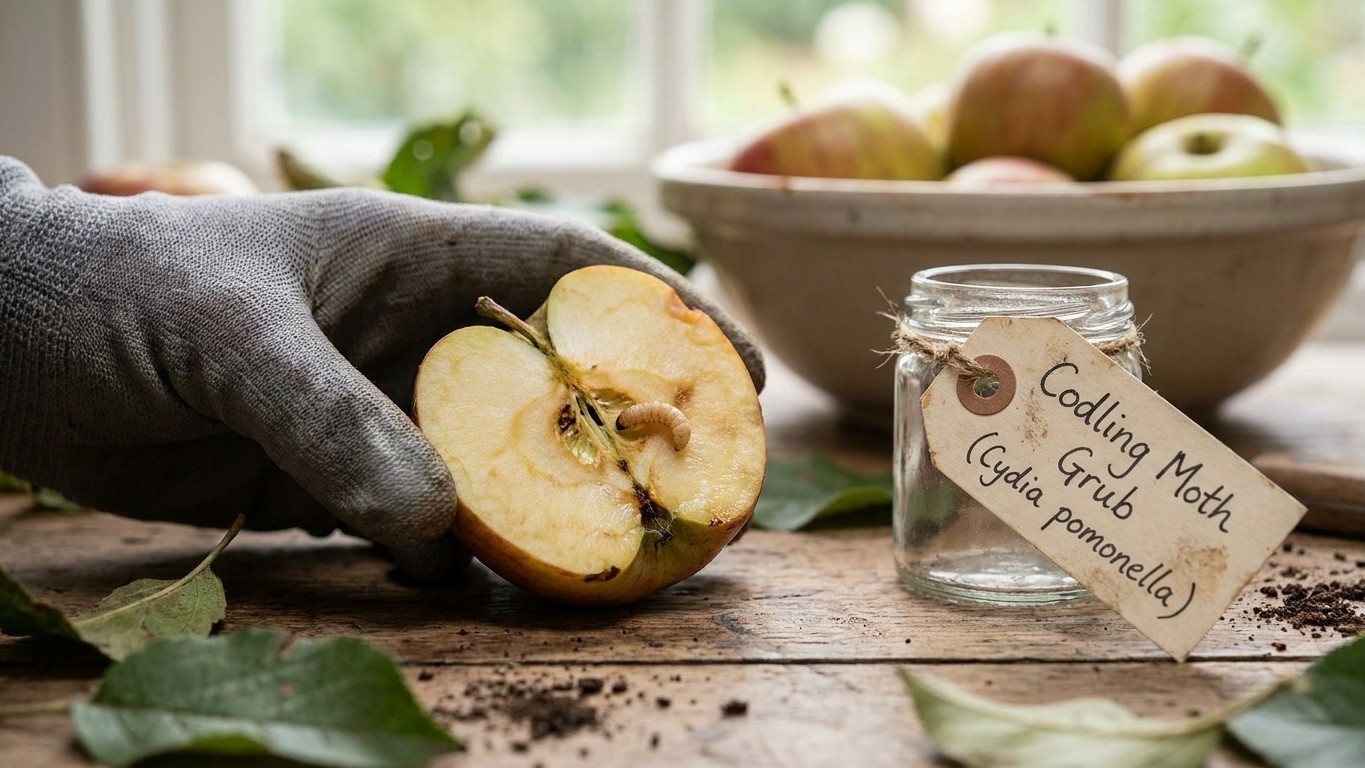

The grub inside an apple is the larva of the codling moth, a pinkish-white caterpillar with a brown head that tunnels straight from a frass-plugged hole in the skin to the core. It is the single most common reason a home-grown apple looks fine outside and rotten inside. Cut open any apple showing a small hole with reddish-brown crumbs at the surface before you decide whether the rest of the crop is worth saving.
The damage it leaves

On the fruit
The first sign is usually a small, dark hole in the side of the apple, often near the stem end or wherever two fruits touch, plugged with a crumbly reddish-brown mass. That plug is frass, the caterpillar’s chewed pulp and droppings pushed back out of the tunnel behind it. Cut into the fruit at that spot and the tunnel runs straight for the core, not looping around through the flesh the way some other pests’ trails do.
Inside, the apple looks worse than the skin suggests. The core is often hollowed out around the seeds, with a wet, brown mass where the larva fed and where secondary rot has already set in behind it. A single caterpillar can ruin a fruit that looked nearly perfect from the outside, which is why checking only for surface blemishes misses this pest until the apple is sliced open at the table. Occasionally a second, cleaner, rounder hole shows up elsewhere on the same apple. That is the exit hole the larva chewed on its way out to pupate, and it looks nothing like the ragged, frass-packed entry.
On the tree
Fruit that is heavily tunneled tends to drop before it should. A tree shedding apples weeks ahead of normal ripening is worth checking fruit by fruit rather than blaming June drop or weather.
On the trunk and scaffold limbs, especially where bark is rough or peeling, look for flat, silken cocoons tucked into bark crevices or under loose flakes. These are pupation sites, easy to miss unless you run a thumbnail under loose bark on purpose, and finding them confirms a tree carried an infestation the previous season even when the current crop looks clean so far.
Making sure it is this one
Cut it open
Cut the suspect apple in half through the core rather than just paring the skin. A codling moth tunnel is wide enough to see without a magnifier and runs directly to the seed cavity, loosely packed with frass along the way. Apple maggot leaves a very different mark: fine, winding brown trails threaded through the flesh with no single wide tunnel and no frass plug at the surface, covered in more detail on our page about apple maggot. If what you find is a caterpillar rather than a legless maggot, with a brown head capsule and a body running pinkish-white to cream and up to about three-quarters of an inch long, that settles it on its own.
Where the damage sits on the fruit also tells the two apart. Codling moth almost always enters at the stem end, the blossom end, or wherever two apples or an apple and a leaf touch and give a newly hatched larva cover while it chews in. Apple maggot instead leaves shallow dimples scattered anywhere over the skin, since the adult fly stings the surface at random rather than seeking a hidden crevice.
Hang a trap
A hanging trap removes the guesswork before more fruit is damaged. A delta-shaped cardboard trap baited with a codling moth pheromone lure, hung in the canopy at the pink stage just before bloom opens, catches male moths flying in to find a mate. A trap catching moths week after week means the population is active in that yard, and any control measures should shift earlier rather than later.
Checking several apples from different parts of the canopy is worth the extra few minutes, since a light infestation can sit in fruit closest to the trunk while apples on the outer limbs still look clean.
When it attacks
From pink stage through petal fall
Codling moth times its whole life cycle to the tree, not to the calendar. Adults that overwintered as pupae in bark crevices and leaf litter emerge and start flying around the pink stage, when flower buds show color but have not yet opened, and mating and egg-laying continue through bloom and into petal fall. Eggs are laid singly on leaves near a fruit spur or directly on the young fruit itself.
The larva that hatches does the damage. It bores into the nearest apple within a short window of hatching, usually while the fruit is still small, feeds inside for several weeks, then tunnels back out to pupate, either in bark crevices on the same tree or in the litter beneath it. Scouting by stage rather than date matters most in an early or late spring, since a tree at petal fall is at the same biological point whether that stage lands two weeks earlier or later than the year before.
How many generations
How many generations complete in a season depends on the length and warmth of the growing season, and that varies enough from one region to the next that it is worth checking with a local extension service rather than assuming a fixed number. In shorter or cooler seasons a single generation may be all the tree sees. In longer, warmer seasons a second brood, sometimes a partial third, attacks fruit again in late summer, well after the first round of damage has already dropped or been culled.
This is why a single spring trap catch does not mean the season is over. A trap that goes quiet after the first flight and then picks up moths again several weeks later is showing the start of a second generation, and any protective measures need to restart on that timing rather than staying on a spring-only schedule.
What to do about it
Traps and barriers
Traps do double duty. They tell you when moths are flying, and a heavy catch is the signal to add a physical barrier before more eggs get laid. Four tactics work together rather than replacing each other:
- Pheromone trap, hung by the pink stage and checked weekly, gives the earliest warning of a flight starting.
- Cardboard trunk bands, corrugated cardboard wrapped around the trunk and lower limbs, catch larvae looking for a place to pupate.
- Individual fruit bags, paper or mesh, tied on while apples are still small, block a newly hatched larva from ever reaching the skin.
- Daily fruit pickup, since a larva that finishes feeding inside a dropped apple simply crawls off to pupate rather than dying with the fruit.
Trunk bands need checking and destroying every week or two through the season, not once at the end, since larvae keep arriving as long as moths keep flying. Bagging is slow work on a full-size tree but manageable on a handful of prize apples, and it needs no spray timing at all to work.
Tree size and rootstock
Tree size affects how practical the rest of this is. A tree on MM.111 or seedling rootstock, which USU Extension lists at 30 to 40 feet at maturity, puts most of the canopy out of reach for thorough trap placement, banding or bagging. A tree kept on a dwarfing rootstock such as M.9 (8-12 feet) or M.26 (12-15 feet), from the same USU figures, stays small enough for a home grower to check every fruit and every band without a ladder.
Sanitation and physical barriers only go so far once a population is established, and that is where most home orchards eventually look at a spray program. Rates, timing windows and which active ingredients are labeled for home use vary by state, so check with a local extension service before treating, the same office that can help sort codling moth out from the wider run of apple pests a backyard tree can carry.
Keeping it out next year
Winter cleanup
Winter is when this pest is easiest to disrupt, because it is sitting still. Scrape loose, flaking bark off the trunk and main limbs during dormancy, before green tip, to expose and destroy the flat silken cocoons tucked underneath. The same scraping also clears out shelter used by woolly apple aphid, so it earns its time twice over.
Clean up every dropped and mummified fruit left under the tree, not just what fell this year. Mummies clinging to branches and rotting fruit lying in the grass both give larvae a place to finish feeding and pupate close to the trunk they will climb back up next spring.
Through the season
Trunk bands are not only an in-season tool. Leaving one on through late summer and fall catches the generation looking for a winter pupation site, and pulling it off and destroying it before spring keeps that catch from simply overwintering in the band itself.
Keeping a cleared ring of bare or mown ground around the base of the trunk through the dormant season, rather than letting turf or mulch run right up to the bark, makes bark-scraping and band-checking easier to do thoroughly. None of this makes a tree permanently immune. Moths can fly in from a neighboring untreated tree or an abandoned apple along the fence line, so the same checks, trap, bands, bark and cleanup, are worth repeating every year rather than only after a season with visible damage.
Common questions
Can I still eat an apple with a worm hole in it?
You can cut around the tunnel and eat the rest of the apple, but check the flesh near the hole for rot first, since the entry point often lets in decay that spreads well past where the larva actually fed. Apples going into storage should be sorted out entirely, since even a small tunnel gives rot organisms a way in that keeps spreading in the bin.
Does codling moth attack pears the same way?
Codling moth can attack pears as well as apples, since the larva is not picky about which pome fruit is nearby when it hatches. The same tunnel-to-the-core symptom and the same frass plug at the entry hole apply, so the check described above works on either fruit.
If I find one wormy apple, does that mean the whole tree is infested?
Not necessarily. A single fruit can be hit by one wandering larva without the rest of the crop being touched, especially early in a season with a light first flight. Checking a spread of fruit from different parts of the canopy, rather than judging the whole tree from one apple, gives a more honest picture before deciding whether to add traps or bands.
Is it too late to do anything once I see the frass hole?
For that particular apple, yes. Once a larva is established inside, cutting the fruit out and disposing of it away from the tree is about the only thing that helps that fruit. For the rest of the crop it is not too late at all, since trapping, banding and cleanup all target the moths and larvae that have not yet gotten into a fruit.