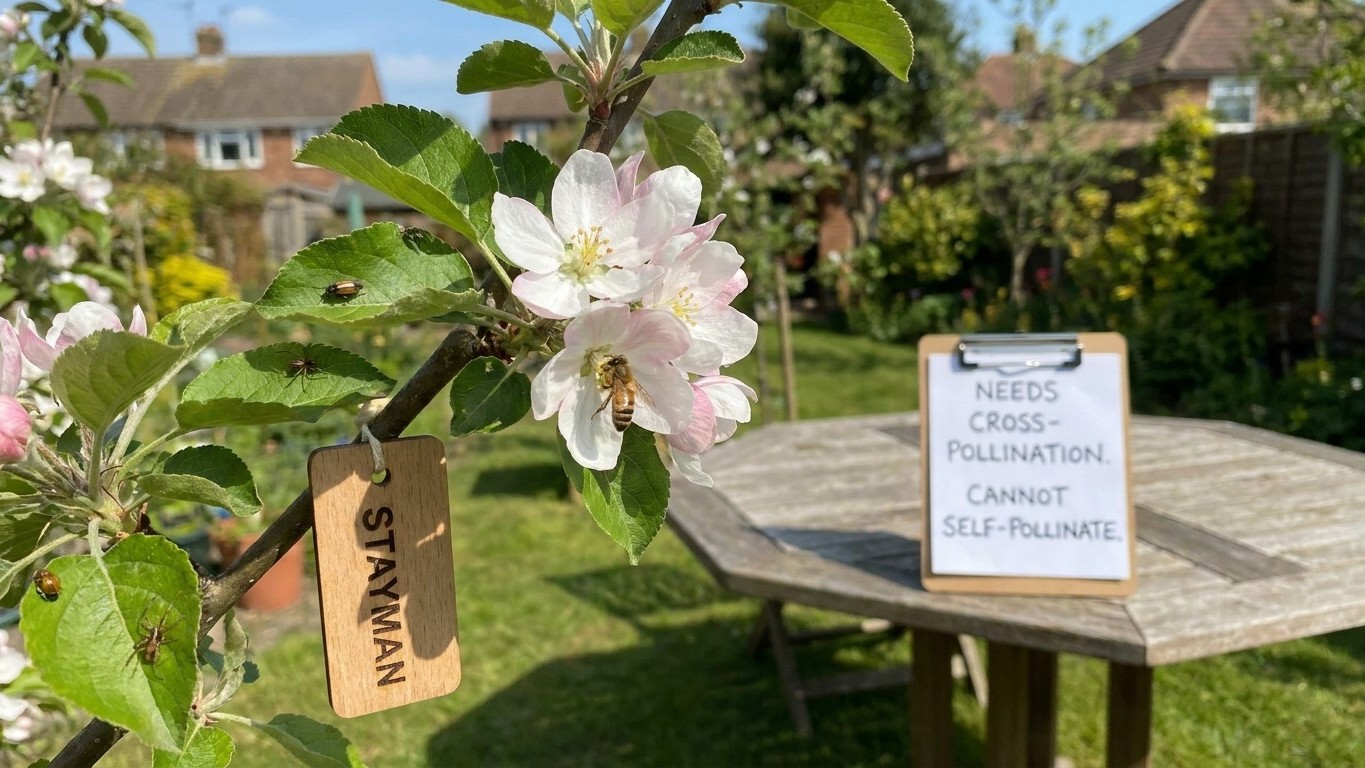

Stayman’s flowers open readily but its pollen is sterile, according to Clemson Cooperative Extension’s HGIC 1350 and the University of Georgia’s C740 apple guide, so it cannot pollinate itself or anything else. Arkansas Black, Golden Delicious, Ozark Gold, Priscilla and Rome Beauty all bloom close enough to Stayman to serve as pollen donors. Plant one of those five within bee range of your Stayman, and plant a third variety near that donor tree so it, too, gets pollinated.
The short answer
The five compatible varieties
Your Stayman won’t set fruit on its own — its pollen doesn’t work, so it needs a neighbor. Plant Arkansas Black, Golden Delicious, Ozark Gold, Priscilla, or Rome Beauty nearby, any one of the five will do, and let bees handle the rest. Just know that neighbor tree will need its own pollen partner too, or you’ll end up short a step later. Check bloom timing before you dig.
Why the count is three trees, not two
What Stayman cannot do is return the favor. Its pollen is sterile, per HGIC 1350 and the University of Georgia’s C740 publication, so a Stayman tree standing next to a Golden Delicious does nothing for that Golden Delicious’s own fruit set. Golden Delicious still needs a fertile neighbor of its own to crop well. That means a garden built around Stayman needs three trees, not two: Stayman itself, one of the five varieties above to pollinate it, and a third fertile variety to pollinate that second tree in turn, unless the second tree already has another fertile neighbor in bee range, such as a crabapple or a tree in a neighboring yard.
This is the detail that trips up a lot of small-garden planting plans. Two trees that both flower in the right window can still add up to no apples at all, if neither one produces pollen that actually works. The fix costs one more planting hole, not one more season of guessing: choose any two of the five named varieties, or one of them plus a fertile tree already growing nearby, and Stayman is covered along with its neighbor. For a wider look at how this plays out across other varieties, Apple Pollination covers the general rule that nearly all varieties crop better with a compatible partner.
Why these varieties and not others

Clemson Cooperative Extension places Stayman in bloom group C, one of several groups extension services use to rank apple varieties by the order they flower in, from earliest to latest, in a given spring. Arkansas Black, Golden Delicious, Ozark Gold, Priscilla and Rome Beauty all fall close enough to that group that their bloom overlaps Stayman’s in most years. That overlap, not anything else about the varieties, is what makes cross-pollination physically possible. A bee has to carry pollen from an open flower on one tree to an open flower on the other while both are still receptive.
The group is an order, not a date
Bloom group C does not mean these trees flower on a fixed calendar date. It means Stayman flowers in the same relative position, midway through the local bloom sequence, whether that sequence runs through a Georgia spring or a Michigan one. The actual dates shift by weeks depending on climate and the particular year. What stays fixed is the order: an early-group variety still opens before Stayman, and a late-group variety still opens after, wherever you garden.
Sharing a bloom group is necessary but it is not, by itself, enough. Two varieties can flower in perfect sync and still set no fruit together if one of them cannot produce usable pollen, or if the two are too closely related for fertilization to work. Bloom group tells you the flowers will be open at the same time. It says nothing about whether the pollen those flowers carry actually does its job, and it says nothing about the parentage of either tree. Both have to be checked separately, which is why Stayman’s compatibility list names specific varieties rather than just a bloom group left for the reader to guess at.
What cannot pollinate it
Jonagold flowers at the same time as Stayman but cannot pollinate it. Jonagold’s own pollen is sterile, the same limitation Stayman has, so the two varieties look like a matched pair on a bloom chart and produce nothing together in the orchard. A grower who plants only a Stayman and a Jonagold, on the reasoning that both bloom in the same window, ends up with two trees full of flowers and no apples on either one come fall.
This is the trap that bloom-group charts alone do not warn you about. Overlapping bloom is a precondition for pollination, not a guarantee of it. Two sterile-pollen varieties can overlap perfectly and still fail completely, because sterile pollen does not become fertile just because the flower next to it is receptive. The fix is the same one that applies to Stayman on its own: at least one tree in the planting has to carry pollen that actually works, and with two sterile varieties, neither one qualifies.
What the published sources do not say
Neither Clemson’s HGIC 1350 nor the University of Georgia’s C740 lists a parentage exclusion for Stayman, the kind of rule that would rule out a variety bred directly from Stayman fertilizing its own parent. Compatibility beyond the five named varieties and the Jonagold exception is not published, and the honest move is to say so rather than guess at a name. If you are considering a variety not on either list, check with a county extension office or a nursery that carries known-compatible stock for your area before committing a planting hole to it.
How close the second tree has to be

Distance, and what carries pollen when there is no second tree
Apple pollen moves on the bodies of bees, not on the wind, so distance matters more than most new growers expect. The closer the pollinator tree, the more bee visits carry pollen between the two, and the more of Stayman’s blossoms actually get fertilized. Same garden beats same street, and same street beats a variety three properties over that a bee has no reason to visit on its way to your Stayman.
A dedicated second tree is not the only way to supply that pollen. Any of the following can do the job if it is flowering at the same time as Stayman:
- A neighbor’s Arkansas Black, Golden Delicious, Ozark Gold, Priscilla, or Rome Beauty, if bees regularly cross between the two properties
- An ornamental crabapple in bloom during the same window, which many home orchards already have for looks rather than fruit
- A branch of a compatible variety grafted onto Stayman’s own trunk, covered in the next section
What no amount of proximity fixes is bad weather during bloom. Bees fly little or not at all in cold, wet, or windy conditions, and a pollinator tree standing right next to Stayman does no good if the bees never leave the hive while both are flowering. A spring with a warm, dry bloom window and a mediocre pollinator planting will often out-produce a spring with poor bloom weather and a perfect planting. There is no substitute for the insects doing the work, so anything that keeps them active during bloom, avoiding insecticide sprays on open flowers being the most common mistake, matters as much as the planting layout itself.
If there is no room for a second tree
Four ways to fit a pollinator into a small garden
A small garden does not have to choose between an empty pollinator slot and no apples. Several options bring a compatible pollen source into a space that only has room for one trunk.
| Option | What it costs | What it does not solve |
|---|---|---|
| Multi-grafted tree (several varieties on one trunk) | Buying from a specialty nursery, or grafting it yourself over a season or two | Still needs bee activity during bloom, and the grafted varieties must actually overlap Stayman’s bloom window |
| Pollinator branch grafted onto the existing Stayman | A single graft, cheap, but takes a year or more to grow enough flowering wood to matter | Only helps once the graft is mature enough to bloom in quantity |
| Columnar apple variety planted alongside | A second planting hole, but a narrow one, often a foot or two wide | Still a separate tree with its own watering and feeding needs |
| Ornamental crabapple planted for bloom timing | One more planting hole, chosen for flowering rather than fruit | Produces no apples of its own worth harvesting |
The multi-grafted tree is the closest thing to a one-trunk fix, since it puts Stayman and a compatible donor like Rome Beauty on the same root system. A grafted pollinator branch on an existing tree is cheaper but slower, and it only starts paying off once it carries enough bloom to attract bees in real numbers. A columnar variety or a well-timed crabapple both work if there truly is no room for anything larger, but neither removes the need to check that its bloom actually lines up with Stayman’s in your own garden, not just on a catalogue chart. Growers weighing the same tradeoff for other varieties can compare notes with What Pollinates Fuji, and What Cannot and What Pollinates Suncrisp, and What Cannot, since both run into the same small-garden constraints.
Common questions
Will two Stayman trees pollinate each other?
No. Stayman’s pollen is sterile, so two Stayman trees planted together produce flowers but no fruit between them. You need a variety with fertile pollen in the mix, not a second Stayman.
Can a crabapple really substitute for a named pollinator variety?
Yes, as long as the crabapple is flowering at the same time as Stayman. Its own fruit is not the point. It only needs to supply bees with pollen that reaches Stayman’s open blossoms during the same window.
If I already have Jonagold, does adding a third tree fix the pair?
Yes. A third, fertile variety such as Rome Beauty or Golden Delicious will pollinate both Stayman and Jonagold, since both share the same problem of sterile pollen and neither can help the other on its own.
How do I check that my trees are actually blooming together, not just on the same chart?
Watch the flowers in your own garden each spring rather than relying on the bloom group alone. Bloom group C only sets the relative order, and actual dates shift with the weather that particular year, so the only reliable check is looking at the trees themselves during bloom.
Does the rootstock of the pollinator tree need to match Stayman’s?
No. Rootstock controls the mature size of a tree, not its compatibility as a pollen source. Choose the pollinator’s rootstock based on the space you have and how large you want that tree to grow, independent of what Stayman is grafted onto.