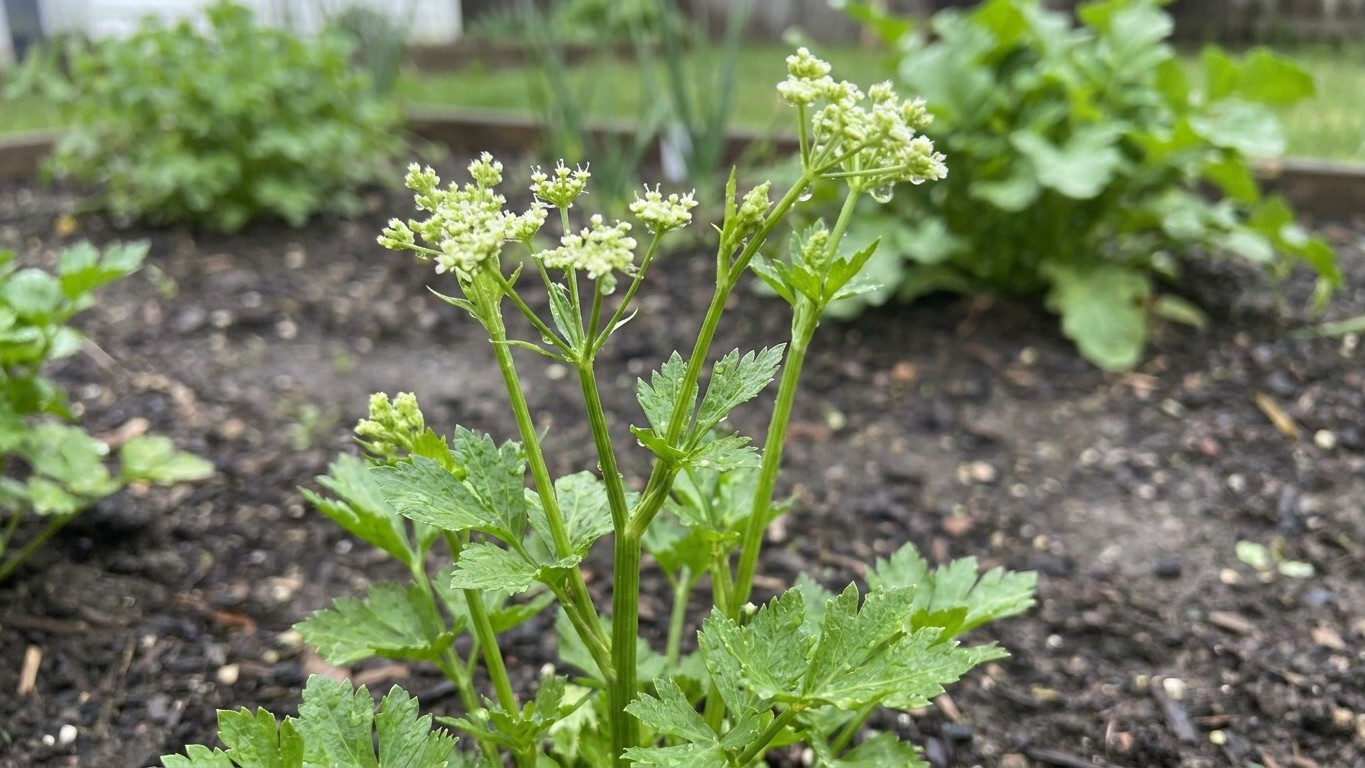

Celery bolts from cold, not heat. According to Utah State University Extension, exposing celery to several weeks of cool temperatures pushes the plant to flower early, ruining the crop before it ever forms usable stalks. That single fact reverses the usual gardening instinct: setting transplants out too soon is the real risk, not waiting a little longer. Celery’s temperature tolerance, together with its shallow, poor-foraging root system, explains nearly every rule that follows for planting, watering, and harvest.
The short answer
Celery bolts, meaning it sends up a flower stalk instead of building crisp petioles, when it spends several weeks exposed to cool temperatures. Utah State University Extension puts the minimum survivable temperature for celery at 36 F, but warns that if plants are exposed to cool temperatures for several weeks, they will flower. The plant’s ideal range sits well above that survival floor, between 55 and 65 F. That gap between “won’t die” and “will grow properly” is where most home celery crops go wrong.
The instinct with a cool-season crop is to get it in the ground early and let it toughen up in cold weather. Celery punishes that instinct. A stretch of chilly nights that a cabbage or kale plant shrugs off is exactly the kind of exposure that convinces celery it has already lived through a winter and needs to reproduce now, not spend the season building stalks. That is why timing the move from seed tray to garden bed matters more for celery than for almost any other cool-season vegetable.
Utah State University Extension recommends transplanting celery rather than direct-seeding it in the garden, and it sets a clear benchmark for when a seedling is actually ready: three to four mature leaves and a well-established root system. Getting a seedling to that point takes 9 to 13 weeks of indoor growth, according to the same source. Counting backward from your own last frost date, that means starting seed roughly two to three months before you intend to move plants outdoors, then judging readiness by leaf count and root development rather than by a date circled on the calendar.
Frost is a separate hazard from cold-induced bolting, and celery is described as very susceptible to both early and late-season frost. Utah State University Extension advises protecting young transplants with hot caps, plastic tunnels, or fabric row covers. Those covers do double duty: they guard against a frost event, and the extension’s own findings note that they stimulate early growth and produce bigger plants. The practical result is a narrow, protected window between “too cold for weeks” and “unprotected frost,” and celery needs help staying inside it on both ends.
What actually decides it
Two mechanisms run underneath almost every celery rule, and once you see them, the rest of the growing instructions stop feeling arbitrary.
The cold trap that causes bolting
A single cold night and several weeks of cool weather are not the same threat. Celery survives down to 36 F without dying, but sustained exposure at cool temperatures for an extended stretch reads to the plant as a completed winter, and it responds by shifting into reproduction: a flower stalk, not more petioles. This is the opposite of what a gardener growing a “cool-season crop” typically assumes. The mistake isn’t planting celery too late in the cool season; it’s planting it out early enough that it sits through weeks of marginal cold before the weather settles into celery’s actual comfort zone of 55 to 65 F.
Heat causes a different problem entirely, and a more forgiving one. Above 85 F, the plant doesn’t bolt, it stresses, and that stress shows up as fiber development and stringiness rather than as a ruined crop. Utah State University Extension’s remedy for heat stress is simply to water more frequently. There’s no equivalent quick fix for cold-triggered bolting once it starts. That asymmetry, an easy answer for heat and none for sustained cold, is the core reason timing the transplant matters so much more than protecting against a hot spell later on.
The shallow root system behind every other rule
Celery has a small, shallow root system and is a poor nutrient forager. That one physical fact, stated once by Utah State University Extension, is the reason behind three separate garden rules. Watering has to be frequent and thorough, at least 1 to 2 inches a week, because the roots can’t reach down for reserves the way a deeper-rooted vegetable can. Fertility has to be supplied directly into that shallow zone, since the plant cannot forage for what it needs, which is why a complete fertilizer with a high potassium ratio and scheduled nitrogen side-dressing matter more for celery than for many other vegetables. Weeding has to stay shallow, because celery’s own roots occupy that same thin top layer of soil, and deep cultivation damages the crop as easily as it removes competition.
How to do it
- Soak seed before sowing. Celery seed carries natural germination inhibitors. Soaking the seeds in water and changing that water every day helps leach the inhibitors away and leads to more even germination.
- Start indoors, counting back from your last frost date. Transplants need 9 to 13 weeks of indoor growth. Count backward from the date you expect your last frost to fall in your area, then start seed that many weeks ahead, roughly two to three months out.
- Grow until the transplant meets the benchmark, not the calendar. Wait for three to four mature leaves and a well-established root system before moving plants to the garden, regardless of how many weeks that takes.
- Move plants outdoors with frost protection in place. Because celery is very susceptible to early and late frosts, set out hot caps, plastic tunnels, or fabric row covers at transplanting. These also stimulate early growth and produce bigger plants.
- Space rows 2 feet apart and plants 12 inches apart within the row. A tight planting helps force tall growth and long petioles, which is the goal for stalk celery.
- Water 1 to 2 inches per week, soaking the soil thoroughly. The shallow root system can’t compensate for a dry gap between waterings the way deeper-rooted crops can.
- Side-dress with nitrogen at 4 and 8 weeks after transplanting. Apply 1/4 cup of 21-0-0 per 10 feet of row at each of those two points, alongside a complete fertilizer with a high potassium ratio such as 4-4-8.
- Cultivate shallow and often to control weeds. Celery’s slow growth and thin root system mean it competes poorly with weeds, but deep cultivation damages the roots it does have.
- Harvest outer petioles as they reach a foot or more in length. Take the outside stalks first and let the plant keep producing from the center; whole plants are ready when they measure 3 inches or more across.
What goes wrong
- Plants bolt instead of forming stalks. This happens after several weeks of cool temperature exposure, typically from transplanting too early. Once flowering starts, it cannot be reversed for that planting; the fix is timing the next batch to spend fewer weeks in marginal cold before conditions settle into the 55 to 65 F range.
- Seeds come up unevenly or barely at all. The cause sits inside the seed itself, natural germination inhibitors, not in watering or soil technique. Soaking seed and changing the water daily before sowing addresses this directly.
- Stalks turn stringy with a strong, harsh flavor. This is a permanent record of water stress that occurred weeks before harvest. There’s no fixing an already-stringy stalk; the only remedy is consistent watering, at least 1 to 2 inches a week with thorough soaking, going forward for the next crop.
- Harvested celery is tough, stringy, and bitter. Celery cut during hot, dry weather develops these traits. Watering more frequently once temperatures pass 85 F reduces the stress that causes it.
- Black discoloration appears in the center of the plant. Known as black heart, this injury happens gradually and isn’t visible until later in the season, which means it was set in motion long before it shows. It’s a localized calcium deficiency at the growing point, not a soil-wide shortage, caused when water stress prevents calcium from reaching the center. Calcium-rich fertilizer, bone meal, blood meal, or calcium sprays, along with avoiding water stress, minimizes it going forward.
- White powdery patches spread across the leaves. Starting on older leaves and moving to the rest of the plant, powdery mildew is best managed by choosing resistant varieties and watering in a way that lets leaves dry during the day rather than staying damp overnight.
- Leaves crinkle and curl. This points to aphids. Insecticidal soap or a strong stream of water dislodges them without resorting to broader chemical treatment.
Common questions
How many celery plants should I grow per person?
Utah State University Extension recommends planting 5 to 10 celery plants per person to cover both fresh eating and storage needs through the season.
How long does harvested celery keep?
Stored in the refrigerator, harvested celery holds for up to 2 weeks according to Utah State University Extension.
Which stalks taste best, and should they be cooked?
The inner stalks are the most tender and taste best eaten raw, while outer petioles, tougher by comparison, hold up better in cooked dishes.
Do I harvest the whole celery plant at once?
Not necessarily. Outer petioles can be removed individually once they reach a foot or more in length, letting the plant keep growing from the center. A whole plant is ready to harvest at once when it reaches 3 inches or more in diameter.