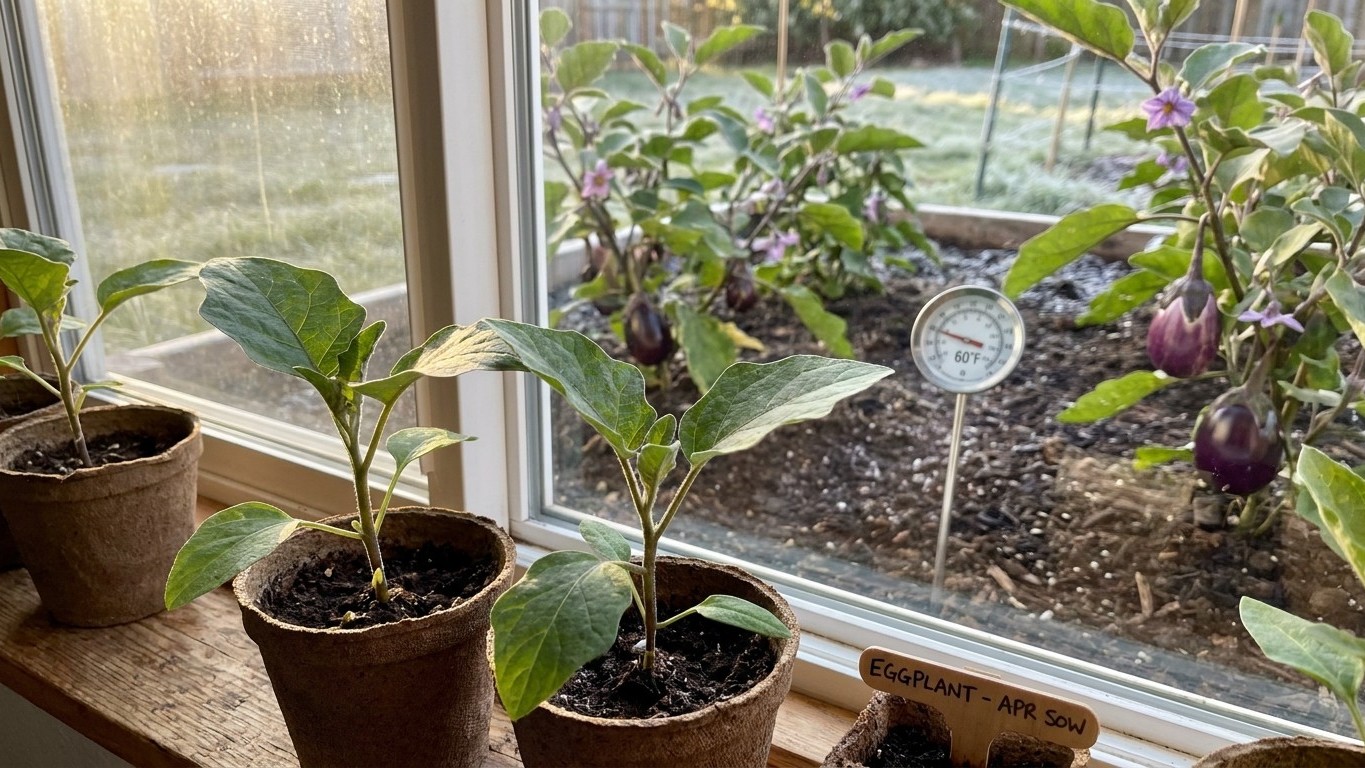

Eggplant seedlings that go out too soon rarely make up the ground they lose in the first few weeks. Utah State University Extension’s guide, Eggplant in the Garden, sets the transplant threshold at a soil temperature of 60 F or after all frost danger has passed, whichever lands later on your calendar. Miss that mark and the plant stalls, sometimes for the rest of the season.
The short answer
Start seed indoors 8 to 10 weeks before you intend to set plants in the garden. That’s the window Utah State University Extension gives for growing a transplant, and it’s counted in weeks, not by a calendar date, because the real trigger isn’t the season, it’s soil temperature. Eggplant goes into the ground only when soil reads 60 F or after all frost danger has passed for your area, whichever comes second. There’s no exception carved out for gardeners who want a jump on the season by setting plants out earlier.
That single rule explains why eggplant behaves so differently from the cool-season crops many gardeners grow alongside it. Cabbage and broccoli tolerate a chilly transplant and even benefit from an early start. Eggplant does the opposite. Utah State University Extension is blunt about it: eggplants are very sensitive to cool temperatures, full stop. Push the transplant date ahead of the soil hitting 60 F and you’re not saving time, you’re borrowing stress the plant will pay back later in stunted growth, delayed flowering, or fruit that never fills out properly.
The 8-to-10-week runway matters because it has to end at the right moment. Work backward from the date you expect your soil to reach 60 F and frost risk to have cleared, using your local frost-date records as the anchor point, then count 8 to 10 weeks earlier to find your seed-starting date. Start seed too early and you’re stuck holding an overgrown, root-bound transplant waiting on the weather. Start too late and the transplant goes in undersized, missing the leaf count and root development that Utah State University Extension says drives rapid establishment.
The two-temperature germination detail feeds directly into this timeline. Seeds germinate fastest at 80 F until the root emerges, then the flat moves to cooler air, 65-75 F, to grow out the seedling. Skip the cooldown and the plant grows leggy and soft rather than stocky. Skip the initial heat and germination drags, eating into the 8-to-10-week window you don’t have room to lose. The count only works if both temperature stages happen in the right order.
What actually decides it
The title’s warning about an early start isn’t about impatience, it’s about a chain of consequences that starts underground and ends at the fruit.
Cold soil stalls the roots before you see it
Eggplant roots simply don’t function well below 60 F. A transplant set into cold ground doesn’t die outright, it sits. Root growth slows, nutrient uptake slows with it, and the above-ground plant idles instead of establishing. By the time a gardener notices the stall in leaf color or size, the plant has already lost days it can’t recover, because every week of root inactivity delays the leaf count and canopy size that everything downstream depends on.
A flowering transplant has already spent its start
Utah State University Extension is specific here: transplants that are stocky, dark green, carry 6-9 leaves, and stand 5-8 inches tall establish fastest. Plants already carrying blossoms or fruit establish slowly and yield poorly. It looks like a head start at the garden center, a plant already flowering seems ahead of schedule. It’s actually behind. That plant has diverted its limited root system’s energy into reproduction before it has the root mass to support it, and transplant shock compounds the problem. The stocky, leafy, flowerless plant outperforms it every time.
Leaf loss exposes fruit to the sun
The chain runs the other direction too, from foliage to fruit. Leaf blights and spots, favored by cool, wet conditions, spread across the plant until the foliage dies back. That’s not just a cosmetic loss. Dead foliage means bare fruit, and bare fruit sitting in direct sun during hot, dry weather develops sunscald: overheated patches that dry out and color unevenly. A big, leafy plant shades its own fruit. A defoliated one exposes it. One problem creates the second.
How to do it
- Choose a type suited to your space and use. Utah State University Extension groups garden varieties into two categories without attaching a days-to-maturity figure or size rating to any of them.
Fruit type Named varieties Black skin Black Beauty, Black Bell, Black Magic, Classic, Dusky, Little Fingers, Orient Express Specialty Calliope, Easter Egg, Fairy Tale, Ichiban, Snowy, Zebra Pick based on your growing environment, how you plan to use the fruit, and how much garden space you can give it.
- Germinate seed at 80 F until the seed root emerges, then move seedlings to sterile seeding mix and grow them out at 65-75 F.
- Light the seedlings 14-16 hours a day under cool white fluorescent tubes held 2 to 3 inches above the plants. Utah State University Extension calls adequate light essential; without it, transplants come out weak regardless of temperature control.
- Water regularly and feed weekly with a half-strength soluble complete fertilizer through the indoor growing period.
- Count backward 8 to 10 weeks from the date your soil is expected to hit 60 F and frost risk has cleared in your area, using your local last-frost data as the reference point, and start seed on that date.
- Lay black plastic mulch and set row covers if you want to move the transplant date earlier. This pairing, plastic on the soil plus a cover over the plant, is the only route Utah State University Extension gives for setting plants out several weeks before the last frost date. Neither one alone buys the time.
- Transplant once soils are 60 F or frost danger has fully passed, choosing plants with 6-9 leaves and a well-developed root system, spaced 24 inches apart in the row with rows 24 inches apart.
- Ventilate row covers whenever air temperature under them exceeds 80 F.
- Hold off on organic mulch such as grass clippings, straw, or newspaper until soil warms past 75 F; used earlier, it cools the soil rather than warming it.
- Side dress lightly, a half tablespoon of fertilizer per plant at 4 and 8 weeks after planting. Over-fertilizing pushes leaf growth at the expense of flowering and fruit maturity.
What goes wrong
- Tough, leathery skin. Caused by night temperatures under 55 F, day temperatures over 95 F, water stress, or over-mature fruit. Two of those four are out of a gardener’s hands. Utah State University Extension’s own advice: keep plants well watered and harvest fruit at full size and maturity, since you can’t do much about the temperature swings.
- Root rot or tough fruit from irregular watering. Both under- and over-watering cause the same tough, leathery texture, along with root rot on the wet end. Water on a consistent schedule rather than reacting to a dry spell after the soil has already cracked.
- Sunscald on exposed fruit. Direct sun during hot, dry weather overheats and dries exposed patches, and they never color evenly. Big plants with full leaf cover shade their own fruit and see far less of it; a thin canopy leaves fruit exposed.
- Verticillium wilt. Leaves yellow and wilt starting at the bottom of the plant, with a brown discoloration inside the stem and root. No variety on the market resists it. Crop rotation and soil solarization are the only measures that help; there’s no substitute variety to plant your way out of this one.
- Leaf blight and leaf spot. Dark spots spread until the foliage dies, exposing fruit to sunscald as a direct result. Favored by cool, wet conditions. Avoid overhead irrigation late in the day and let the soil dry between waterings.
- Flea beetles on seedlings. They chew tiny holes in cotyledons and young leaves and can kill seedlings outright or thin a stand. Young transplants are the vulnerable stage; established plants tolerate the damage better.
Common questions
How do I know a transplant is ready to buy or move outside?
Look for a stocky, dark green plant with 6-9 leaves and a height of 5-8 inches, with a well-developed root system. A plant already showing blossoms or fruit is not further along, it establishes slowly and yields poorly once transplanted.
Can I get eggplant out earlier than the frost-free date?
Only with black plastic mulch on the soil combined with a row cover over the plants. That pairing is the one method Utah State University Extension names for setting eggplant out several weeks ahead of the last frost date; the soil still needs to be trending toward 60 F.
Should I refrigerate harvested eggplant?
No. Mature eggplant stores for 7 days at 50-55 F and suffers chilling injury in a refrigerator. Keep it in a cool spot rather than the crisper drawer, and use it within the week since it doesn’t can or dry, though it does freeze.
How do I tell when a fruit is ready to pick?
Harvest at full size, 6-8 inches long, with a glossy sheen, firm and plump with fully colored, smooth skin. Fruit reaches full size 10 to 20 days after flowering. A dull, soft skin means it’s over-mature and will taste bitter and seedy. Cut the stem with a knife or shears rather than twisting the fruit off, and wear gloves, the stems and undersides of the leaves carry small prickly thorns.