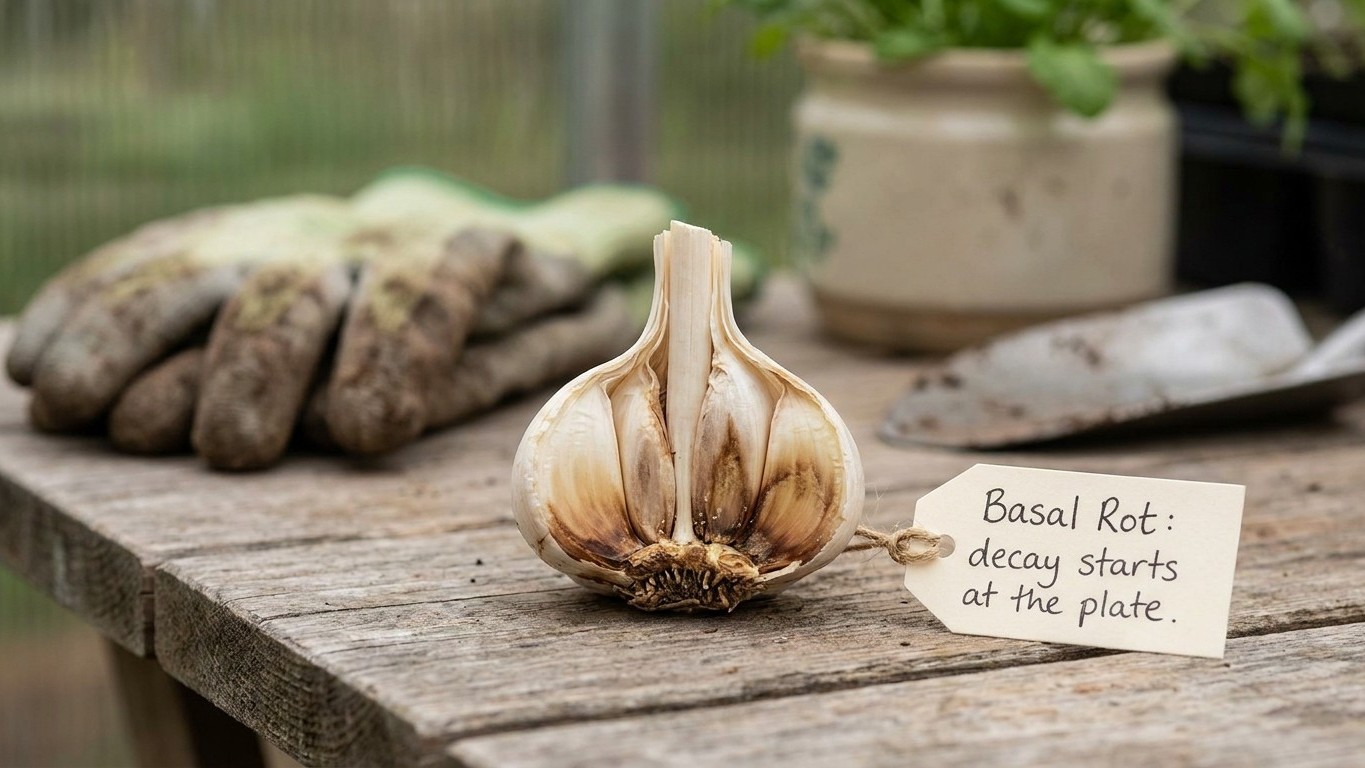

Fusarium basal rot in garlic starts at the stem plate, the flat disc at the bottom of the bulb where the roots attach, and works upward into the cloves as the fungus Fusarium oxysporum f. sp. cepae feeds on the tissue there. UC IPM’s Pest Management Guidelines for Onion and Garlic (UC ANR Publication 3453) list it among the soil-borne rots that persist in a garden indefinitely once established. Pull one questionable bulb now and slice it top to bottom through the base: a brown, sunken, cracked stem plate is the tell, not the yellow leaves above it.
What you are looking at

The first sign most gardeners notice is a plant that isn’t holding its color the way its neighbors are. Foliage yellows unevenly, often starting with the older leaves, and dieback runs in from the leaf tip rather than starting at the base the way a foliar blight would. A stand can look ragged well before harvest, with some leaves collapsing while others nearby stay upright.
What the bulb looks like once you pull it
Lift a suspect plant and the real story is at the bottom, not the top. The stem plate turns brown and pitted instead of staying the pale, firm tan of a healthy bulb. Rot begins there and works upward into the base of the cloves, so a bulb can look intact from the side while the point of attachment is already collapsing. Under dry conditions the damaged plate doesn’t turn to mush so much as it cracks, leaving a dry, fissured surface where healthy tissue is normally smooth. Cut a suspect bulb in half through the stem plate rather than peeling it from the outside. Peeling can miss the rot entirely; a cross-section through the base almost never does.
Roots on an infected plant are often sparse or already dead by the time the foliage shows real trouble, because the tissue they attach to has been eaten away underneath them. In storage, bulbs that carried a low-grade infection into the barn keep declining: the base softens further, and cloves that looked sound at harvest turn spongy and discolored from the bottom up over the following weeks. A bulb that feels light and loose at the neck when you pick it up is worth checking now rather than storing it and hoping.
What it is not
Garlic yellows for reasons that have nothing to do with a fungus. Underwatering during bulb sizing turns leaf tips pale and papery in a way that can look a lot like early basal rot from a distance. Nitrogen deficiency shows up as a uniform, whole-plant yellow-green rather than dieback confined to leaf tips, and it usually clears up once you feed the bed. And every garlic plant yellows and dies back on its own schedule as the bulb finishes sizing and the plant shifts energy out of the leaves. That last one is the big one: foliage dieback in the weeks before harvest is normal maturation, not disease, and pulling a whole bed early because the tops are going down is a common overreaction.
The discriminating check is always the base plate, not the leaves. Dig one plant, slice through the stem plate, and look. Healthy tissue there is firm and pale. Water stress and nitrogen deficiency never touch it; only a base rot does. If the plate is clean and the roots are white and intact, the yellowing above ground is almost certainly cultural, not pathogenic. If the base is clean, save your worry: plenty of other conditions covered in our full rundown of garlic diseases can explain tired-looking foliage without any rot at all.
Where it comes from and when it strikes
The pathogen behind this rot is Fusarium oxysporum f. sp. cepae, a soil-dwelling fungus that specializes in onions and garlic. It gets into a garden one of two ways: it’s already living in soil that has carried alliums before, or it rides in on seed cloves that look perfectly sound but harbor a low-grade infection around the base plate. Once it’s in the soil, there’s no cultural trick that removes it.
The temperature window
UC IPM’s Pest Management Guidelines for Onion and Garlic put the disease’s active range at 59 to 90°F, with an optimum of 77 to 82°F, for infection and spread. Those figures are soil temperature, not air temperature, which matters because a mild spring at head height can sit over soil that warmed weeks earlier and is already well inside that window. A soil thermometer pushed a few inches into the bed gives a far more useful reading than the forecast does for judging whether conditions favor the fungus.
Within that window, the fungus infects through wounds and natural openings at the base plate and through root tips, then colonizes inward. Damp, poorly drained soil speeds it along, because saturated ground stresses roots and gives the fungus more entry points, while soil that swings between wet and dry can crack the base plate outright and hand the pathogen a way in. Beds that have grown onions, garlic, leeks or shallots repeatedly carry the heaviest loads, since every allium crop is a chance for the fungus to build up numbers in the soil it leaves behind.
There’s a useful contrast worth knowing if you’ve also read up on white rot in garlic: that disease thrives in cool soil, while Fusarium basal rot needs it warm, prospering exactly where the other is held in check. In warmer climates it’s also worth ruling out southern blight in garlic, since it favors the high end of the same temperature range but leaves a different signature at the base plate.
What to do about it now
There is no fungicide or soil drench available to a home gardener that reverses basal rot once a plant is infected. Commercial growers manage the disease at field scale with soil fumigation and banded in-furrow fungicides applied at planting, but those are farm-scale tools tied to specific products and equipment, not something to reach for in a backyard bed. Once the base plate is rotting, the plant is not going to recover, and treating it as salvageable wastes time better spent protecting the rest of the bed.
Pull infected plants as soon as you find them rather than waiting for harvest. Dig a wide enough circle to get the roots and any soil clinging to the base plate, since that soil carries the fungus too. Do not put infected plants, or the soil that came up with them, into the compost pile. Home compost rarely reaches the sustained heat needed to kill a soil-borne Fusarium, and composting infected material is one of the more common ways gardeners spread the fungus from one bed to the next season after season.
Bag the pulled plants and their root soil and send them out with household trash, or bury them well away from any bed that will ever grow alliums again. Clean the trowel or fork you used on that plant before it touches healthy soil, since the fungus travels readily on tool blades and boot soles. For bulbs that reach harvest with only a mild base infection, sort them out of the storage batch entirely. A bulb with even light pitting on the stem plate declines faster than its neighbors and can spread trouble to sound bulbs sitting next to it.
Keeping it out of your garden
The single most useful thing a home grower can do is start with clean seed. UC IPM’s guidelines for onion and garlic call for planting stock that has been tested and found free of Fusarium, and that matters more than almost anything else you’ll do this season: a lot of basal rot in home gardens doesn’t come from the soil at all, it comes in inside the cloves you planted. Buy seed garlic from a supplier who can confirm it has been tested, and inspect every clove before planting. Reject any with brown discoloration or softness at the base, even if the rest of the clove looks fine.
Rotation and soil practices
Where the fungus has already turned up in a bed, rotation is the home-garden answer to the field-scale tools growers use. Keep alliums, meaning onions, garlic, leeks and shallots, out of that ground and grow something unrelated there instead. The fungus survives indefinitely in soil once established, according to UC IPM’s guidelines, so rotation isn’t a one-season fix. It’s a long-term decision about which beds get to grow garlic again, not a two-year break after which the ground is declared clean.
- Test or source-verify seed garlic before planting, not after trouble shows up
- Sanitize trowels, forks and knives between beds, especially after touching suspect soil
- Improve drainage in beds that stay soggy, since saturated soil stresses roots and opens entry points
- Cure bulbs fully and store below 39°F at low humidity to slow any low-grade infection already on board
Sanitizing tools between beds costs nothing and closes off one of the easiest ways the fungus travels. Good drainage helps too: raised beds or amended, free-draining soil work in your favor even though they don’t eliminate risk on their own.
Storage is the other half of prevention, and it’s one most guides skip. Cure bulbs fully and store them below 39°F at low humidity, the storage condition UC IPM lists for limiting the disease, since bulbs held warm and damp give any low-grade infection the conditions it needs to keep spreading through the batch. A single soft bulb in a warm pantry can take down several sound neighbors before you notice.
Common questions
Can I still eat garlic that has basal rot?
Cloves from a bulb with only minor base discoloration are usually fine to eat once you trim well past the affected tissue, since the rot itself doesn’t produce a toxin of concern. A bulb where the rot has spread up into most of the cloves is better thrown out, since flavor and texture go along with the spoiling tissue. Either way, put the trimmings and any spoiled bulb in the trash rather than the compost, for the same reason you’d toss an infected plant from the garden.
Does rotating out of garlic for a year clear up a contaminated bed?
No. Fusarium oxysporum f. sp. cepae survives indefinitely in soil once it’s established there, according to UC IPM’s guidelines, so a single season or even a few years growing something else won’t eliminate it. Rotation reduces how much the fungus builds up while you’re not growing alliums there, but it doesn’t reset the bed to clean. Treat a confirmed infected bed as a long-term loss for garlic, onions, leeks and shallots specifically, and use it for unrelated crops instead.
Will basal rot spread to other vegetables planted nearby?
Not this strain. Fusarium oxysporum f. sp. cepae is specific to onions, garlic, leeks and shallots, so it won’t infect tomatoes, peppers, beans or other unrelated crops sharing the same bed. Other formae speciales of Fusarium oxysporum do attack other crops, but they behave as effectively different pathogens under the same species name, and the allium-specific strain doesn’t cross over to them.
How do I tell basal rot from ordinary storage mold?
Look at where the damage starts. Basal rot begins at the stem plate on the bottom of the bulb and moves upward, with the base itself brown, pitted or cracked before the rest of the bulb shows anything. Storage molds more often show up as surface growth on the outside of the bulb or between cloves, without the base plate being the clear point of origin. If you’re unsure, slice through the base plate: sound tissue there points away from Fusarium.