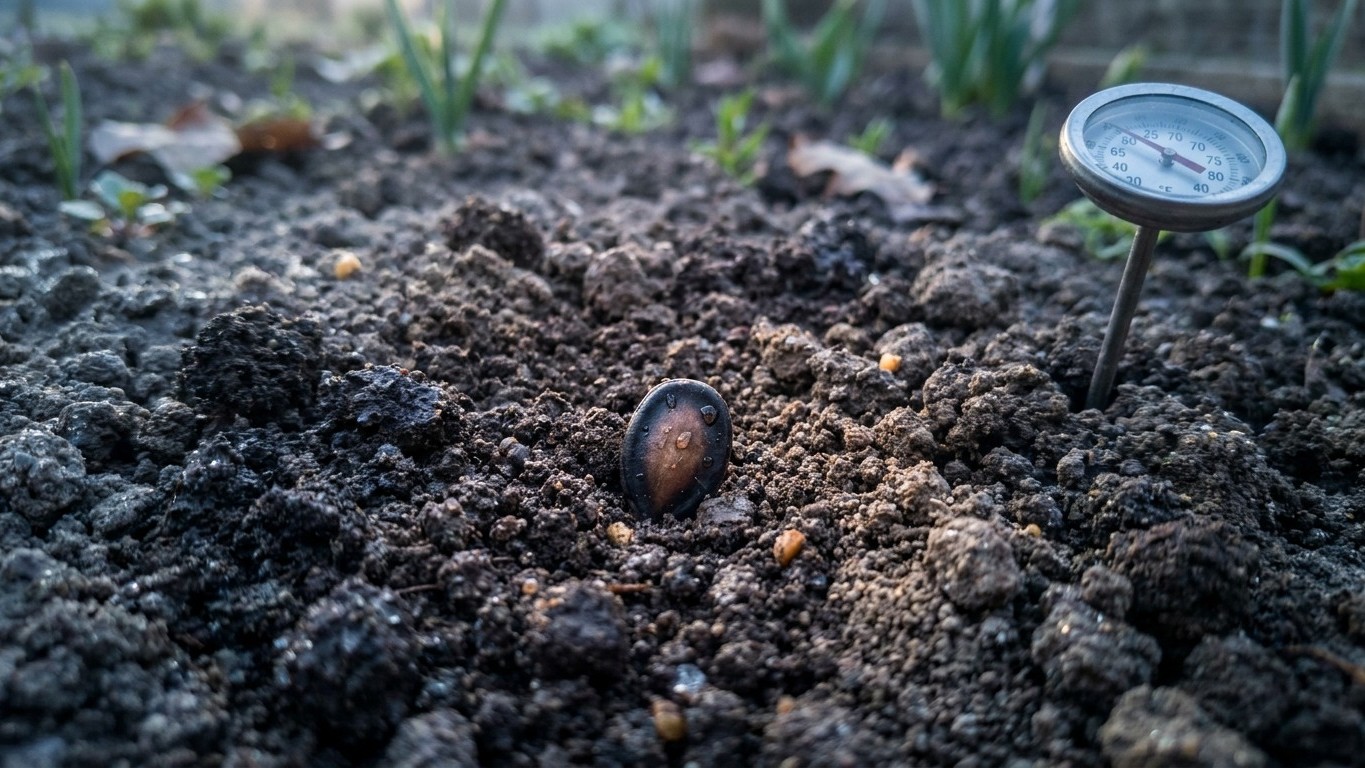

Melon seed needs soil consistently at 65 to 70°F to germinate, and it does best above 70. That’s warmer than tomatoes, peppers, or squash want, and it explains why so many home melon crops disappoint. Gardeners plant by the calendar instead of by the ground, and cold soil punishes that shortcut all season long.
What is actually going on
The thing to understand is germination and root establishment, not frost dates. Melon seed absorbs water through its coat before it can sprout, a process called imbibition. In warm soil, that water uptake is steady and the seed swells evenly. In cold, wet soil, the same seed pulls in cold water slowly and unevenly, and the seed coat can rupture or the embryo can suffer chilling injury before a root ever appears. Fungal organisms that cause damping-off thrive in exactly those cool, damp conditions, so a seed that survives the cold water often rots anyway, one reason “the seed just never came up” is such a common complaint with melons.
Beans and summer squash tolerate a cooler start and largely shrug it off, pushing out new roots once the soil finally warms. Melons don’t work that way. A melon seedling checked by cold soil in its first two or three weeks builds a smaller, shallower root system, and that root system is what the plant relies on for the rest of the season to pull water and nutrients. There’s no growth spurt later that rebuilds a stunted root system from scratch. The plant survives, but it stays behind the melons that never had a cold start, flowering later, setting fewer fruit, and often running out of season before those fruit finish sizing.
This holds across melon types, whether you’re growing a netted muskmelon type, a smooth-skinned honeydew type, or a watermelon (technically a different genus but grown under the same soil-temperature rules). A state extension service can point to which types of each have performed well in local trials; this page won’t name a variety because the right one depends entirely on your season length and disease pressure, both of which vary by county, not just by state.
One more piece of the mechanism matters for later: sugar in a melon accumulates on the vine as the fruit matures, fed by the leaves and root system built earlier in the season. A melon does not sweeten after it’s picked, it only softens. That’s a separate topic from soil temperature, but it starts here, because a plant with a stunted root system from a cold start has less capacity to load sugar into fruit even when the vine and weather look fine by midsummer.
In the garden
Judging soil warmth by feel or by the calendar is the habit that gets most gardeners into trouble. Air temperature can hit 75°F on a sunny April afternoon while the soil four inches down is still sitting in the mid-50s, especially in clay or in a bed that’s still shaded part of the day. A soil thermometer pushed in about two inches, checked at midmorning for three or four consecutive days, is the only reliable way to know when the ground itself is ready.
Gardeners have two main tools for pushing soil warmth ahead of the season, and each one fails in a specific way when it’s misused.
| Method | How it works | What goes wrong if it’s skipped or misused |
|---|---|---|
| Soil thermometer check | Confirms actual soil temperature at seed depth instead of guessing from air temperature or frost date | Skipping it means trusting a calendar date; seed goes into soil still in the 50s and sits swelling in cold water until it rots |
| Black plastic mulch | Laid over the bed one to two weeks ahead of planting, it absorbs sun and raises soil temperature several degrees above open ground | Left off in a cool, cloudy spring, the soil warms only as fast as the air, which in many regions runs weeks behind what melon seed needs |
| Clear plastic or low tunnels | Clear film traps heat directly at the soil surface, often warming ground faster than black plastic since sunlight passes straight through | Left in place too long after seedlings emerge, tunnels trap enough heat to cook young plants on the first genuinely hot day |
| Transplanting instead of direct seeding | Starting seed indoors and setting out transplants once soil has already warmed skips the weeks a seed would otherwise spend sitting in cold ground | Setting a warm, tender transplant into soil that’s still cold causes root shock; the plant usually survives but stalls for two to three weeks, erasing the head start it was meant to provide |
Notice that every failure mode traces back to the same error: trusting air temperature, a frost date, or a nursery tray’s warm indoor start as a stand-in for what the ground itself is doing. None of them are. And once a melon plant is stressed by cold roots early on, no amount of later heat, feeding, or watering fully rebuilds the capacity that early setback cost it, including its later ability to load sugar into fruit as it matures on the vine.
What it depends on where you are
The temperature range melon seed needs to germinate well is a fixed biological fact, roughly the same in Vermont as it is in Arizona. What varies enormously is how long it takes local soil to reach that range and stay there, and how much runway the rest of the season gives a melon plant once it starts. Season length, summer heat, and summer rainfall all shift the practical answer to “when do I plant,” even though the soil-temperature target itself doesn’t move.
A short-season region with a late, cool spring may not see soil hold steadily in the melon-friendly range until well into what feels like summer elsewhere, which is exactly why extension programs in those states often recommend transplants and plastic mulch as standard practice rather than an optional trick. A region with intense, humid summer heat faces a different problem: soil warms early and fast, but heavy rainfall and high humidity bring their own disease pressure once the vines are up, which is a separate issue from germination but shapes which melon types perform reliably in that climate.
This page can describe the mechanism and the tools; it can’t tell you when your particular garden’s soil crosses 65°F, because that depends on your soil type, your drainage, how much sun that specific bed gets, and this spring’s weather, none of which this page has access to. The state-level pages in this melon guide series cover regional planting windows in more detail, and your state’s cooperative extension service publishes soil-temperature guidance and melon variety trial results specific to your county, both worth checking before you commit seed to the ground.
The mistake that costs the most
The single costliest mistake is planting melon seed by the frost date instead of the soil temperature, treating “safe from frost” and “warm enough for melons” as the same milestone. They’re not. Air can be well above freezing risk for weeks before soil four inches down catches up, particularly in a bed that still has some shade in early spring or soil with a heavy clay content that holds cold longer than sandy ground does. Gardeners who plant melons the same week they plant tomatoes are usually planting into soil that’s still ten degrees or more short of what melon seed actually needs.
The fix costs nothing but a few dollars for a soil thermometer and a little patience. Check the soil, not the air, at planting depth, over three or four consecutive days, and don’t seed or transplant until it holds in the mid-60s or better. If the calendar says it’s time but the thermometer says otherwise, believe the thermometer. Warming the bed ahead of time with plastic mulch, or starting seed indoors and transplanting only once the ground has caught up, both buy real time without forcing seed into soil that isn’t ready.
What’s easy to miss is that this mistake doesn’t just delay germination, it quietly caps what the plant can do all season, including how well the fruit finishes. A melon stressed by cold soil early builds a smaller root system, and a smaller root system limits how much sugar the vine can eventually load into its fruit as those melons mature. And once a melon is cut from the vine, that sugar-loading stops for good. It only softens after that, it never sweetens further, no matter how long it sits on a counter. The soil temperature at planting time, not anything done at harvest, is where a sweet melon actually starts.