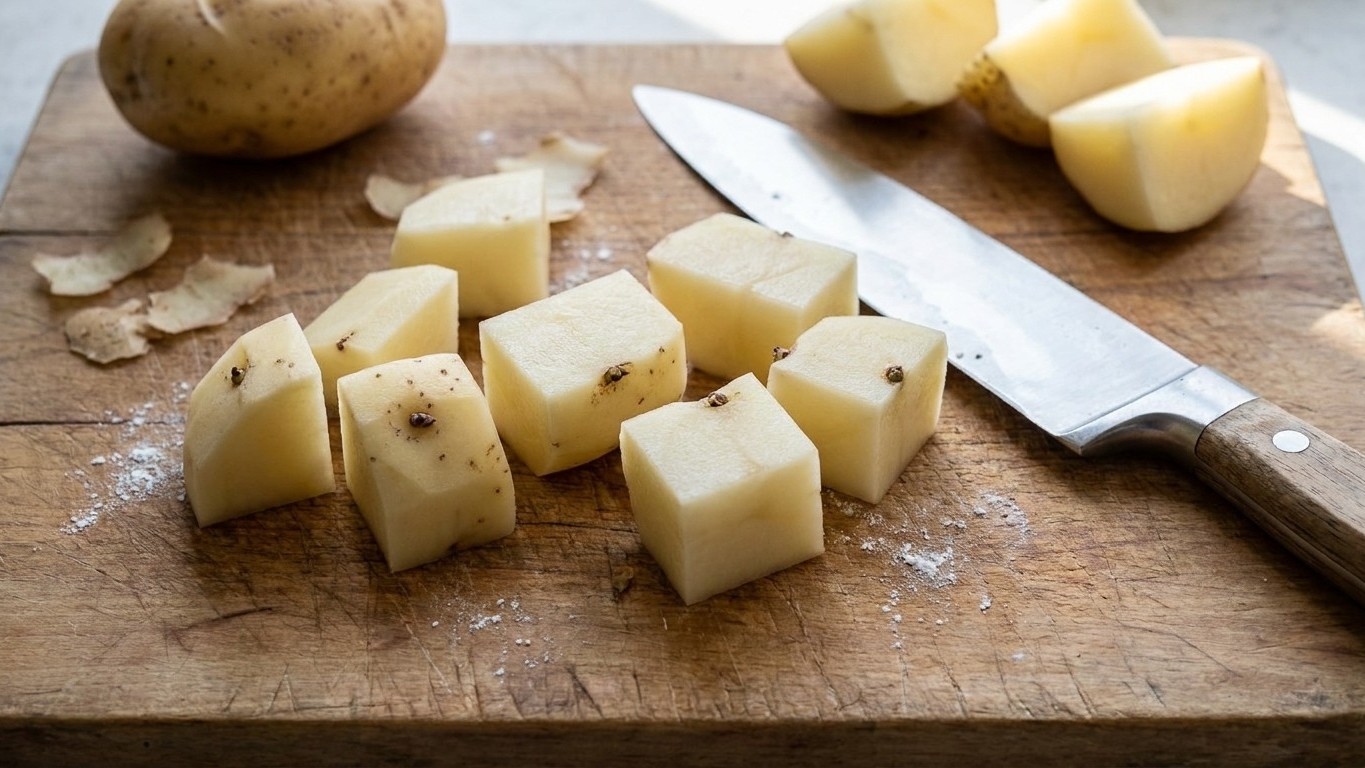

Cut seed potatoes into blocky pieces weighing 1 3/4 to 2 1/4 ounces, each carrying at least one eye, and never let a piece measure under an inch across. That standard comes from the University of Maine Cooperative Extension, Bulletin #2077. Before any knife touches a tuber, though, one decision outweighs the cutting itself: buy certified seed. Utah State University Extension warns that uncertified seed, including anything pulled from a grocery bin, carries virus that no amount of careful cutting will undo.
The short answer
That weight window, 1 3/4 to 2 1/4 ounces, isn’t a rounded-off guess. It’s the amount of stored tuber tissue a sprout needs to push through soil and keep feeding itself until roots take over the job. Cut lighter than that and the piece runs out of reserves before it can support new growth. Cut heavier and you’re wasting seed stock that could have started another plant somewhere else in the row.
Do the math on a pound of potatoes and the range gets concrete fast: sixteen ounces divided across pieces of 1 3/4 to 2 1/4 ounces works out to roughly seven to nine seed pieces per pound, depending on how close to either end of that window each cut lands. That’s the kind of number a gardener can actually plan a seed order around, rather than guessing how many pounds to buy for a given row length.
The eye requirement matters just as much as the weight. An eye is the only place a sprout can emerge from, so a chunk of tuber flesh without one is just food with no growing point attached. It will sit in the soil, feed nothing, and eventually rot. That’s why “at least one eye” isn’t a suggestion tacked onto the weight guideline. It’s the other half of what makes a piece viable at all.
Why the one-inch floor exists
The minimum size, never under an inch across, protects against a different failure mode. A very small piece has a large cut surface relative to its mass. That cut surface is an open wound, and the smaller the piece, the higher the ratio of wound to stored energy. Small pieces are more likely to rot in cool, damp soil before they can heal over and root, which is exactly the outcome the size floor is built to prevent.
What actually decides it
Weight, eyes, and size all trace back to the same underlying tension: a seed piece has to survive being wounded, then feed a sprout, before it can start photosynthesizing on its own. Everything about how a piece is cut either supports that sequence or works against it.
Stored energy versus wound size
Every cut you make opens a surface that soil organisms can colonize. A larger piece has more stored carbohydrate to draw on while that surface heals, which buys time. A smaller piece has less of a buffer, so the same soil conditions that a larger piece shrugs off can rot a small one outright. This is the mechanism behind the weight range: it’s not about the potato looking a certain size, it’s about giving the piece enough reserve to outlast the healing period.
Where the eyes are and why it matters
A tuber’s eyes aren’t distributed evenly across its surface, and different growers will find eyes clustered more heavily toward one end of a given potato than the other. That’s exactly why “at least one eye” is checked piece by piece rather than assumed. A cut that looks like a reasonable chunk of potato can still come up empty if the eyes on that tuber happened to sit elsewhere. Reasoning through this on a potato you haven’t cut yet means turning it over and locating eyes before deciding where the knife goes, not after.
Certified seed and the virus problem
Utah State University Extension’s warning about uncertified seed points to a mechanism that has nothing to do with cutting technique at all. Viral infection in a potato tuber often produces no visible symptom on the outside. A potato can look perfectly healthy, cut cleanly, and still carry a virus load that will show up as reduced vigor and lower yield once it’s growing in the ground, and that virus can pass from an infected piece to a healthy one through the same blade if the knife isn’t cleaned between cuts. Certification exists precisely because appearance can’t be trusted to catch this.
How to do it
- Start with certified seed potatoes, checked for soft spots or shriveling before you commit them to cutting.
- Locate the eyes on each tuber before making any cut, so you know where the growing points sit.
- Cut into blocky pieces weighing 1 3/4 to 2 1/4 ounces, keeping at least one eye on every piece and never leaving a piece under an inch across.
- Work on a clean, sanitized cutting surface and sanitize the blade between potatoes to avoid carrying disease from one tuber to the next.
- Set the cut pieces aside to air-dry until the cut surface calluses over, rather than planting them straight from the knife.
- Plant with the eyes oriented upward toward the soil surface.
What goes wrong
- Pieces smaller than an inch across rot in the ground. The wound-to-mass ratio is too high for the piece to heal before soil organisms take hold. Recut generously and aim for the 1 3/4 to 2 1/4 ounce range rather than stretching a small tuber into extra pieces.
- A piece has no eye and never sprouts. That’s wasted seed with nothing to show for it. Check every piece for at least one visible eye before setting it aside for planting, not after.
- Grocery-store or otherwise uncertified potatoes are used as seed. Utah State University Extension is direct about this: uncertified seed can carry virus with no outward sign, and the resulting plants underperform in ways that only show up after the crop is already in the ground. Buy certified seed potatoes specifically sold as seed stock, not table potatoes.
- The cutting knife spreads infection between tubers. A single blade run across an infected potato and then a healthy one can transfer virus even when neither piece shows symptoms. Sanitize the blade between potatoes, or at minimum between lots from different sources.
- Freshly cut pieces go straight into cool, wet soil. An unhealed cut surface planted immediately is far more vulnerable to rot than one that’s had time to callus. Let the cut surface dry and firm before planting rather than treating cutting and planting as one continuous step.
Common questions
Can I use a potato from the grocery store as seed?
No. Utah State University Extension specifically warns against uncertified seed, and a supermarket potato is not seed stock. It can carry virus with no visible symptom, and that virus will follow the plant through the growing season regardless of how carefully it’s cut.
Do all seed potatoes need to be cut, or can small ones go in whole?
That threshold isn’t published in the sources used here. What is established is the target for cut pieces: 1 3/4 to 2 1/4 ounces, at least one eye, never under an inch across. If a whole tuber falls outside that discussion, treat it as a separate question this page doesn’t answer.
How many eyes does a good seed piece actually need?
At least one, according to the University of Maine Cooperative Extension. A piece with zero eyes has no growing point and won’t produce a plant, no matter how much tuber mass it carries.
What actually happens if a cut piece is too small?
The surface exposed by cutting is proportionally larger relative to the piece’s stored energy, which slows healing and raises the odds of rot before the piece can root. That’s the reasoning behind the one-inch minimum published by the University of Maine Cooperative Extension.