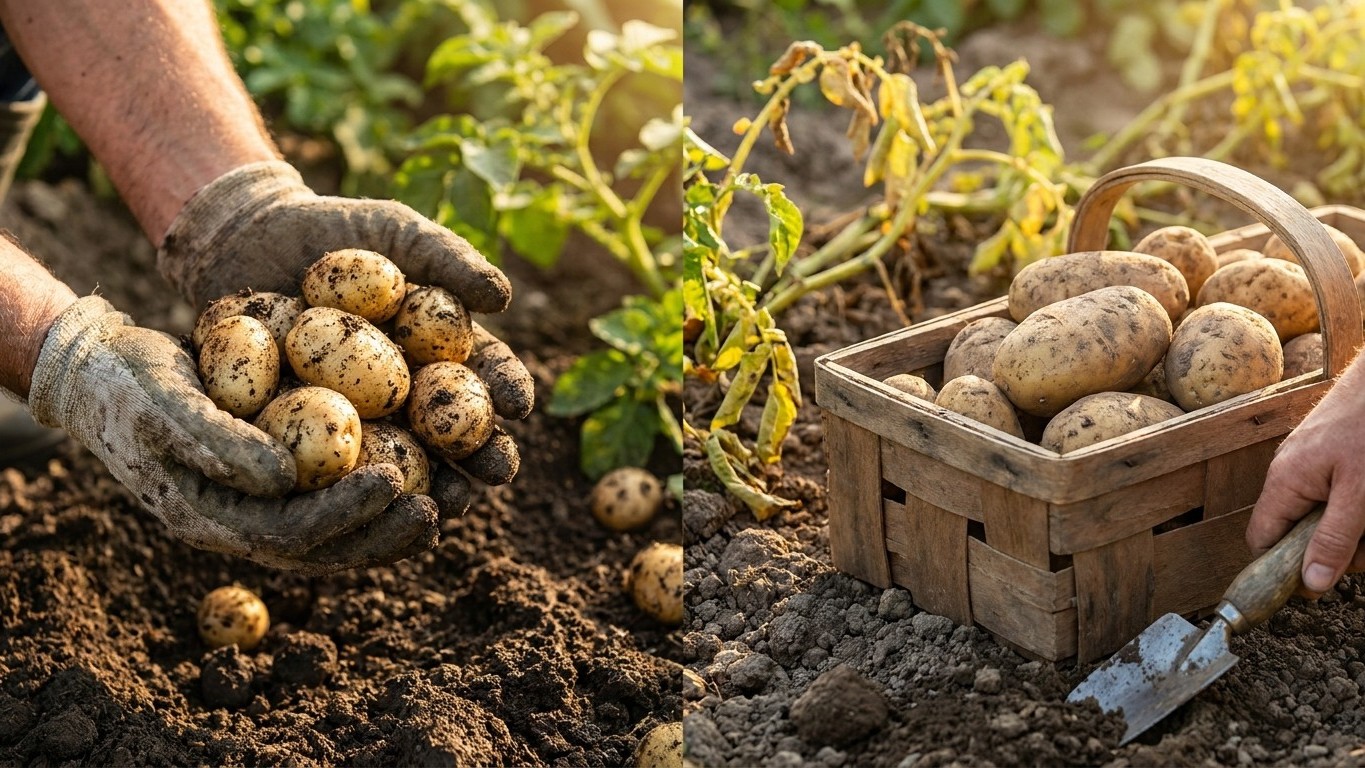

The choice is a trade, not a date on a calendar. Dig new potatoes early and you get thin-skinned, tender tubers meant for the table that same week. Wait for the vines to die back and you get a crop with skin set thick enough to survive months in storage. You cannot have both from the same hill. Once you decide which one you want, the rest of the digging decision follows naturally.
The short answer
According to Utah State University Extension, in its guide Potatoes in the Garden, potatoes can be harvested as soon as they begin forming (new potatoes) or as they mature. That single line covers both harvest windows gardeners ask about, and it puts the decision where it belongs: on the gardener’s intent, not on a fixed number of weeks after planting.
New potatoes are simply tubers pulled young, while the plant is still green and growing. They are small, thin-skinned, and best eaten within days because that skin has not had time to toughen. A full crop is the opposite approach: you let the plant finish its job, the foliage yellows and collapses on its own, and the tubers underground use that extra time to develop a skin thick enough to resist scuffing, moisture loss, and the slow rot that undoes a root cellar’s worth of potatoes by midwinter.
Neither approach is more correct than the other. A gardener who wants a handful of buttery potatoes for a weekend meal has no reason to wait out the whole season. A gardener who wants a bin of potatoes to eat through winter has every reason to. The Utah State University Extension guidance treats both as legitimate harvest points, which is worth repeating because a lot of garden advice quietly assumes only one of them exists.
What the guidance does not offer is a days-to-maturity figure for any particular variety, and that is deliberate on our part as well: those numbers vary by variety and are not part of the source used here. Instead of counting days, the practical approach is to read the plant itself, its flowering, its foliage, and eventually its dieback, and let that tell you which window you are in. That reading is the subject of the next section, because it is the part gardeners most often get backward.
What actually decides it
The mechanism is skin set, and it happens on the tuber’s timeline, not the calendar’s. When a potato plant is actively growing, the tubers underground have thin, loosely attached skin that rubs off with a light thumbnail scratch. That is fine, even expected, for new potatoes: you are digging them precisely because the skin is not yet a barrier and the flesh is not yet starchy and dense. The trade-off is that thin skin means no storage life. A new potato left in a paper bag for two weeks will shrivel and soften long before a mature one would.
As the plant finishes its growth cycle, something changes below ground even while the visible signal is above ground: the foliage yellows, then collapses, then dies back entirely. That dieback is the plant redirecting its remaining resources into the tubers one last time, and it is during this stage that skin set actually happens. The skin thickens and adheres more tightly to the flesh. A tuber dug during or right after this dieback holds up to handling, curing, and months of cool storage in a way a tuber dug three weeks earlier simply cannot, regardless of how big it has grown.
This is the part that gets confused most often: size is not the same signal as skin set. A tuber can size up nicely while its plant is still green and vigorous, and digging it at that stage still gives you a new potato in every practical sense, thin skin included, even if it is as large as a fist. Conversely, a small tuber dug after full dieback can have proper skin set despite its modest size. Gardeners chasing “big potatoes” sometimes dig on size alone and end up with large new potatoes that rot in storage within weeks, because size was never the variable that mattered.
The other confusion worth naming here is treating foliage dieback as a single event you either catch or miss. In practice it is a process, starting with lower leaves yellowing and ending with the whole plant collapsed and dry. Utah State University Extension’s framing, that potatoes can be dug as they begin forming or as they mature, essentially brackets this whole process: the early bracket is any point after tuber formation begins, and the late bracket is full maturity, with skin set as the practical marker that separates a storage-ready harvest from an early one.
What to do about it
- Decide the purpose of the harvest before you dig anything. If the goal is new potatoes for near-term eating, you can dig selectively around the base of a plant, take a few tubers, and leave the rest of the hill undisturbed to keep growing. If the goal is a storage crop, plan to wait through full foliage dieback instead of digging on a fixed date.
- For new potatoes, confirm tuber formation has begun before digging, since pulling too early yields nothing but disturbed roots. Flowering is a common visual cue that tubers have started forming beneath the plant, though the only confirmed marker from the source used here is that harvest is possible once tubers begin forming.
- For a full crop, let the foliage die back on its own rather than cutting it down early to force the issue. Skin set develops during this natural dieback, and cutting foliage prematurely shortens that window instead of speeding it up.
- Scout the plants for pests and disease before and during harvest, and identify what you are looking at before treating anything. Identification comes first because the appropriate insecticides or the appropriate fungicide differ by pest and by disease, and treating the wrong problem wastes the treatment while the actual issue keeps spreading.
- Handle dug tubers gently regardless of which harvest you chose, since bruised or scraped skin invites rot in storage and shortens shelf life even on a properly matured, well-set-skinned potato.
What goes wrong
- Mistaking large size for maturity. A big tuber on a still-green, upright plant is still a new potato in terms of skin set. Gardeners dig it expecting storage life and are surprised when it softens within days.
- Mistaking disease dieback for natural maturity dieback. Foliage that collapses suddenly, unevenly, or with dark lesions rather than a gradual yellowing may signal disease rather than the plant finishing its cycle. Digging on that signal can mean harvesting tubers that never properly finished forming or that carry disease into storage.
- Cutting foliage early to “speed up” harvest. This is a common shortcut that backfires: it stops the plant from feeding the tubers during the dieback window, cutting skin set short rather than accelerating it.
- Treating pests or disease before identifying them. Reaching for a treatment before confirming what is actually affecting the plant risks using the wrong appropriate insecticide or appropriate fungicide for the problem at hand, which delays real control while the underlying issue continues.
- Assuming a fixed number of days will tell you when to dig. No days-to-maturity figure is used here, because that number varies by variety and growing conditions. The plant’s own signals, tuber formation for new potatoes and foliage dieback for a full crop, are the markers actually published by Utah State University Extension.
Common questions
Can I dig some new potatoes and leave the rest of the plant to mature?
Yes. Digging selectively around the edge of a hill to take a few new potatoes while leaving the plant otherwise undisturbed is a standard approach, and it lets a gardener enjoy both harvest windows from the same planting.
Do new potatoes store as well as a full crop?
No. New potatoes have thin skin that has not set, so they are meant for near-term eating rather than storage. A full crop dug after foliage dieback develops the thicker, better-adhered skin that storage depends on.
Is bigger always better when deciding whether to dig?
No. Tuber size and skin set are separate things. A large tuber on a still-green plant can still have thin, unset skin, while a smaller tuber dug after full dieback can be properly set for storage.
Should I cut the foliage down to force the plant to finish?
No. Skin set develops while the plant naturally dies back and redirects its remaining resources into the tubers. Cutting the foliage early interrupts that process rather than speeding it along.