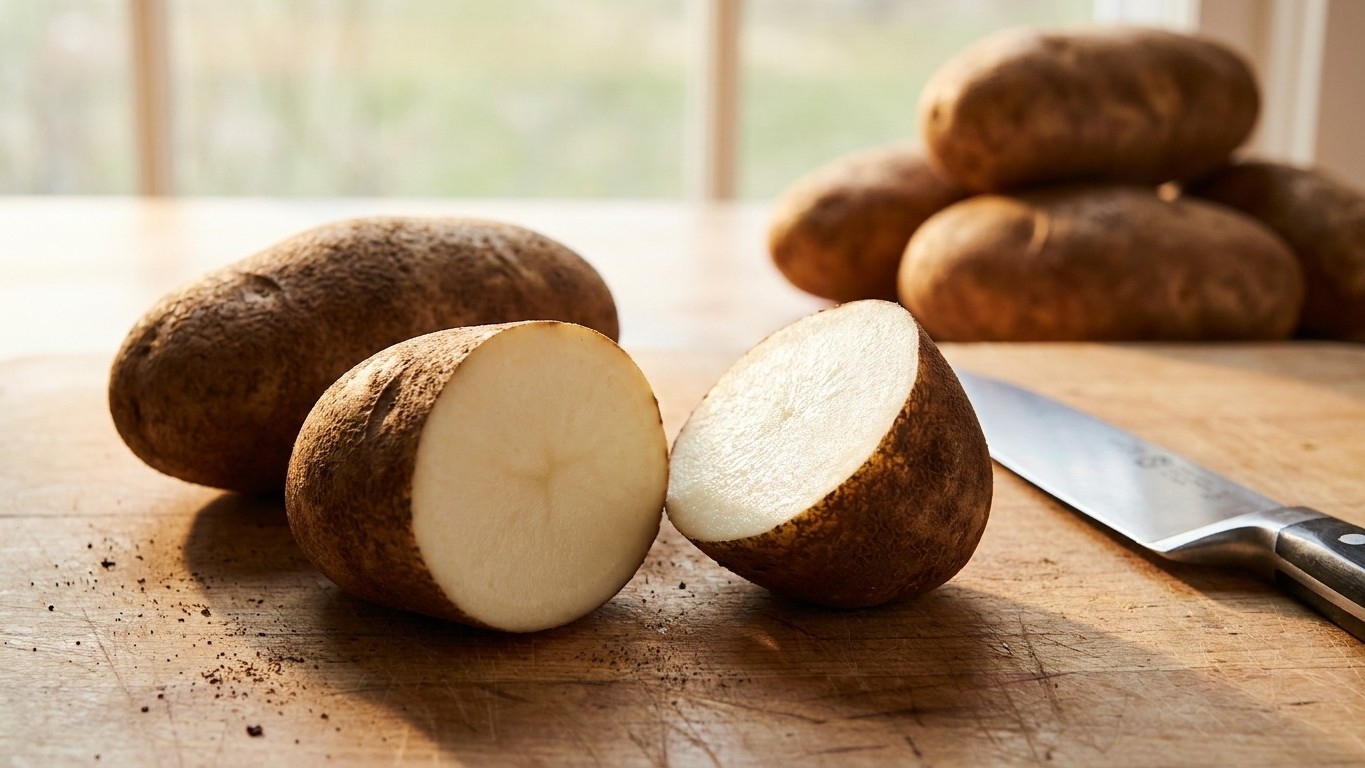

Russet Burbank is a late-season potato with white flesh under russeted skin, bred for baking. That is the profile the University of Maine Cooperative Extension publishes in Bulletin #2077, Growing Potatoes in the Home Garden. No days-to-maturity number comes with it, only a season class, and that class tells a grower more about timing than any single day count ever could.
The short answer
Four data points define this variety in the extension record, and each one answers a different question a grower or a cook actually asks. Flesh color is white. Skin color is russeted, meaning the thick, netted brown skin most shoppers already picture when they hear the word “russet.” Season class is late. And the published use is baking. Steven B. Johnson, author of Bulletin #2077, lists these as separate fields, not as a single description, because they answer separate questions: what the tuber looks like when you cut it open, what it looks like in the bin, when it finishes growing, and what you do with it once it’s on the counter.
Two columns, not one label
It matters that flesh and skin are recorded as two different columns. A lot of gardeners assume a potato’s color is one fact, but the bulletin treats skin and interior as independent traits, because they don’t always match. A variety can carry white flesh under red skin, or yellow flesh under a tan coat. Russet Burbank happens to line up with expectation: white flesh, russeted skin. But the reason the bulletin insists on listing both is that plenty of varieties don’t, and a grower who only learns the flesh color can misidentify what’s in the ground.
The season class carries the same kind of weight. “Late” isn’t a vague adjective here. It’s a classification the extension service uses to sort varieties by how long they need in the ground and how they respond to a shortening or lengthening growing window. Paired with the baking use, that classification is what actually tells a reader whether this variety fits their yard, and what to do with the harvest once it’s in.
Where it suits, and where it does not
Season class is the single most useful number this bulletin gives, because it interacts directly with soil temperature. Utah State University Extension notes that tuber set and tuber fill stop once soil temperature climbs above 90 degrees Fahrenheit. That threshold is the dividing line between varieties that finish before a hot stretch arrives and varieties that need the whole season, heat or not.
An early-season variety can be planted, bulk up its tubers, and get dug before soil temperatures climb into that danger zone in the heart of summer. A late-season variety like Russet Burbank doesn’t have that escape route. It needs a season that stays under the 90-degree soil ceiling through the entire stretch when tubers are setting and filling, which means it belongs to climates with long, cool-to-moderate growing seasons rather than regions where soil temperature spikes hard and early.
Matching the season class to the ground
| Season class | How it behaves against the 90°F ceiling | Climate it fits |
|---|---|---|
| Early | Can often be dug before peak summer heat pushes soil past the ceiling | Short-summer regions, or areas where soil heats up fast |
| Late (Russet Burbank) | Needs the growing season to stay under the ceiling through set and fill | Long, cool-to-moderate growing seasons |
This is why the same variety that thrives in a high-elevation valley or a northern state can disappoint in a region where midsummer soil regularly climbs past that 90-degree mark. It isn’t a flaw in the potato. It’s a mismatch between a late season class and a climate that doesn’t give it the cool runway it needs. A gardener in a hot-summer state isn’t wrong to want to grow it, but they’re working against the clock the bulletin already describes, and mulching, timing the planting date early, and choosing a partially shaded bed can all buy a late variety a little more room under that ceiling.
In the kitchen
The bulletin lists this variety’s use as baking, and that single word describes a category, not a flavor note. Extension bulletins group potato varieties by intended kitchen use because that’s the information a home cook can act on immediately, without needing a lab test or a taste panel. Baking, in this context, means the variety is suited to the classic method: scrubbed, pricked, and put whole into a hot oven until the skin crisps and the inside can be split open with a fork.
What the label actually changes at the stove
A variety published for baking is the one to reach for when the plan is a whole baked potato, a stuffed potato, or oven fries cut thick enough to hold their shape. It’s also the natural choice for mashing in large batches, since a baking-classified potato tends to break down easily under a masher without turning gluey. None of that comes from a texture word the source doesn’t use. It comes directly from the “use” column the extension bulletin publishes, which exists precisely so a gardener doesn’t have to guess.
What the label doesn’t tell you is how the potato performs in a cold salad or a dish that needs cubes to hold their edges through a boil. The bulletin doesn’t publish a separate rating for that, and guessing at one would mean inventing a claim the source never made. If a recipe calls for potato pieces that stay firm and distinct after boiling, that’s a different published use entirely, and it belongs to a different variety’s entry in the same bulletin, not to this one.
For a home cook working from a garden harvest, the practical takeaway is simple: pull this variety for the oven, for mash, and for thick-cut fries. Save the recipes that need firm, intact cubes for a potato whose bulletin entry actually lists that use.
Growing it
Growing a late-season variety successfully comes down to giving it enough cool-soil runway before that 90-degree ceiling becomes a problem. The sequence below follows the season class rather than a calendar date, since no days-to-maturity figure is published for this variety by either source.
- Plant early in the window your local frost date allows. Because this is a late-season class, the goal is to get roots established while soil temperatures are still moderate, giving the plant as much cool growing time as possible before summer heat arrives.
- Hill soil around the stems as the plants grow. Hilling keeps developing tubers covered, protects them from light exposure and greening, and helps buffer the soil around the root zone from surface heat, which matters more for a late variety than an early one.
- Watch soil temperature through the height of summer. Since tuber set and fill stop above 90°F according to Utah State University Extension, mulching the bed or providing partial afternoon shade during the hottest weeks can help keep the root zone under that ceiling.
- Let the vines die back naturally before lifting. A late-season variety needs its full season to bulk properly, so resist digging early; wait until the foliage yellows and collapses on its own, which signals the tubers have finished filling.
- Lift and cure before storage. Once dug, let the tubers sit in a cool, dark, dry spot for a short period so the skins toughen, which matters for a russeted skin variety being stored for winter use.
Common questions
Is Russet Burbank an early or late potato?
It’s classified as a late-season variety by the University of Maine Cooperative Extension, meaning it needs a season that stays under the 90°F soil ceiling through tuber set and fill, rather than one that finishes before summer heat peaks.
What color is the flesh, and what color is the skin?
The flesh is white and the skin is russeted, meaning thick and netted brown. The bulletin lists these as two separate traits, since flesh and skin color don’t always match on other varieties.
Is this a good baking potato?
Yes. The extension bulletin lists its published use as baking, which fits whole oven-baked potatoes, mashing, and thick-cut fries rather than dishes that need firm, intact cubes.
How many days does it take to mature?
Neither the University of Maine bulletin nor Utah State University Extension publishes a days-to-maturity figure for this variety. What they do publish is the season class, late, which is the number to plan a season around instead.