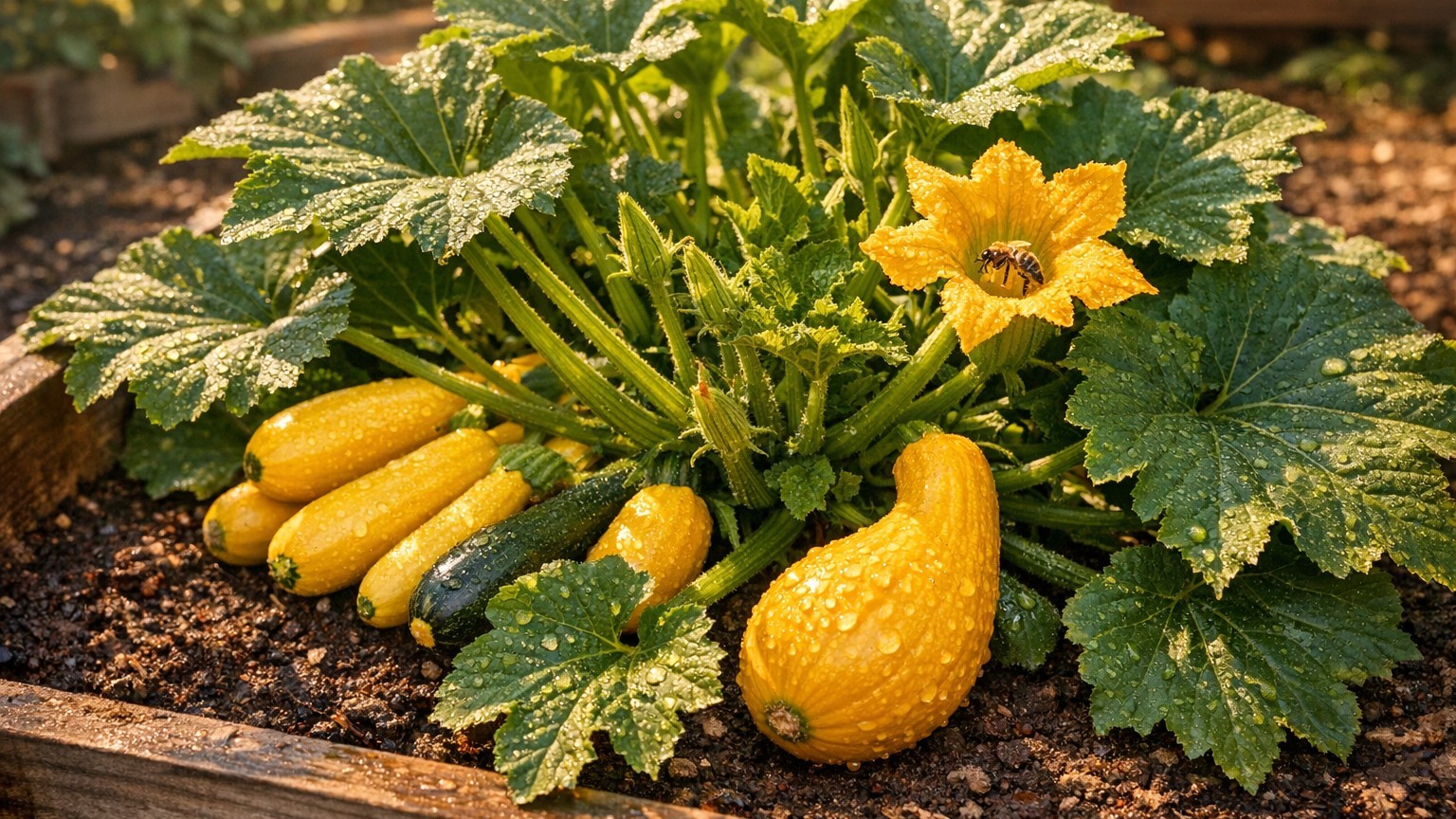

A summer squash plant runs on four things: warm soil to root without stalling, enough elbow room to spread its leaves, a steady visit from bees or a human hand to move pollen, and a gardener willing to check it every day once fruit starts forming. Meet all four and one healthy plant can outproduce what a family eats fresh in a week.
What a summer squash plant asks for
Seed packets rarely explain why a squash plant that looked fine in June suddenly quits in July. Usually one of four conditions slipped, and the plant is built to punish neglect fast. Squash seeds germinate poorly below 60°F soil temperature, and seedlings planted into cold, wet ground often rot at the root before they ever push a true leaf. Warmth is the first non-negotiable, and it’s why garden centers sell squash transplants weeks after they sell lettuce and peas.
Space comes next, and gardeners underestimate it constantly. A single squash plant can spread three to four feet across by midsummer, and crowding several into a small raised bed sets up a humid, airless pocket where fungal disease moves fast between plants. Give each one room to breathe and airflow does half the disease prevention work on its own.
Pollination is the demand most gardeners forget entirely, because squash flowers do the work for weeks before anyone notices a problem. Each plant produces separate male and female flowers, and only a bee-carried pollen transfer turns a female flower into a fruit. Cool, rainy stretches keep pollinators grounded, and a garden with heavy pesticide use nearby can leave female flowers unfertilized no matter how many blossoms open. Small yellow fruit that shrivels and drops a few days after the flower fades is almost always a pollination failure, not a disease.
Then there’s picking, which is less a demand than a deadline. Once a squash plant sets fruit, it reads a mature fruit left on the vine as a signal that its job is done, and it slows flower production accordingly. Daily or every-other-day picking, while fruit is still small, keeps the plant producing for months instead of weeks.
| Demand | What happens when it’s not met | Where to read more |
|---|---|---|
| Warm soil | Seeds rot, seedlings stall or die at the root | Soil temperature for planting squash |
| Room to spread | Poor airflow, faster spread of fungal disease | Spacing summer squash plants |
| Pollinators | Flowers form but fruit shrivels and drops | Hand-pollinating squash flowers |
| Daily picking | Plant slows flowering, redirects energy to seed-filled fruit | How often to harvest summer squash |
Here’s the part seed catalogs gloss over: two well-tended plants, meeting all four demands, typically feed a household through the season. Most home gardens plant six. That’s not wasted effort exactly, but it explains why so many porches end up with a box of squash nobody asked for by August. Planting fewer plants and tending them well beats crowding in a row of six and fighting mildew all summer.
Whichever type you settle on, a state extension service will have a current list of varieties trialled for your climate and season length, and that list changes yearly as new selections are tested for disease resistance in your region.
Zucchini, yellow squash, pattypan and crookneck
The type of summer squash you plant decides how the whole season plays out, from how fast fruit sizes up to what happens if you miss a picking window for a few days. All four types share the same warm-season habit and the same pollination needs, but they’re built differently and they fail differently.
| Type | How it’s built | How it’s typically eaten | Behavior when picked late |
|---|---|---|---|
| Zucchini | Straight, cylindrical, thin-skinned, dark green or striped | Sliced and grilled, shredded raw, baked into quick breads | Skin toughens fast, seeds enlarge, flesh turns watery and spongy |
| Yellow straightneck squash | Straight body, smooth yellow skin | Sautéed, baked, grated into fritters | Skin thickens, interior turns hollow and seedy |
| Yellow crookneck squash | Curved narrow neck widening into a bulb, often bumpy skin | Same uses as straightneck, sometimes peeled first | Neck hardens quickly and can turn bitter |
| Pattypan (scallop squash) | Flat disc shape with scalloped edges, pale green, yellow, or white | Roasted whole when small, stuffed and baked when larger | Shell hardens like a small winter squash, flesh turns stringy |
Zucchini gets planted more than any other type, mostly because it’s forgiving of small kitchen mistakes and holds its shape whether it’s grated into a batter or thrown whole on a grill. Yellow squash, whether straightneck or crookneck, tends to have a slightly sweeter flavor and a softer texture once cooked, which is why it shows up more in sautés than on the grill. Crookneck’s curved shape and bumpy skin make it the one type most likely to get peeled before cooking, especially once a fruit has sized up past the point most gardeners would call ideal.
Pattypan behaves the most differently from the other three. Picked small (about the size of a golf ball to a tennis ball), it’s tender enough to roast whole with the skin on. Left on the vine even a few extra days, the shell firms up fast and the eating quality drops off a cliff compared to zucchini, which stays edible, if not ideal, a bit longer past its prime.
This site doesn’t keep a list of named squash varieties, and it won’t invent one. A county extension office, or a state university’s vegetable trial reports, will have current recommendations for which specific selections of each type perform best against local disease pressure and heat.
Reading a squash plant that is going wrong
Squash plants tend to show trouble through a handful of recognizable signals, and most gardeners will eventually see at least one of them. None of these is a firm diagnosis on its own. Think of the list below as a starting point for narrowing down the likely cause, not a substitute for a closer look at the actual plant.
| What you see | Likely cause | Where to read more |
|---|---|---|
| Fruit rotting at the blossom end | Uneven watering disrupting calcium uptake to the fruit | Blossom end rot in squash |
| Plant collapsing overnight | Squash vine borer damage or bacterial wilt in the stem | Squash vine borer: signs and control |
| White powder coating the leaves | Powdery mildew, common in humid or crowded plantings | Powdery mildew on squash leaves |
| Plenty of flowers, little to no fruit | Pollination failure or an imbalance of male and female blossoms | Why squash flowers but doesn’t fruit |
| Sawdust-like material at the base of the stem | Entry point of a squash vine borer larva | Squash vine borer: signs and control |
Blossom end rot looks alarming, a sunken, dark leathery patch at the tip of an otherwise healthy fruit, but it’s rarely a soil deficiency in most home gardens. It’s more often a symptom of inconsistent watering, where dry spells followed by heavy watering interrupt the plant’s ability to move calcium into fast-growing fruit tissue. Adjusting a watering routine solves it more often than adding anything to the soil.
A plant that looks perfectly healthy one evening and wilted flat the next morning is the classic sign gardeners associate with squash vine borer, though bacterial wilt spread by cucumber beetles can produce a similar collapse. Checking the base of the stem for a small entry hole and sawdust-like frass is the fastest way to tell them apart, since borer damage leaves physical evidence and bacterial wilt generally doesn’t.
White, powdery patches on leaves, usually starting on the older, lower leaves and working upward, point toward powdery mildew, a fungal disease that thrives in the same crowded, still-air conditions that poor spacing creates in the first place. It rarely kills a plant outright but it does reduce the leaf area available for photosynthesis, which in turn reduces fruit production over the following weeks.
Why the answer changes with where you garden
Everything above describes the biology of a squash plant, but the calendar around it belongs to your specific location. A gardener in coastal Georgia and a gardener in Vermont are growing the same plant biology under completely different seasons, and the dates that matter (when soil is warm enough to plant, how many weeks of frost-free growing remain, how much summer heat and rainfall the plant will face) shift by months between those two places.
Season length decides how many succession plantings are realistic. In a longer growing region, a gardener can plant a second round of squash in midsummer to replace plants that are winding down from disease or borer pressure, and still harvest before frost. In a shorter season, that second planting may not have time to mature, which makes protecting the first planting from pests worth more effort.
Summer heat changes plant behavior directly. In regions with long stretches above 90°F, squash plants can stop setting fruit temporarily even with active pollinators present, because extreme heat affects pollen viability itself. Production often resumes once a heat wave breaks. Gardeners in milder summer climates rarely see this pause at all.
Rainfall patterns shift disease risk more than almost anything else on this page. Humid, rain-prone regions see far more pressure from powdery mildew and other fungal diseases, which makes spacing and airflow choices more consequential there than in a dry, low-humidity climate where the same disease may barely appear some seasons.
None of this changes what a squash plant needs biologically. It changes when those needs have to be met, and how much effort goes into managing pests and disease pressure specific to a region. A state extension service, or a county office within it, tracks local pest cycles, regional disease pressure, and which specific varieties of each squash type have performed best in trials run in that state’s own climate. That kind of local, current recommendation will always outperform a general national guide, including this one.