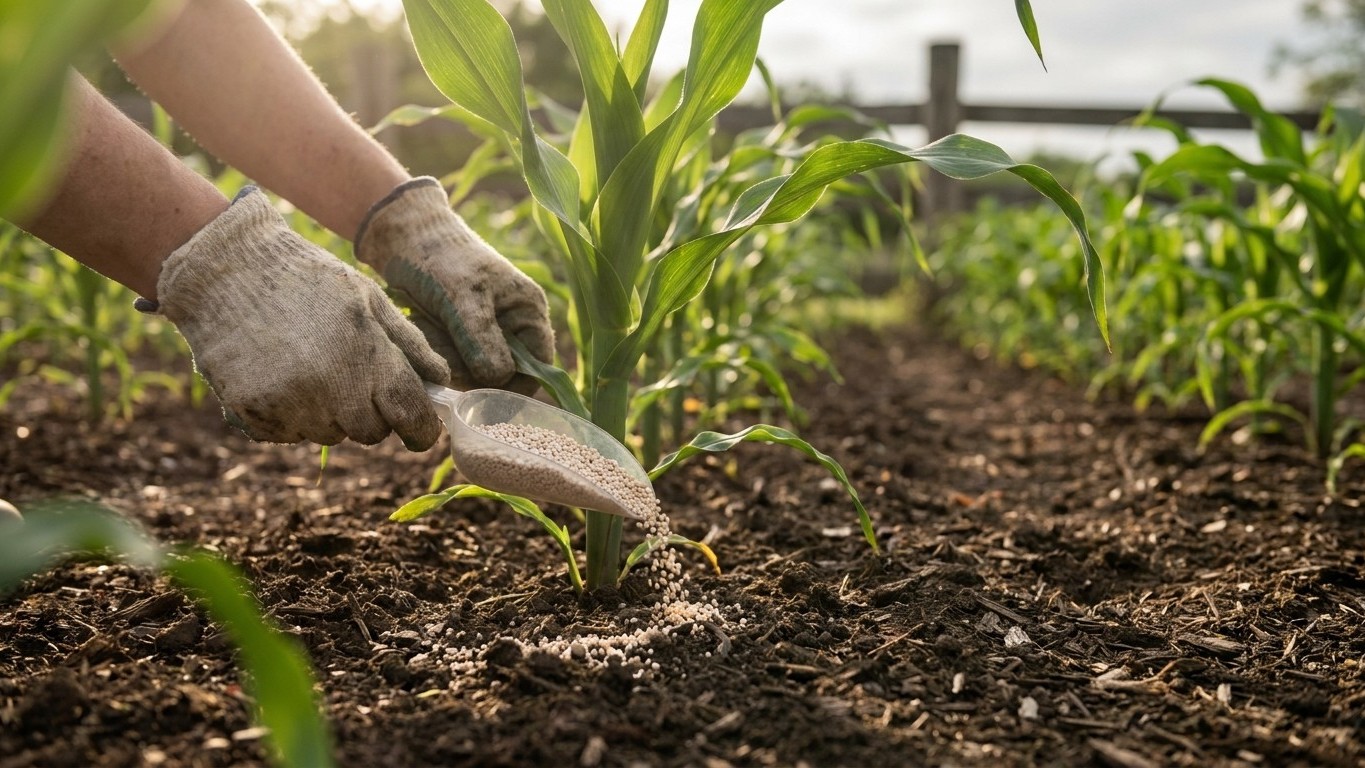

Sweet corn needs a nitrogen boost twice during its life: once when the stalks reach knee height and start pushing out several leaves, and again just as the first tassels or silk strands appear. Skip either feeding and the ears come in short, sparsely kerneled, or oddly stunted at the tip. Timing matters more than what’s printed on the fertilizer bag, because corn pulls nitrogen hardest exactly when it’s building the structure that will become an ear. Here’s what that schedule actually looks like, and why two smaller feedings beat one heavy application.
The short answer
Utah State University Extension lays out the schedule in plain terms: side dress sweet corn with 1/2 lb. of 21-0-0 per 100 square feet when plants are near knee high (8 to 10 leaves), then add another 1/4 lb. per 100 square feet when the first tassel or silks appear. That’s the whole feeding plan in two numbers, tied to two visual cues you can check by walking the row rather than counting days on a calendar.
21-0-0 is a nitrogen-heavy blend with no phosphorus or potash listed, which makes sense given the job it’s doing. Both feeding windows land during periods of fast vegetative and reproductive growth, when the plant is assembling leaf tissue, then stalk and ear structure, and needs nitrogen more than anything else. Phosphorus and potash, if a garden needs them, typically get worked into the soil before planting rather than side-dressed mid-season.
The measurement itself is a per-area rate, not a per-plant one. A 100-square-foot bed is roughly a 10-by-10 patch, so a smaller home garden gets a proportionally smaller amount. Side dressing means placing the fertilizer along the row, a few inches from the stalks, and working it lightly into the soil surface rather than sprinkling it directly onto leaves, which can scorch them.
The two-stage approach isn’t arbitrary. A single large application at planting risks nitrogen leaching away or volatilizing before the plant can use it, especially in sandy soils or after a heavy rain. Splitting the dose so the second half arrives right as tasseling and silking begin means nitrogen is available exactly when the plant is deciding how many kernels to set and how well to fill them. Growers who feed once and walk away often see fine-looking stalks but disappointing ears, because the nitrogen ran out before the reproductive stage even started.
What actually decides it
The growth-stage trigger, not the calendar
Knee high with 8 to 10 leaves and first tassel or silk emergence are physiological markers, not fixed dates. Depending on soil temperature, weather, and variety, a planting can hit knee high anywhere within a range of weeks after emergence, and different rows in the same garden planted a few days apart won’t reach these stages in lockstep. Walking the patch and checking leaf count and tassel appearance beats guessing from a planting date written on a seed packet.
Water at the same two moments
Utah State University Extension notes that soils should be maintained near field capacity, and that water needs are critical during tasseling, silking, and ear formation. That’s the same window as the second nitrogen feeding. A plant short on water during silking can’t move the nitrogen you just applied where it needs to go, and drought stress at that exact moment is one of the fastest ways to end up with poorly filled ears regardless of how much fertilizer went down. Feeding and watering aren’t separate chores here; they’re the same job at the same two moments in the plant’s life.
Two clocks that answer different questions
Sweet corn runs on two separate timers, and mixing them up causes confusion. One clock counts from planting: a variety generally needs somewhere in the range of 60 to 90 days from planting to reach harvest, and that number tells a gardener whether the crop fits the local season at all. A second, much shorter clock starts at silk emergence: roughly 17 to 24 days after silks first appear, the ears are ready to check for ripeness. The first clock is a planning tool, used back in spring to decide if there’s enough season left. The second clock is the one that actually gets a gardener out to the patch with a bucket. Treating them as the same figure leads to picking either far too early or letting ears sit too long in the field.
How to do it
- Wait until soil has warmed to 60 F before planting seed. This is a separate threshold from the last frost date; soil typically stays cool for a good while after frost danger has passed, so checking soil temperature directly avoids planting into cold, slow-germinating ground.
- Track leaf count and stalk height rather than days on a calendar. When plants are near knee high with 8 to 10 leaves, side dress with 1/2 lb. of 21-0-0 per 100 square feet along the row, working it lightly into the soil rather than letting it sit on foliage.
- Keep soil moisture near field capacity through this stage and beyond. Water needs become critical as the plant moves toward tasseling.
- Watch for the first tassel or the first silks, whichever appears first, and apply the second feeding: an additional 1/4 lb. of 21-0-0 per 100 square feet.
- Maintain consistent watering through tasseling, silking, and ear formation. This window decides how well kernels fill, and it’s the same stretch where the second feeding is doing its work.
- Once silks emerge, start counting the second clock, roughly 17 to 24 days, and begin checking ears for the three ripeness signs together: silks dry and brown, husks still moist and green, and kernels near the tip plump and releasing milky juice when punctured.
- Harvest by grasping the ear and snapping downward while twisting it off the stalk.
- Refrigerate promptly and leave ears unhusked until ready for use, since sweet corn can be stored for several days under refrigeration this way.
What goes wrong
- Skipping the knee-high feeding entirely. Plants that miss the first nitrogen dose often look pale and grow slowly through the vegetative stage, arriving at tasseling undersized. Catch it by checking leaf count weekly starting a few weeks after emergence, and feed as soon as the plant hits 8 to 10 leaves, even if it’s a bit later than expected.
- Treating the second feeding as optional. Some gardeners feed once at planting and assume that covers the season. Without the additional 1/4 lb. at first tassel or silk, ears can come in with poor tip fill because nitrogen ran short exactly during kernel set. Watch for tassel or silk emergence directly rather than relying on a single early application to carry the whole crop.
- Letting soil dry out during tasseling and silking. Because water needs are critical during this exact window, a dry spell here does more damage than the same dry spell earlier or later in the season. Keep soil near field capacity through tasseling, silking, and ear formation, checking soil moisture directly rather than guessing from rainfall totals.
- Planting different sweet corn types that tassel at the same time. Standard (su), sugary enhanced (se), and supersweet (sh2) types cross-pollinate when their tassels overlap, which can leave ears starchy and disappointing regardless of how well they were fed. The fix is staggering planting dates or choosing plantings whose tasseling windows don’t coincide, arranged in blocks rather than single rows so pollen from one type doesn’t drift heavily onto another.
- Judging ripeness from a single sign. Dry brown silks alone, or green husks alone, aren’t enough. All three signs need to show up together, dry brown silks, husks still moist and green, and milky juice from a punctured tip kernel, before an ear gets pulled.
- Letting picked ears sit out in the heat. Sweet corn loses sugar from the kernel rapidly at high temperatures, and even under optimal cold storage it holds for about five days before flavor drops off with each additional day. That five-day figure is a ceiling, not a guarantee, and it shrinks fast if ears sit on a warm counter instead of going straight into the refrigerator unhusked. Genotype plays into this too: standard (su) types lose sugar fastest, sugary enhanced (se) types hold it longer, and supersweet (sh2) types hold longest, which is worth weighing when choosing what to plant in the first place.
Common questions
Can I use a different fertilizer analysis instead of 21-0-0?
Utah State University Extension’s published rate is specific to 21-0-0. Substituting a different nitrogen blend means recalculating the actual nitrogen delivered rather than swapping pound-for-pound, since analyses vary in nitrogen percentage.
What happens if I miss the knee-high window and only feed once, later?
A single late feeding won’t fully make up for the missed vegetative-stage nitrogen, since the plant needed it during active leaf growth. Feed as soon as the miss is noticed and still apply the second dose at first tassel or silk on schedule.
Is the 17 to 24 day silk-to-harvest window the same for every variety?
The window runs from silk emergence, not from planting, which is what makes it useful across different varieties with different days-to-maturity ratings. Still, checking the three ripeness signs together matters more than counting days alone.
Does side dressing replace watering, or do both matter equally?
Both matter, and neither substitutes for the other. Nitrogen applied to dry soil sits unused until moisture carries it to the roots, which is why water needs are described as critical during the same tasseling, silking, and ear-formation window as the second feeding.