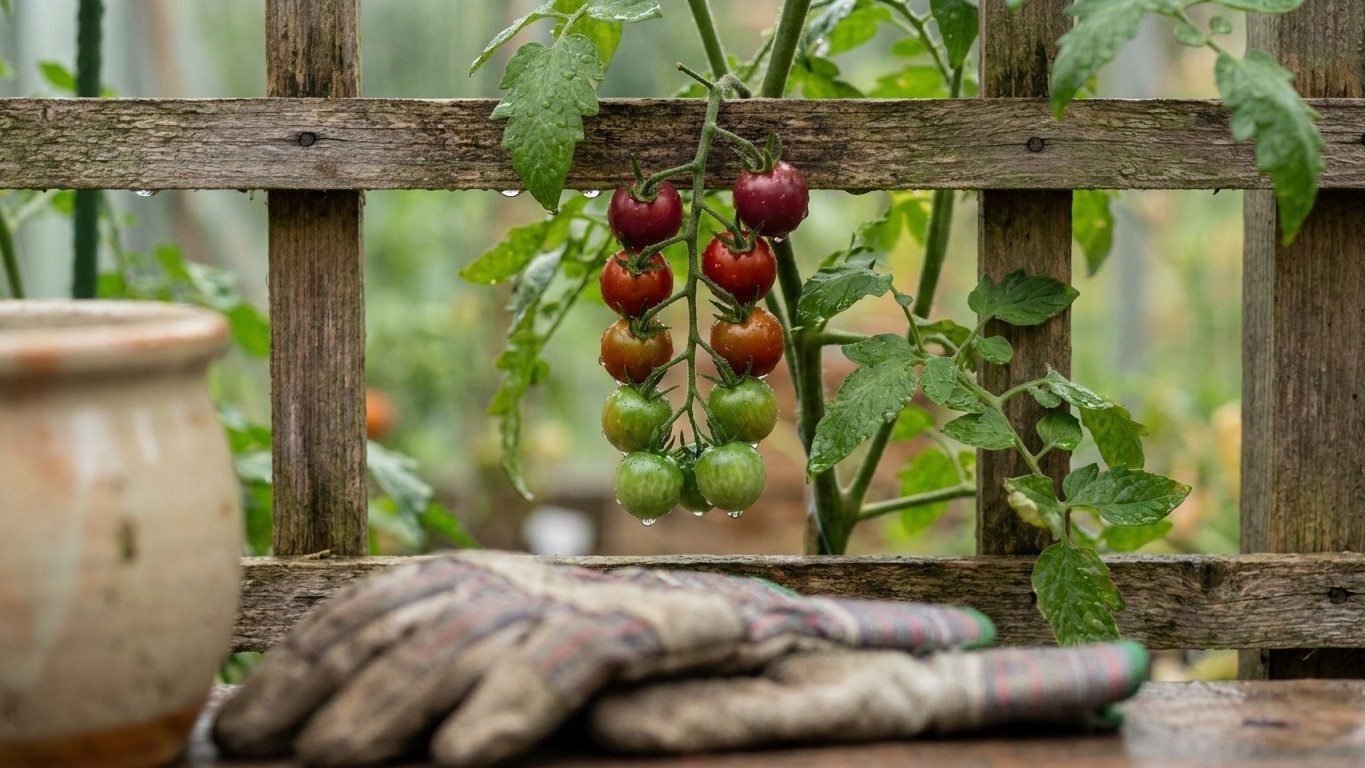

Sakura is a cherry tomato bred to crop early and keep producing right through to frost, with a catalogue days-to-maturity figure of about 55 days counted from the day you set out transplants, not from the day you sowed seed. That number, paired with your local frost dates, tells you almost everything about whether this variety fits your garden. Pull your area’s frost-free window from your state extension office or from NOAA’s climate normals before you buy seed, since that single figure decides your transplant date more than anything else on the packet.
What Sakura actually is

Sakura is a red, round cherry tomato grown for fresh eating, and its fruit stays small and uniform, which is why it shows up so often in market gardens and salad mixes. The plant is indeterminate, meaning it keeps growing, flowering and setting new trusses all season instead of ripening in one flush and stopping.
The catalogue figure of about 55 days from transplant to first ripe fruit is what you plan around, and it is worth saying plainly that seed catalogues always count from transplant, never from the day seed goes into a starting tray. Add another five to seven weeks of indoor growing before that if you are starting from seed rather than buying plants. Because it is indeterminate, Sakura also needs a support structure from the day it goes in the ground, not added later once it starts to flop. That single detail changes the whole first section of the growing notes below, since a stake driven in after the fact damages roots that a cherry tomato this productive cannot spare.
What Sakura is good for
Cherry tomatoes carry a high ratio of skin and juice to flesh, and Sakura is no exception: the fruit is built to be picked warm off the vine and eaten standing in the garden, which is exactly what most of a Sakura crop is used for before it ever reaches a cutting board. That’s not a failing of the variety, it’s the shape of the category. Sakura’s flesh is packed so tightly into such a small fruit that there’s no real volume of pulp to break down, so it never cooks down into sauce the way a paste tomato does in twenty minutes.
Where Sakura does earn its place in the kitchen is raw. It’s described as firm and crack resistant, which means the fruit holds its shape when halved and tossed through a salad instead of collapsing into seed and liquid — a real problem with softer-skinned cherry types that split as they ripen and weep once cut. That firmness also means the fruit survives a short trip from garden to bowl without bruising, which matters if you’re snacking straight off the truss or packing them for a lunchbox. Combined with the sweetness the variety is bred for, that firm skin is why the stated uses are salads and snacking rather than anything that involves heat.
If you do cook with Sakura — tossed whole into a hot pan for a quick blistered side dish, for instance — expect the skins to hold together rather than break down into a sauce base the way a low-water, thick-walled paste tomato would. That’s a function of the fruit’s small size and high water content relative to flesh, not a defect. Beyond salads and snacking, no other culinary use is documented for this variety, and nothing here should be read as a substitute for testing it yourself in whatever dish you have in mind.
Where it ripens in time, and where it is a gamble
The arithmetic is the same wherever you garden: take your frost-free window, subtract roughly two weeks for the soil to warm enough to set transplants safely, subtract Sakura’s 55 days to first fruit, and what is left is your picking season. Where that remainder runs under a month, one cool week can end the harvest before it properly starts.
Where the margin is tight
In Yukon, the reference station at Whitehorse gives growers a set-out window in mid June and a first ripe fruit around mid August, leaving only about 12 days of margin before frost returns. That is not enough for a second flush, and a cold snap in a poor year takes the whole crop. Whitehorse also logs only around 600 accumulated degree-days across the season, which matters independently of frost: even a long, mild autumn cannot compensate for a summer that never gets warm enough for long enough, and a grower there is better served by a greenhouse or a poly tunnel than by an open bed. Nunavut, measured from Rankin Inlet, is similar: 17 days of margin and only around 159 degree-days, which is a heat deficit no amount of frost-free window fixes.
Where a greenhouse tips the balance
Alberta, measured from Calgary, gives about 49 days of margin with a set-out in early June and first ripe fruit by late July, and Manitoba and Saskatchewan sit close behind at 53 and 54 days respectively. All three are graded “greenhouse” territory in our figures, not because the frost-free window is short, but because the season’s accumulated warmth runs low, around 1,171 degree-days in Calgary and closer to 1,800 in Winnipeg and Saskatoon. An early cherry variety and black plastic mulch to push soil temperature up both help close that gap, the same trick that makes a variety like Sun Gold workable at similar latitudes.
Where the margin stops mattering
Further south the picture flips entirely. Washington, from the Seattle station, shows about 171 days of margin with transplants going out from mid March to early April and first fruit by late May. Texas, from Houston, and Louisiana, from New Orleans, run over 200 days of margin each, with transplants going out as early as mid February. At that point frost is no longer the limiting factor at all, and the constraint moves to summer heat instead, which the next section covers.
The two ways a season goes wrong
A long frost-free window on paper does not guarantee a good crop, and Sakura’s early maturity puts it on the right side of both problems that a frost table cannot show you.
Not enough warmth, not just not enough time
In the coldest territories above, the limit is not the calendar, it is accumulated heat. Tomato flowers will not set fruit reliably once nights fall below 50F, and a place like Whitehorse or Rankin Inlet can have a technically frost-free stretch that never delivers enough warm nights in a row for pollination to happen consistently. This is why degree-days matter more than the frost date once you are gardening at that latitude, and why a tunnel or greenhouse that raises night temperature earns its keep even where the open-air frost window looks adequate on paper.
Too much heat, at the wrong end of the country
In Gulf Coast and desert territories, the opposite failure shows up. Once daytime temperatures push past roughly 86F, tomato pollen goes sterile and flowers drop without setting fruit, which is why growers in places like Houston, New Orleans and Las Vegas run a spring crop and a separate autumn crop rather than one continuous season. For Sakura specifically, its short 55-day maturity is an advantage here: a spring transplant set out in February can ripen well before the mid-summer heat shuts pollination down, and a second round can go in once nights cool in early autumn. A slower-maturing variety loses that flexibility because it runs straight into the sterile window before it finishes its first flush.
For this variety, the northern heat-deficit problem is the more serious of the two, because indeterminate cherry tomatoes are bred to keep flowering all season, and a short accumulated-warmth window simply denies them the chance to use that habit at all.
What it resists, and what it does not
Sakura carries high resistance to Fusarium Wilt races 1 and 2, a soil-borne fungal disease that otherwise causes wilting and yellowing that starts on one side of the plant and works up the stem. High resistance means the plant can be grown in soil carrying those races without the disease taking hold under normal pressure, which is a real advantage in beds that have grown tomatoes for years without rotation.
That is the only resistance listed for this variety, and it is worth being direct about what that means: Sakura carries no listed resistance to early blight, late blight, septoria leaf spot or verticillium wilt, all of which are common problems for cherry tomatoes grown in humid or wet summers. A grower who plants Sakura expecting broad disease protection because of its Fusarium resistance is setting up for a bad surprise the first time leaf spot shows up in a wet August. The practical response is the same one that applies to any tomato without blight resistance: keep foliage dry with drip irrigation instead of overhead watering, space plants for airflow, and remove lower leaves that touch the soil where fungal spores overwinter. None of that is specific to Sakura, but skipping it is the mistake growers make precisely because a variety’s one strong resistance gets mistaken for general toughness.
Growing it without the usual mistakes
Because Sakura is indeterminate, it needs the same commitment as any vining tomato: a stake, cage or trellis installed at transplant time, not added once the plant starts sprawling. A single stem trained up a stake with side shoots pinched out gives the earliest fruit and the easiest picking, while an unpruned plant in a cage sprawls wider and yields more total fruit but ripens each truss a little later.
Spacing and feeding
Give it the spacing any indeterminate cherry tomato needs, since crowded plants are slower to dry after rain and more prone to the leaf diseases the previous section flagged. Feed it a balanced fertilizer through the first flush of fruit, then cut nitrogen back once the plant is setting heavily. This keeps the plant putting energy into fruit rather than leaf growth, which matters more for an indeterminate variety than for a determinate one, because Sakura will happily keep growing new foliage all season if you let it, at the expense of the trusses already loaded with fruit.
The mistake this variety’s timing invites
Because Sakura ripens quickly, growers in short-season territories are tempted to set it out as early as the soil allows, sometimes before the two-week soil-warming window the arithmetic above assumes. Tomato roots stall in cold soil regardless of how fast the variety matures above ground, so an early transplant into cold ground often ends up ripening no sooner than one set out on schedule, just weaker for the whole season. The fix is patience with soil temperature, not with the calendar: wait for the soil to warm rather than the air, and count your 55 days from that date.
- Stake or cage installed at transplant, before the vine needs it
- Drip or soaker-hose watering instead of overhead sprinklers
- Nitrogen reduced once heavy fruit set begins
- Lower leaves removed as they yellow or touch soil
- Transplant timed to soil temperature, not to the earliest safe air date
Anyone growing several tomato varieties side by side will notice Sakura’s vines keep producing after slower main-season types have finished their first big flush, which is the payoff for the staking and feeding work above.
Common questions
How many days does Sakura tomato actually take to ripen?
The catalogue figure is about 55 days from transplant, not from seed. That figure is measured under good growing conditions, so expect it to run a week or so longer in a cool spring or in soil that was set out before it had fully warmed.
Is Sakura tomato determinate or indeterminate?
Indeterminate. It keeps growing and setting new fruit all season rather than ripening in one flush, which is why it needs staking from the start and why it can keep cropping until frost where the season allows.
Can I grow Sakura tomato in a short-season climate?
Yes, with help. In territories where the accumulated summer warmth runs low, growers use a greenhouse or poly tunnel, an early transplant date once soil has warmed, and black plastic mulch to lift soil temperature, all of which push the margin in the plant’s favor.
Why did my Sakura tomato stop setting fruit in midsummer?
Most likely the pollen went sterile from daytime heat above roughly 86F, a problem in the hottest parts of the country rather than a plant health issue. Fruit set usually resumes once nights cool, which is why growers in hot territories plant a spring crop and a separate autumn crop instead of expecting one long season.