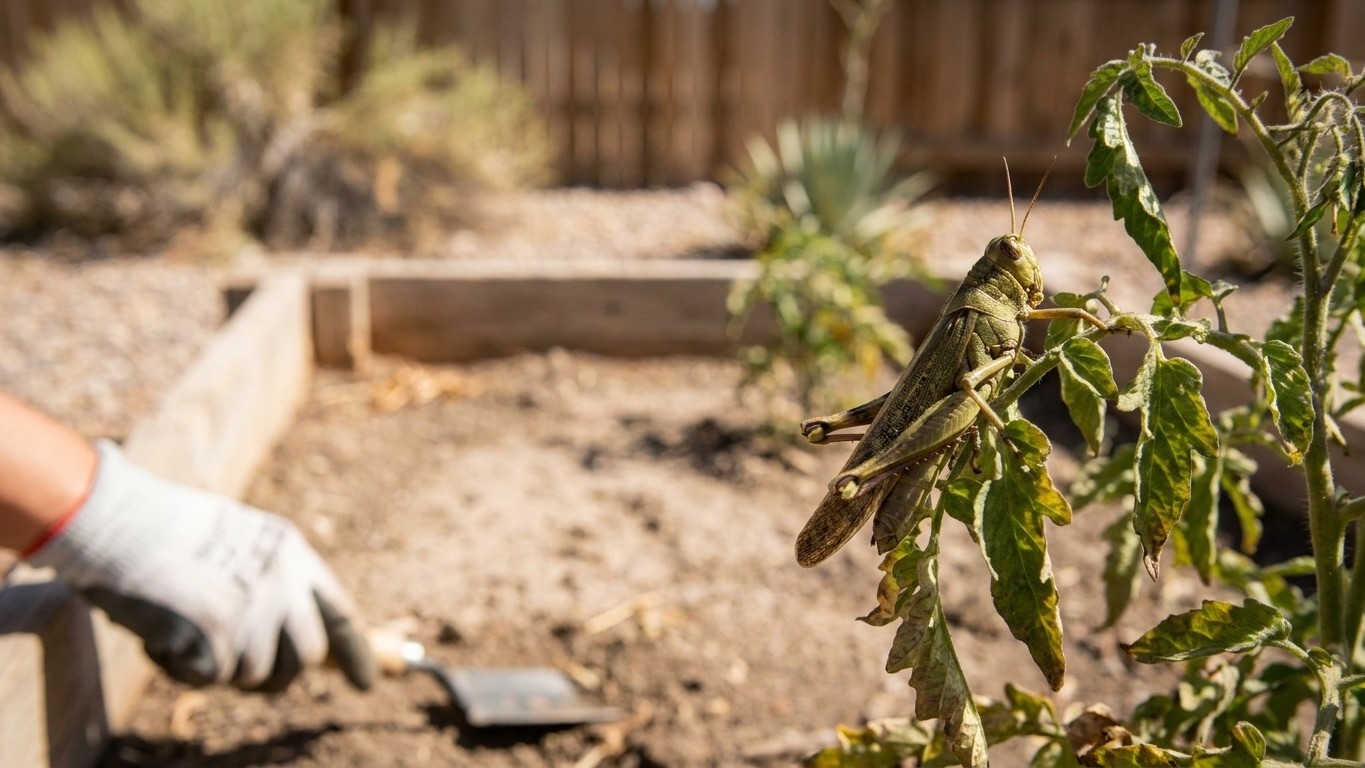

Nevada gardens contend with nine pests that the state’s own extension service flags most often for home growers: squash bugs, aphids, Mormon crickets, hornworms, cabbage moths, earwigs, shield bugs (the ones most gardeners call stink bugs), elm leaf beetles, and Japanese beetles. Which ones actually find your yard depends on what you grow, how close you sit to open desert or an elm-lined street, and where you are in the season. The rest of this guide covers what each pest does to a plant, how to separate insect damage from disease or a watering mistake, and where to send a specimen when you genuinely can’t tell.
What Nevada gardens actually deal with

Why the climate favors these pests
Nevada’s growing conditions are demanding in ways that push plants toward stress, and stressed plants are exactly what many of these pests are built to exploit. Long stretches of dry heat with very low humidity mean vegetable beds and ornamentals lose water fast, and a plant that’s running a moisture deficit is more attractive to piercing-sucking feeders like aphids than a well-watered one. Wide plantings of a single crop, which is common in home gardens built around what actually tolerates desert heat, gives pests like squash bugs a concentrated food source to settle into once they find it. The same logic applies to street trees: elms are planted heavily in dry landscaping because they hold up to heat and poor soil, and that concentration of one species is precisely what lets elm leaf beetle populations build year after year in the same neighborhoods.
Mormon crickets are a different case entirely. They’re a rangeland species, not a garden pest by origin, and their numbers rise and fall in cycles tied to conditions well outside any one yard. In a year when their population booms on open desert or foothill ground, a garden sitting near that terrain can see a sudden wave of them regardless of what’s actually planted, while a garden in a denser urban pocket may never see one. That’s the one pest on this list where prevention in your own beds does almost nothing; watching regional reports matters more than anything you do with a hose or a row cover.
The nine to know
Here’s what each one targets and the signature sign it leaves behind. This is a starting point for identification, not a diagnosis on its own; treat it as a first filter before you look closer at the actual damage.
| Pest | Plants Most at Risk | Signature Sign |
|---|---|---|
| Squash bug | Squash, pumpkin, other cucurbits | Wilting vines, clusters of bronze eggs on leaf undersides |
| Aphids | Nearly any vegetable or ornamental | Sticky honeydew, curled new growth |
| Mormon cricket | Vegetable beds near open desert or rangeland | Sudden, heavy defoliation during outbreak years |
| Hornworms | Tomatoes, peppers | Large chewed leaves, dark droppings on foliage below |
| Cabbage moth | Brassicas (cabbage, broccoli, kale) | Ragged holes in leaves, small green larvae |
| Earwigs | Seedlings, soft fruit | Ragged edges, feeding concentrated at night |
| Shield bugs (stink bugs) | Tomatoes, beans, many vegetables | Cloudy or sunken spots on developing fruit |
| Elm leaf beetle | Elm trees | Skeletonized leaves, lacy leaf veins |
| Japanese beetle | Roses, fruit trees, many ornamentals | Skeletonized leaves, metallic green-and-copper beetles |
Telling damage apart

Reading the pattern first
The shape of the damage tells you more than the plant it’s on. Ragged, ripped edges usually mean something with chewing mouthparts is at work, whether that’s a hornworm, an earwig working at night, or a beetle feeding in the open during the day. Fine pale stippling, almost like a dusting of tiny dots across a leaf, points to piercing-sucking feeders that drain individual cells rather than take bites, which is the pattern aphids and shield bugs both leave. Leaves reduced to a lace of veins with the green tissue gone are a sign of heavy, sustained beetle feeding, the kind elm leaf beetle and Japanese beetle both cause once their numbers build. Sticky residue on leaves, or a black sooty film growing on top of that residue, is the calling card of an aphid colony, since the honeydew they excrete coats everything below them and mold grows on the sugar.
When it’s not a bug at all
Wilting is the symptom that fools the most people, because it can come from a pest, a disease, or nothing more than a watering mistake, and the fix is completely different in each case. If the soil at the root zone is dry, the plant is underwatered, full stop; check depth with a finger or a trowel rather than trusting the surface, since the top inch can look dry while the root zone underneath is fine. If the soil is moist and the plant is still wilting, especially if it’s wilting evenly rather than in one section, that points toward root rot or a vascular disease rather than an insect, and no pest spray will help it. If the wilting is localized to one vine or one branch while the rest of the plant looks fine, that’s more consistent with an insect feeding right at that point, which is exactly how squash bug damage often starts.
Before treating anything, turn the leaf over. Diseases tend to show as spots with defined margins or rings, and they hold still from day to day; live insects and their eggs are visible on close inspection, and the damage they cause tends to spread day over day as they keep feeding. Skipping that check is the single most common reason home treatments fail, because a fungicide does nothing for an aphid problem and an insecticide does nothing for root rot.
- Look under leaves before assuming it’s disease
- Check soil moisture at the root zone, not just the surface
- Note whether the damage is spreading day to day or holding in one spot
- Look for frass, eggs, or the insect itself, not just the damage it left
When each one shows up
Early season
The most vulnerable window for any plant is right after it goes into the ground, when tissue is soft and there’s little of it to spare. Earwigs and aphids both key in on tender new growth, so seedlings and fresh transplants deserve a close look in the first weeks rather than waiting until damage is obvious. Cabbage moth larvae tend to appear once brassica leaves are big enough to support them, so a young broccoli or kale plant that looked clean a week ago can carry chewed holes seemingly overnight once the larvae hatch and start feeding.
Midsummer through fall
Squash bugs build in step with the plant itself, showing up as vines spread and flowering starts, and the eggs cluster on the undersides of leaves near the base of the plant where they’re easy to miss if you only glance at the top growth. Hornworms tend to arrive once tomato and pepper plants are full-sized and setting fruit, and the droppings on the leaves below usually show up before you spot the caterpillar itself, which is remarkably well camouflaged against the stem. Shield bugs follow fruit set closely on tomatoes and beans, feeding directly on developing fruit rather than foliage. Elm leaf beetle activity tracks the tree’s own leaf-out and full canopy stage, so mature elms are worth checking through the growing season rather than at one fixed point.
Japanese beetle and Mormon cricket activity don’t follow a plant-growth pattern the way the others do; both are tied more to population cycles than to what stage your garden happens to be at. The practical habit, across all nine of these, is watching your specific plants at each growth stage rather than marking a date on a calendar, since a low desert valley like Las Vegas and a cooler, higher part of the state can run weeks apart on the same crop.
What actually works
Prevention comes first
Rotation breaks life cycles that depend on the same host being in the same spot year after year, which matters most for squash bugs since they overwinter near where cucurbits grew before; moving that crop to a different bed each season denies them an easy start. Timing helps too: getting transplants past their most tender stage before pest pressure typically builds, and using row cover over young seedlings while they’re small, keeps the most vulnerable window shielded without any spray at all. Physical removal works better than most gardeners expect, since scraping squash bug egg clusters off the undersides of leaves before they hatch, or hand-picking hornworms off tomato stems, eliminates the problem directly rather than just suppressing it.
Encouraging predators is the part gardeners skip most often, and it’s arguably the highest-value move available. Lacewings, ladybugs, and several parasitic wasps all prey on aphids and other soft-bodied pests, but a broad-spectrum insecticide kills them right alongside the pest it was aimed at, which can make a problem worse a few weeks later once the aphids rebound with no predators left to check them. Letting a few plants flower rather than deadheading everything gives those beneficial insects a food source and a reason to stick around. Skip the companion-planting claims that promise one plant repels everything; the evidence behind most of those pairings, like marigolds warding off every pest in the bed, is thin at best.
When intervention is needed
Once a pest is established, hand-picking remains one of the most effective responses for anything large enough to see, which covers hornworms, Japanese beetles, and adult squash bugs. A strong jet of water knocks aphid colonies down and is worth trying before reaching for any product. If you do use a spray or dust, match it to the actual pest and its life stage rather than buying whatever’s marketed broadly, and read the label fully before applying it, since wrong pest, wrong dose, or wrong timing is the most common reason a home treatment does nothing. Dish soap sprays, garlic sprays, and similar home remedies that circulate online have little to no real effect once a pest population is established, whatever the anecdotes claim.
None of this is unique to Nevada. Rotating host plants, breaking a pest’s life cycle, and favoring beneficial insects over broad sprays are the same fundamentals that hold up wherever you garden, including places with a completely different climate; see how growers handle their own seasonal pattern in Garden Pests in Montana: What Shows Up, When, and How to Stop It.
Local help
If you can’t pin down what’s actually chewing, sucking, or wilting your plants, don’t guess with a spray. University of Nevada, Reno Extension identifies specimens for home gardeners and tracks outbreak activity across the state, and their extension service is the right first call before you buy anything. For more on gardening through Nevada’s different climate zones, from low desert valleys to higher, cooler ground, browse our Nevada guides.
Common questions
Is that a stink bug or a shield bug in my garden?
They’re the same insect family under two different names; Nevada’s extension service uses “shield bugs,” while most home gardeners default to “stink bugs.” Don’t let the naming throw off your identification, since the damage pattern, cloudy or sunken spots on developing fruit, is the same regardless of which name you use.
Do Mormon crickets actually show up in home gardens, or is that just a farm problem?
They can reach home gardens, particularly ones near open desert or foothill terrain, during years when their regional population spikes. Away from that kind of edge terrain, a garden may see little to none of them even in a heavy outbreak year, so local reports matter more than anything happening in your own beds.
Will ladybugs actually get rid of my aphids?
Ladybugs and their larvae genuinely eat aphids, but buying a container of them and releasing them into an open garden rarely delivers lasting control, since most fly off within a day or two if there isn’t enough food and shelter to hold them. Encouraging populations that are already present, by skipping broad sprays and letting a few plants flower, does far more than one release ever will.
How do I know if Japanese beetles have reached my area?
Look for the beetles themselves, metallic green with copper-toned wing covers, feeding openly on leaves in daylight, along with the skeletonized leaf damage they leave behind. If you’re not certain what you’re looking at, that’s exactly the kind of specimen University of Nevada, Reno Extension can confirm rather than guessing from a photo online.