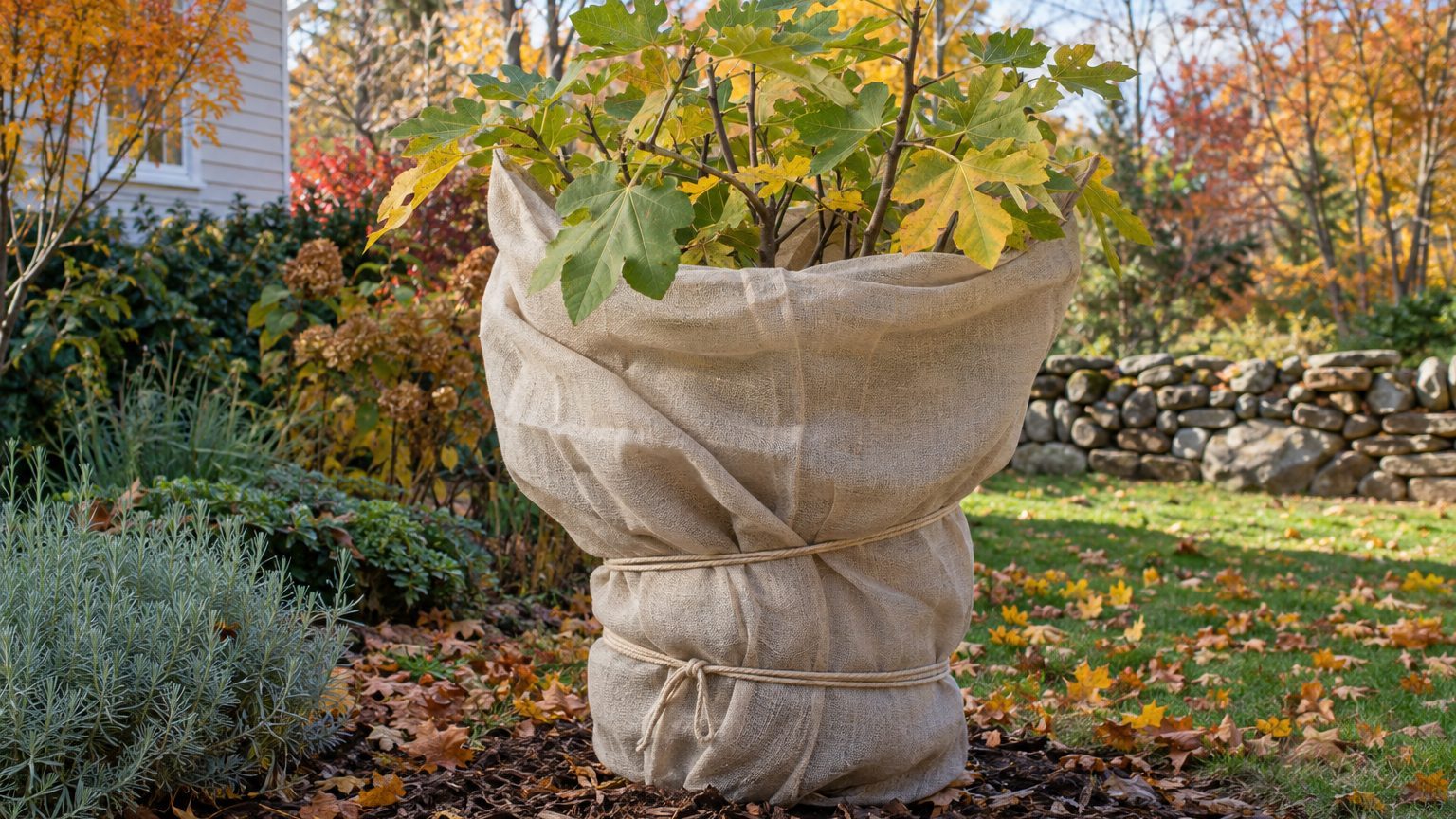

Burlap over tied-up branches, a deep organic mulch around the base, and no plastic anywhere will carry an in-ground fig through a hard winter. A fig in a large pot can skip the wrapping if you have a cool, unheated spot to park it. Pick the route that suits your yard now. Then get the burlap on the shelf or the garage floor cleared before the cold settles in.
Wrap it, mulch it, or bring it in

UNH Extension says figs grow well in USDA Zones 7-10, and Rutgers NJAES Cooperative Extension says they thrive where winter temperatures do not drop below 15° F. In colder places a fig in the ground needs protection, and a fig you cannot protect belongs in a container.
Check your own winter first
The two sources measure cold differently. UNH uses a hardiness zone, which reflects long-term average winter lows. Rutgers gives a temperature floor. Do not convert one into the other. Look at your zone, then look at what your own yard actually gets. A low corner where cold air pools, or a bed open to wind, can be harsher than the zone suggests. A spot against a sheltered wall can be kinder.
Canadian readers should treat a cold-climate fig the same way. It needs the protection the sources below describe, and where Canadian guidance differs from these US extension recommendations, follow the Canadian guidance. Your provincial or local extension contact is the place to check.
The three routes
| Route | What you do | Source | What you accept |
|---|---|---|---|
| Wrap in the ground | Tie the branches, cover with burlap or canvas, mulch the base | Virginia Cooperative Extension | A job to finish before hard cold, and a tree that stays outdoors |
| Container in a cool place | Grow in a large container, store in an unheated attached garage or cool basement | Iowa State University Extension and Outreach | A heavy pot to move and indoor space to give up |
| Accept dieback | Leave the tree and let the roots regrow | University of Illinois Extension | Branches that may be winter-killed |
The first route keeps the most of the tree. Virginia Cooperative Extension’s guide for backyard figs covers the wood above ground and the base below it. The second route suits a gardener in a cold state. Iowa State says that in Iowa, common figs are best grown in large containers and overwintered in a cool location, such as an attached, unheated garage or cool basement. The third route is less a plan than a fallback. University of Illinois Extension notes that if the winter is incredibly harsh and the branches are winter-killed, the roots usually send up new branches in spring.
These are not exclusive. A gardener on the edge of fig country might wrap an in-ground tree and keep a potted backup in the garage in case the wrap fails.
Wrapping a fig in the ground
Virginia Cooperative Extension gives four steps for an in-ground fig, and the order matters because each one sets up the next. The wrap is one case of the wider job of winter protection. The principle is shelter without sealing. Plan the work against your first frost dates by state, so the tree is wrapped before the hard freezes arrive, not after.
- Tie back the flexible branches with string or twine, then cover them with breathable wrapping, such as burlap or canvas.
- Do not use plastic. Virginia Cooperative Extension warns that it will create a moist environment for mold and fungi.
- Protect the base. Virginia Cooperative Extension says it should be mulched 6 to 12 inches from the center with organic materials.
- In winter, water the plant monthly until the soil is just moist.
Why breathable matters
Plastic traps condensation against the bark, which is exactly the damp Virginia Cooperative Extension is warning about. Burlap and canvas are breathable. That is the whole difference between a shelter and a sealed bag. When you tie the bundle, pull the string snug. Do not cinch it too tight. The guide specifies flexible branches, so if a stem resists, leave it rather than force it.
The base and the water
The mulch protects the part of the tree that regrows if the top is lost. Use an organic material such as shredded leaves, straw or bark chips, and measure from the center of the plant, as the guide does. If you want more on laying it, see our page on mulching.
The watering instruction is easy to skip because nothing seems to be growing. Virginia Cooperative Extension says to water monthly until the soil is just moist. The target is just moist, not wet. A wrapped tree under mulch will not get much from rain, so the soil can dry out.
A fig in a container
Iowa State University Extension and Outreach is blunt about this for cold states. In Iowa, common figs are best grown in large containers and overwintered in a cool location, such as an attached, unheated garage or cool basement. Moving the tree solves the problem at its source. A pot is out of the wind, and nothing needs wrapping.
Choosing the spot
The key word in the Iowa State advice is cool. A heated living room does not qualify, and neither does a basement with a furnace running beside the tree. Ask your county extension office what range suits figs in your area, and compare it against the space you have.
A large container means a heavy one once it is full of soil. Put it on a wheeled plant caddy before you fill it. The monthly watering in the previous section is Virginia Cooperative Extension’s advice for in-ground plants, so for a pot, follow our guide on how to overwinter potted plants, which covers watering and storage for containers.
If the branches die anyway
A fig can lose its top growth and still be alive. University of Illinois Extension says that if the winter is incredibly harsh and the fig branches are winter-killed, the roots usually send up new branches in spring. Do not dig the tree out because the branches look dead in late winter. The roots are the part that matters, which is why the mulch around the base is worth doing even if you skip the wrap.
Wait until spring growth shows before you cut. Live wood leafs out and dead wood does not, so the tree will tell you where to prune. The Illinois statement is about branches, not fruit. Treat any figs as a bonus.
If you are unsure how likely a harsh winter is where you live, check your state’s guide for local conditions, and keep an eye on your frost dates so you are never caught without a wrap or a plan.
Common questions
Can I use plastic if I cut holes in it?
No. Virginia Cooperative Extension says not to use plastic at all, because it creates a moist environment for mold and fungi. Holes will not make it behave like burlap or canvas, which are the materials the guide names.
Do I need to protect a fig in Zone 8?
Possibly not, but check your own winter lows. UNH Extension says figs grow well in USDA Zones 7-10, so Zone 8 sits inside that range. Rutgers NJAES Cooperative Extension sets its own line at winter temperatures not dropping below 15° F. If your yard gets colder than that, protect the tree.
I’m in Canada. Do these rules apply?
The method does, but the thresholds may not. A cold-climate fig needs the protection these US extension sources describe. These sources say nothing about Canadian zones, so use Canadian guidance where it differs.
When should I cut off the dead branches?
Wait until spring growth appears. University of Illinois Extension says the roots usually send up new branches after a harsh winter. Until the tree leafs out, you cannot tell dead wood from dormant wood, and cutting early may remove branches that were still alive.
Winter protection advice is revised over time, so confirm the current recommendation with your county extension office before you act.