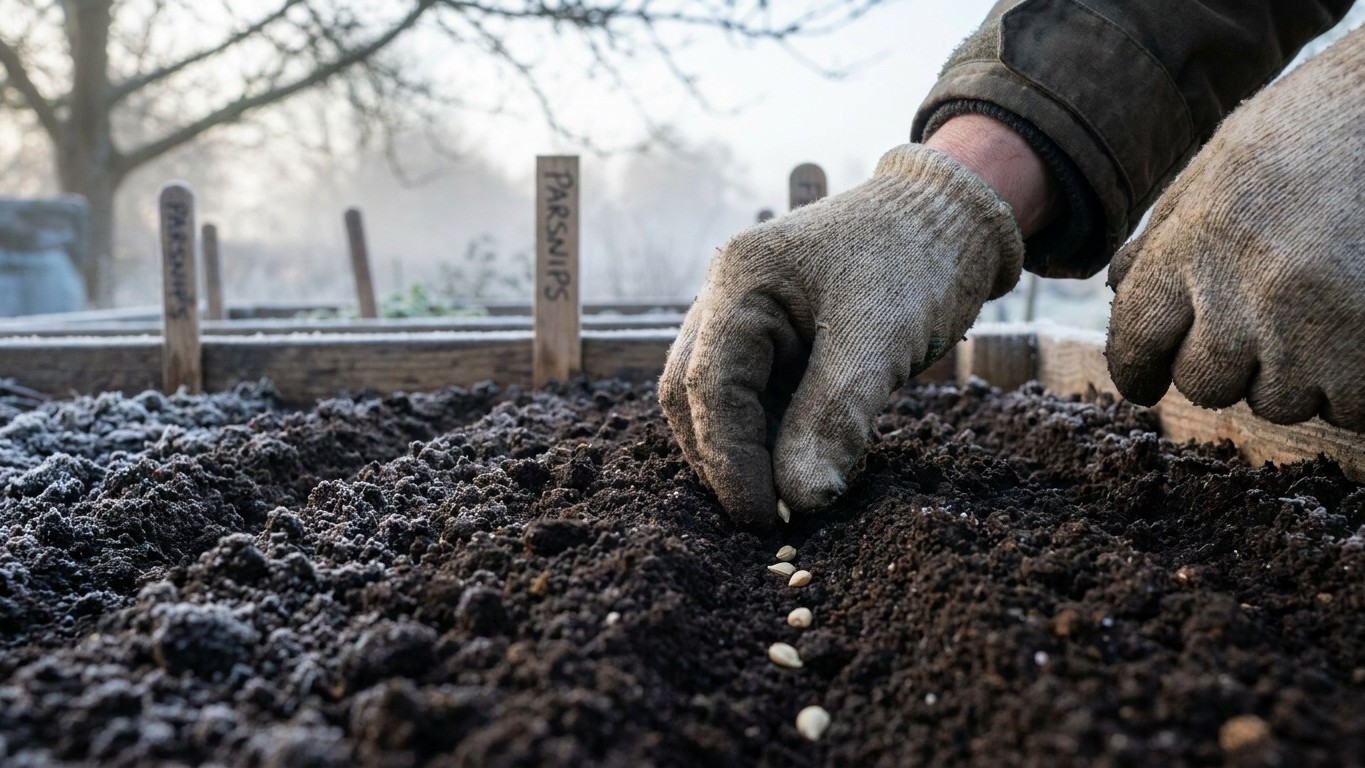

In Illinois, parsnip seed goes into the ground about two to three weeks before the last spring frost, which the Chicago reference station places between April 11 and April 22. That puts the sowing window at roughly March 21 to April 8, earlier in warmer pockets, later in cooler or low-lying spots. Illinois winters run cold enough that parsnips left in the soil will sweeten, not just size up.
The short answer
The question that actually settles this isn’t which hardiness zone a county sits in. It’s whether the ground here goes through several genuinely frosty weeks, because that’s what converts a parsnip’s stored starch into sugar. Hardiness zones tell you what a plant can survive over winter. They say nothing about whether a root vegetable sitting in that same ground gets cold enough, often enough, to change its flavor.
For the Chicago reference station, the mean daily minimum temperature during the coldest month sits at 18.8°F. That’s not a record low and not a seasonal average, it’s the typical low point of an average night in the coldest stretch of winter, drawn from NOAA NCEI’s 1991-2020 climate normals. A number that low, repeated across weeks rather than a single cold snap, is exactly the kind of sustained frost exposure parsnips need. This isn’t a one-night frost that nips a few leaves. It’s weeks of the ground dipping well below freezing on a regular basis, which is precisely the mechanism Utah State University Extension points to when it says parsnips taste best after several weeks of cool, frosty weather.
So the answer for Illinois growers is straightforward: this climate delivers the cold exposure parsnips need to sweeten properly. A gardener who leaves roots in the ground through October and into the first hard frosts, rather than pulling everything at first light frost, will taste the difference. That’s a real advantage over milder states where winters stay too soft to trigger the starch-to-sugar conversion, leaving growers with a perfectly edible but blander root.
None of this changes when to plant, though. The sweetening happens at the back end of the season, tied to fall and winter cold. The sowing decision is tied to the opposite end, the last spring frost, and to how many days the crop needs before it can even think about facing that first autumn freeze. Those are two separate clocks, and mixing them up is the most common mistake gardeners make with this crop.
Does the season fit?
Parsnips are sown directly in place, not started indoors and transplanted, and the 100 to 120 days USU Extension gives for this crop are counted from the day seed goes into the soil. Here’s how that math plays out against Illinois’s frost calendar.
- Sowing window: Two to three weeks ahead of the April 11-22 last-frost range works out to roughly March 21 through April 8 for the Chicago reference station. Gardens outside the city, especially rural and low-lying ones, often see frost linger a week or two later, so late March feels early for anyone away from an urban heat pocket.
- Germination lag: Parsnip seed is slow. Expect 14 to 21 days before anything visible breaks the soil surface. Sow March 25 and don’t be surprised if nothing shows until well into April. This isn’t a failed sowing, it’s just how this seed behaves, and re-sowing too early out of impatience is a common and unnecessary step backward.
- Maturity math from the early end: A March 21 sowing plus 100 days lands around June 29. Plus 120 days lands around July 19.
- Maturity math from the late end: An April 8 sowing plus 100 days lands around July 17. Plus 120 days lands around August 6.
- Comparing to fall frost: The first fall frost at the reference station arrives between October 24 and November 3. Even the latest maturity estimate, early August, leaves roughly 80 to 90 days of open ground before that first freeze.
That gap is the point. Illinois’s growing season doesn’t just fit the 100-to-120-day requirement, it fits with room to spare, room that lets a gardener leave mature roots sitting in the ground deliberately, absorbing those frosty weeks that build sweetness, instead of racing to harvest the moment the calendar says the crop is technically done.
What goes wrong here
- Forked roots from heavy or stony clay ground. Much of Illinois carries dense clay soil, and parsnip taproots split around compaction, rocks, or clumps rather than pushing through them. USU Extension recommends deep sandy soil for this crop and says heavy soil needs to be double dug before sowing, loosened well beyond the depth of a single spade pass so the root has a clear, uniform path down.
- Forked roots from overwatering. This is a separate cause from soil texture, not a variation on it. Even in loose, well-worked ground, keeping the bed consistently soggy encourages roots to branch and fork as they seek air pockets. Moderate, even moisture beats a heavy hand with the hose, especially once seedlings are established.
- Slow germination mistaken for a failed sowing. Because parsnip seed can take 14 to 21 days to emerge, gardeners often assume the bed failed and till it under to re-sow. Mark the row, keep the soil lightly moist, and give it the full three weeks before making any judgment call.
- Frozen ground blocking harvest. Leaving roots in place to sweeten only works if you can still dig them once winter sets in. A heavy mulch layer applied before the ground locks up keeps the soil workable enough to pull roots through much of the cold season, rather than losing access right when the flavor peaks.
Common questions
Can I sow parsnips earlier than late March in Illinois?
Sowing much earlier than the two-to-three-week window ahead of the last frost risks seed sitting in cold, wet soil for weeks without germinating, which raises the odds of rot before sprouts ever appear. It’s better to wait for soil that’s workable and has started to warm, even if that means starting closer to early April in cooler counties.
Do I need to wait for a hardiness zone map to decide when to sow?
No. The zone map describes winter survival for perennial plants, not the frost timing or frost exposure that governs an annual root crop like parsnips. What matters here is the local last and first frost dates and how cold the coldest month actually runs, not which zone number applies to the county.
How long can parsnips stay in the ground after they mature?
Given the roughly 80 to 90 days of margin between typical maturity and the first fall frost in Illinois, plus additional weeks after that first frost, there’s substantial room to leave roots in place through multiple frosty spells for sweetening, provided the ground stays diggable or is mulched to keep it that way.
Why did my parsnip seed not come up after two weeks?
Two weeks is within the normal range. Parsnip germination runs 14 to 21 days, so a lack of visible sprouts at the two-week mark isn’t unusual. Hold off on re-sowing until the full three-week window has passed and the soil has been kept consistently moist during that stretch.