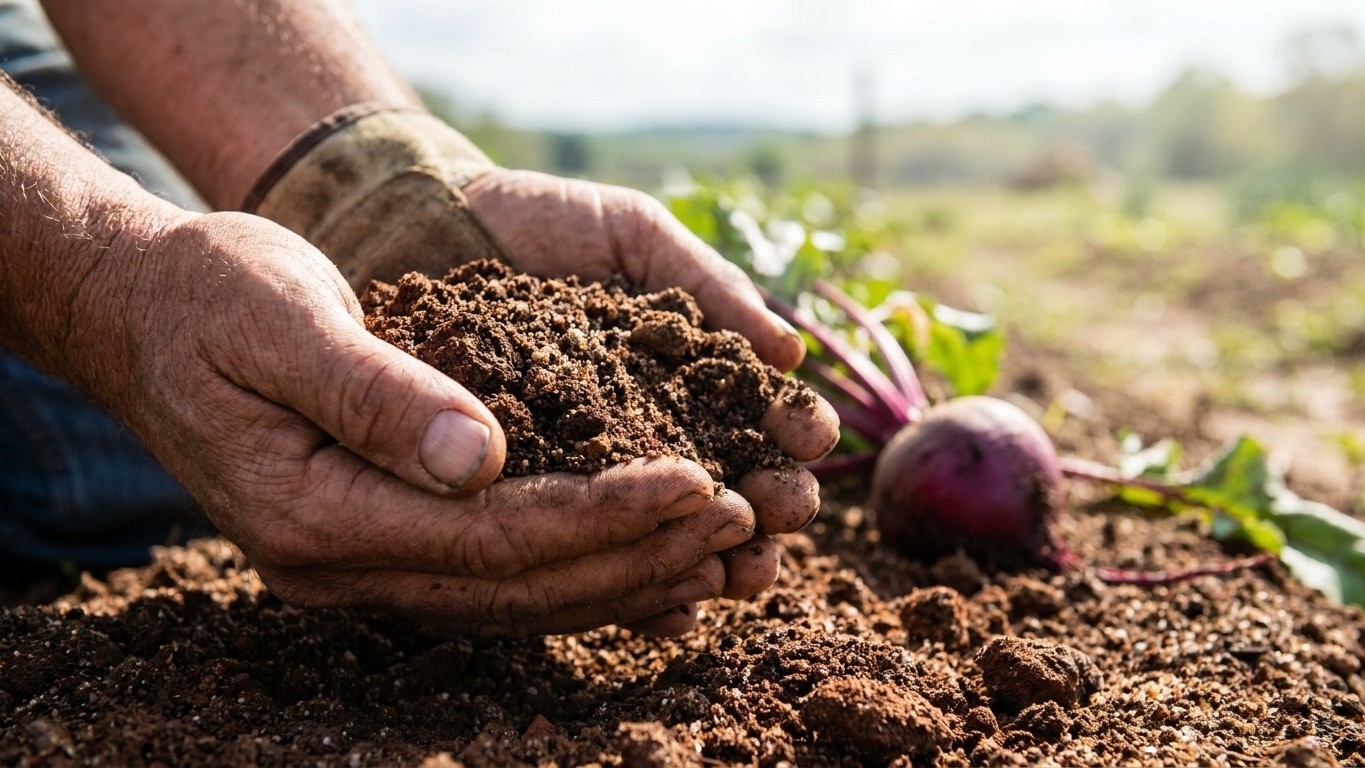

Indiana’s default ground, the Miami series, gives a beet a fair start but not a perfect one: a loam-heavy mix that drains moderately well and sits near neutral pH. The bigger swing factor is timing. Beets sown too early risk bolting from a dry snap; beets that mature into a hot Indiana summer risk turning woody. Neither problem is solved by soil alone.
The short answer
The Miami series, an Alfisol that USDA lists as representative of Indiana, runs 30 percent sand, 20 percent clay and 49 percent silt at the surface, with organic matter around 2.0 percent and a pH near 6.5. It’s classed as moderately well drained. For a beet, that’s a mixed bag. The pH sits comfortably in the range beets tolerate. The drainage is workable, not ideal. What holds the root back is the texture: a silt-heavy loam like this compacts more readily than the deep, sandy, well-drained ground Utah State University Extension describes as what beets actually want.
That gap matters because beet roots push straight down through the top foot of soil. In a compacted silt loam, they fork, stall or come out stubby instead of smooth. The fix Utah State gives is specific: work in composted organic matter, but no more than 1 inch per 100 square feet. More than that and the extra nitrogen pushes leafy top growth at the expense of the root, and can throw off the balance that keeps a beet round instead of forked.
Heat is the other half of the equation, and this is where the record gets thin. There’s no published figure here for how many days a year an Indiana reference city crosses 90 degrees, so that number isn’t stated. What is documented is the threshold that matters agronomically: once temperatures push past 85 F and the plant is also short on water, the root turns fibrous and woody. Indiana summers reliably reach that mark for stretches at a time, which is exactly why sowing date, not soil amendment, ends up deciding whether a beet finishes tender or tough.
None of this describes any one garden with certainty. Indiana spans hundreds of mapped soil series, and the Miami series is simply the one USDA treats as representative of the state as a whole. A yard built on river-bottom silt, hill-country clay, or fill dirt from a construction project can behave nothing like it. The organic-matter and pH figures above describe the natural surface horizon as mapped, not a worked garden bed, so treat this section as a starting point and a home soil test as the actual answer for a specific plot.
The six weeks that decide it here
Beet seed goes in the ground directly, 2 to 3 weeks before the last frost, and the root grows from that sowing date, not from any transplant. In Indianapolis, the 32 F freeze probability window (30 to 70 percent chance) runs from April 9 to April 21, based on NOAA’s 1991-2020 climate normals. Count backward 2 to 3 weeks and sowing lands in late March to early April for that reference point, with southern Indiana running earlier and northern Indiana later by roughly two weeks or more.
That sowing date sets the first six weeks of the root’s life, which is exactly the stretch where water stress does the most damage. Utah State’s research is blunt on this: dry conditions in that early window trigger premature flowering, meaning the plant bolts to seed instead of building a root worth harvesting. Once a beet bolts, there’s no reversing it.
Early spring in this window is the season when Indiana ground is transitioning out of winter wet and into the first warm pushes of the year, and that transition doesn’t move at a steady pace. A cold, saturated stretch can be followed within days by a dry, mild one, and it’s that second kind of stretch, a dry snap arriving while beet seedlings are still shallow-rooted, that puts bolting risk on the table. The moderately well drained Miami series soil doesn’t hold water long once a dry spell sets in, which shortens the margin for error if a gardener isn’t watching.
There’s also a frost card to keep in the back pocket. NOAA’s data carries roughly a 10 percent chance of a 32 F event even after the published spring date, so anyone sowing on the early edge of that window should have row cover or a bucket ready, not as a maybe but as a plan. Losing seedlings to a late frost and losing a root to bolting are different failures, but both trace back to the same six-week stretch right after sowing.
What goes wrong here
- Forked or hairy roots from compacted silt loam. The Miami series’ 49 percent silt content crusts and packs down more than beets prefer. Loosen the bed 10 to 12 inches deep before sowing and work in up to 1 inch of composted organic matter per 100 square feet, no more, to keep the root pushing straight down instead of splitting around a hard layer.
- Bolting from a dry spell in the first six weeks after sowing. This is the failure Utah State ties directly to water stress early in the plant’s life. Keep the bed consistently moist through that window with regular watering and a light mulch layer that slows surface evaporation between waterings.
- Woody, fibrous roots from summer heat. Once temperatures pass 85 F and the plant is also short on water, the root toughens. Sow early enough that the 60 to 80 day maturity window (counted from seeding, not transplanting) finishes before the hottest stretch of summer sets in, and harvest promptly once roots size up rather than leaving them in hot ground.
- Surface crusting that blocks germination. Silt-heavy soil can seal over after a hard rain before tiny beet seedlings break through. A thin mulch or light raking after rain keeps the surface loose enough for emergence.
- Late frost damage to seedlings sown on the early edge of the window. With roughly a 10 percent chance of a 32 F event even after the published spring date for the Indianapolis reference point, keep row cover on hand for any planting done at the front end of that 2-to-3-week pre-frost window.
Common questions
What’s the best time to plant beets in Indiana?
Sow 2 to 3 weeks before the local last frost date. For the Indianapolis reference point, that frost date falls between April 9 and April 21, so sowing lands in late March to early April there, earlier in southern Indiana and later in the north.
Does Indiana’s clay-loam soil need amending for beets?
Generally yes. The state’s representative Miami series soil runs heavier and siltier than the deep, sandy, well-drained ground beets prefer. Loosening the bed and adding up to 1 inch of composted organic matter per 100 square feet helps, but more than that risks pushing leaf growth over root growth.
How many days do beets take to mature in Indiana?
Utah State University Extension’s guidance puts beet maturity at 60 to 80 days, counted from the seeding date since beets are sown directly in place rather than transplanted. Sowing early enough to finish that window before peak summer heat matters more than the calendar date alone.
Can beets handle heavy clay in raised beds instead?
Raised beds sidestep the compaction issue of a silt-heavy native soil by letting a gardener build a loose, amended mix from the start, which suits a beet’s need for deep, unobstructed root growth. The same 1-inch-per-100-square-foot compost limit still applies to avoid forked roots from excess nitrogen.