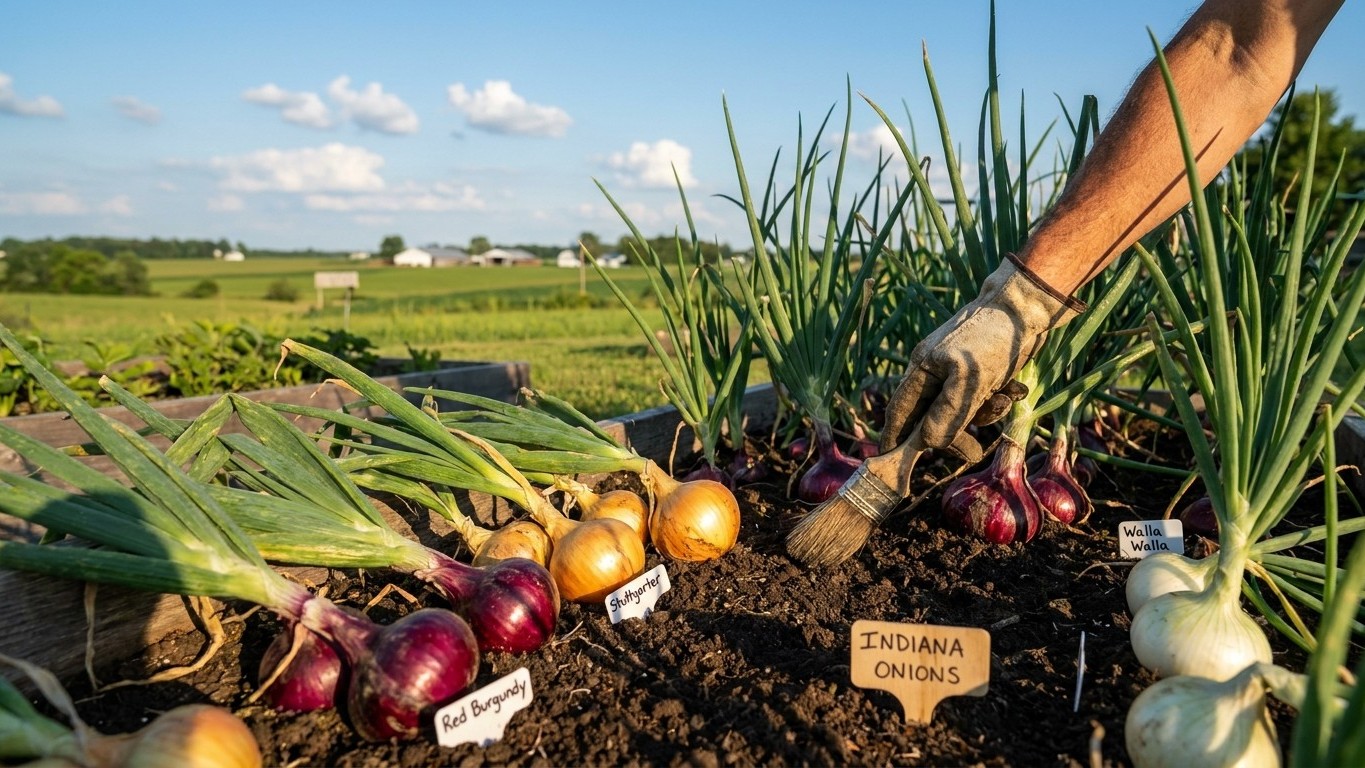

Indiana sits at 39.71 degrees north (measured at Indianapolis), and on the longest day of the year the sun gives that spot 14 hours and 49 minutes of daylight. That’s the number that decides which onions work here. It puts most of the state squarely in intermediate-day and long-day territory, with short-day onions ruled out almost everywhere.
The short answer for Indiana

Onions don’t care about temperature the way tomatoes do. What flips the switch from “grow leaves” to “make a bulb” is day length, and Indiana’s summer ceiling of 14 hours 49 minutes lands right in the zone where both intermediate-day and long-day types are built to operate. Short-day onions, which start bulbing once the day hits about 12 hours, are built for latitudes far south of here and simply don’t belong in an Indiana garden.
Of the 28 varieties tracked on this site, 18 have a published latitude range that covers 39.71N. Ten of them are intermediate-day types: Cabernet, Calibra, Candy, Elsye, Expression, Monastrell, Red Long of Florence, Red Long of Tropea, Scout, and Sierra Blanca. These are bred for a band roughly between 32 and 46 degrees north, and Indianapolis sits comfortably inside that window.
The other eight are long-day varieties: Ailsa Craig, Barolo, Blush, Bridger, New York Early, Patterson, Rossa di Milano, and Walla Walla Sweet. Long-day onions typically need 14 to 16 hours of daylight before they’ll bulb, and Indiana’s 14 hours 49 minutes clears that bar without much room to spare. That’s actually a useful detail: it means Indiana is close to the southern edge of where long-day types still perform reliably, which is why the intermediate-day group deserves just as much attention here as the long-day one.
Two more varieties, Frontier and Red Carpet, sit close enough to a published boundary (both rated 40 to 50N and 40 to 45N respectively) that they fall into a blurred zone rather than a clear yes. They may bulb well in Indiana, particularly in the northern part of the state, but a gardener planting them at 39.71N is working right at the edge of the range rather than comfortably inside it.
What will not work here
Planting the wrong day-length group in Indiana doesn’t produce a smaller harvest. It produces one of two failures, and neither one is a maybe. A short-day onion planted this far north will sense 12 hours of daylight weeks before the plant has built any real size, start bulbing immediately, and lock in a tiny onion no amount of fertilizer will fix afterward. A long-day onion that needs more daylight than Indiana ever provides never gets the signal to bulb at all. It keeps making leaves through the whole season, then rots in the ground or in storage without ever forming a usable bulb.
Four varieties in this catalog are published for latitudes below 39.71N and will bulb far too early here, giving undersized onions rather than no onions:
- Gabriella (short-day, 20-35N): bulbs at Indiana’s day length long before the plant has grown, resulting in a small onion.
- Madalyn (short-day, 20-35N): same early-trigger problem, tiny bulb size at Indiana’s latitude.
- Red Rock (short-day, 30-36N): rated for latitudes well south of Indianapolis, bulbs prematurely here.
- White Castle (short-day, 30-38N): its upper range falls just short of Indiana, and it will bulb too soon at 39.71N.
Four other varieties are published for latitudes above 39.71N and simply won’t get the daylight they need in Indiana:
- Powell (long-day, 43-47N): requires more summer daylight than Indiana provides; makes leaves, then rots.
- Redwing (long-day, 43-65N): built for far northern latitudes, never receives the trigger to bulb here.
- Safrane (long-day, 42-50N): its range starts north of Indiana’s latitude, no bulb forms.
- Talon (long-day, 42-50N): same story, the day never gets long enough to switch it into bulbing.
What changes across Indiana
Indianapolis at 39.71N is a useful reference point, but Indiana itself stretches from around 37.8 degrees north near the Ohio River to roughly 41.7 degrees north along the Michigan border. That’s nearly four degrees of latitude, enough to matter for a plant that responds to daylight down to the minute.
A gardener near the southern tip of the state, close to Evansville, is working with a slightly shorter longest day than Indianapolis sees, which nudges the advantage a bit further toward intermediate-day varieties and keeps long-day types closer to their minimum threshold. A gardener near the Michigan line, closer to South Bend, gets a bit more daylight on the summer solstice than Indianapolis does, which favors long-day varieties more strongly and puts the blurred-zone varieties, Frontier and Red Carpet, in better standing.
| Location | Daylight on longest day (relative to Indianapolis) | What it changes |
|---|---|---|
| Southern Indiana (~38N) | Slightly less than 14h49m | Intermediate-day varieties have a bit more margin; long-day types are closer to their minimum daylight requirement |
| Indianapolis (39.71N) | 14h49m, reference point | Both intermediate-day and long-day groups fit comfortably |
| Northern Indiana (~41.5N) | Slightly more than 14h49m | Long-day varieties bulb with more confidence; Frontier and Red Carpet move out of the blurred zone toward a clearer yes |
None of this changes which groups are excluded. Short-day onions still fail everywhere in Indiana, and the far-northern long-day varieties (Powell, Redwing, Safrane, Talon) still won’t get enough daylight even at the state’s northern edge, since none of those ranges dip as low as 41.7N.
Sweet now, or onions that last
Every onion variety asks a gardener to pick a side in the same trade-off, and it isn’t a matter of taste alone. Onion pungency comes from volatile sulfur compounds, and those same compounds are what protect a bulb through months of storage. A variety with fewer of them tastes sweeter and milder raw, but it breaks down faster once it’s off the plant. A variety loaded with them bites harder at the cutting board and holds up in a cool, dry spot for much longer.
In Indiana, this plays out along the same line as the day-length split. The intermediate-day varieties that suit the southern and central parts of the state, Candy and Sierra Blanca among them, tend to run sweeter and shorter-keeping. The long-day varieties that do well statewide, Patterson and Ailsa Craig for example, tend toward the sharper, longer-storing end.
The practical version of this shows up in March. A pantry stocked mostly with sweet, intermediate-day onions from a summer harvest is likely to be down to soft, sprouting bulbs by late winter. A pantry stocked with long-day, storage-type onions can still be handing out firm, usable onions well into early spring. Neither choice is wrong. It just depends on whether a gardener wants onions to eat fresh through late summer and fall, or onions that carry a household through winter.
Checking this against your own garden
Every figure in this article is anchored to a single point, Indianapolis at 39.71 degrees north, and a garden even 50 or 60 miles away from that point is working with a slightly different day length. Before committing to a variety, it’s worth confirming a few things locally rather than assuming the state-wide picture applies exactly.
- Look up the latitude of your own town or county, especially if you’re near the Michigan border or the Ohio River, since either edge shifts the day-length math in Indiana’s favor or against it.
- Check your local spring and fall frost dates, since those determine when onion sets or transplants actually go in the ground, separate from the day-length question.
- Contact your county extension office for soil test recommendations and any locally observed performance notes on the varieties covered here.
- If you’re growing Frontier or Red Carpet, treat them as a trial rather than a guaranteed result, and note how they perform in your own soil and season.