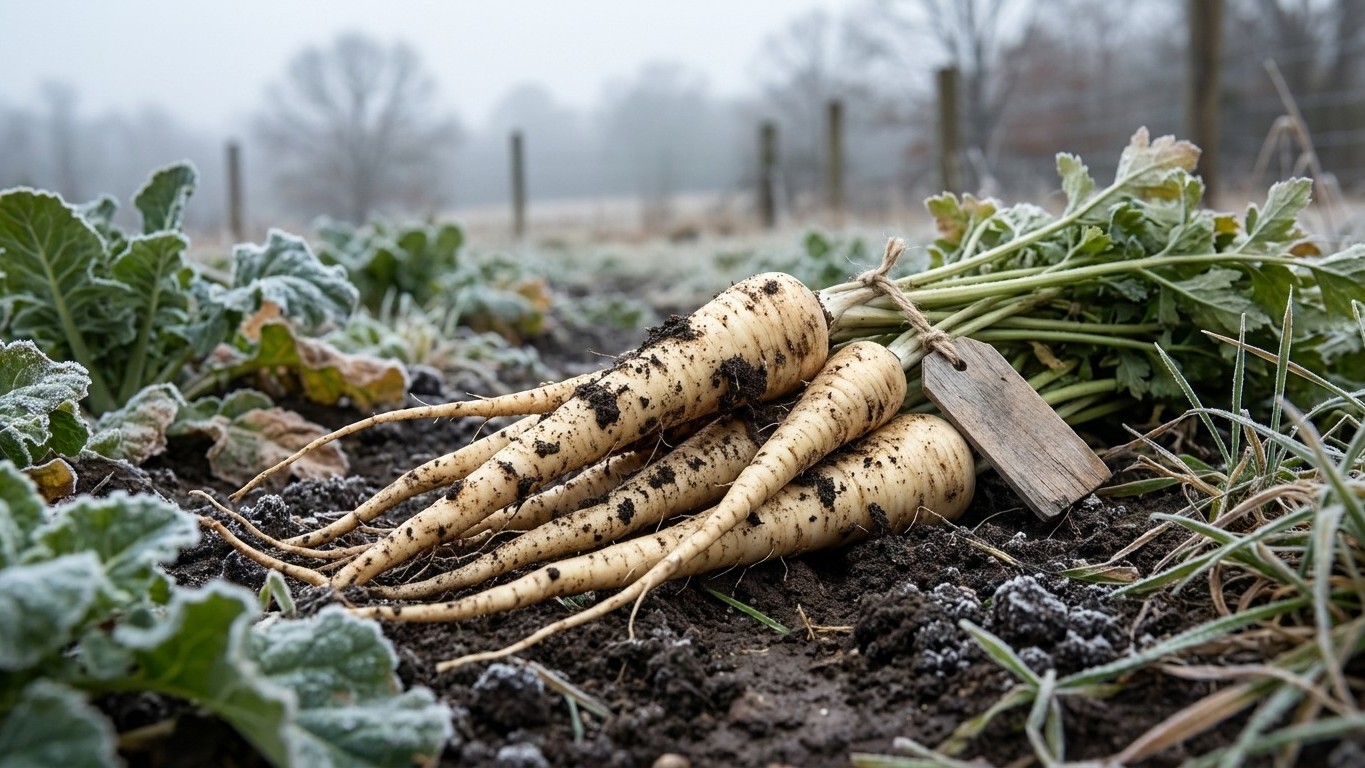

Yes. Indiana’s winters bring exactly the kind of sustained cold that turns a bland parsnip into a sweet one. The mean minimum temperature in the coldest month sits at 20.9°F at the Indianapolis reference station, meaning nights routinely drop well below freezing for weeks at a stretch. That’s the frost exposure parsnips need to convert stored starch into sugar. Combined with a frost-free growing window that runs longer than the crop requires, Indiana gardeners get both the time to grow a proper root and the cold to sweeten it.
The short answer
The question that actually decides this isn’t which hardiness zone a garden sits in. It’s whether the ground gets cold enough, for long enough, once the parsnip roots are already sized up and sitting in the soil. A hardiness zone tells you what survives the winter. It says nothing about whether a root vegetable sweetens inside that winter. Those are two different measurements, and mixing them up is the single most common mistake gardeners make when reading seed catalogs written for a different climate.
Indiana’s number for that specific question is 20.9°F, the mean daily minimum temperature during the coldest month, based on NOAA NCEI Climate Normals from the Indianapolis station. That’s not a record low or a rare cold snap. It’s the average nightly floor across the entire coldest month, which means freezing nights aren’t the exception in an Indiana winter. They’re the rule, repeated for weeks.
That matters because Utah State University Extension is specific about what parsnips actually need: several weeks of cool, frosty weather after the roots have reached size, during which the plant converts its stored starch into sugar. A single overnight frost doesn’t do it. A garden that dips to freezing once and then warms back up doesn’t do it either. The conversion is gradual, and it requires repeated exposure over an extended stretch, not a one-time event.
An Indiana winter delivers that repetition. With a mean minimum in the low 20s across the coldest month, the ground and the roots sitting in it experience cold cycling night after night, not just once. That’s the difference between a parsnip that merely reaches full size and one that tastes noticeably sweet when it’s finally pulled from the ground. Gardeners in territories where the coldest month barely dips below freezing on average don’t get this same reliable sweetening, no matter how carefully they time the harvest. Indiana doesn’t have that problem. The cold is consistent enough that leaving roots in the ground through the early frosty weeks does the work the crop is counting on.
Does the season fit?
Parsnips are sown directly in place, never transplanted, and the clock starts at seeding, not at germination and not at transplant. Here’s how the arithmetic works out for Indiana specifically.
- The last spring frost at the Indianapolis reference station falls somewhere between April 9 and April 21, based on NOAA NCEI 1991-2020 freeze probability normals. Southern Indiana tends to see that last frost roughly two weeks earlier; the northern part of the state, later.
- Parsnip seed goes into the ground 2 to 3 weeks before that last frost date, which puts sowing somewhere in the range of late March to early April for most of the state.
- Germination is slow. Count on 14 to 21 days before seedlings actually break the surface, and don’t dig up the row in the meantime thinking the seed failed. Bare-looking soil in week two is normal, not a sign of a wasted planting.
- From that seeding date, parsnips need 100 to 120 days before the roots are fully grown. Starting from an early-April sowing, 100 days lands in mid-July; 120 days pushes into early August.
- The first fall frost at the Indianapolis station arrives between October 21 and October 30. That’s roughly three months after the roots have already finished sizing up in mid-summer.
- The gap between “roots are ready” (mid-July to early August) and “first frost arrives” (late October) leaves ten to twelve extra weeks of margin before the cold that triggers sweetening even shows up.
That’s a comfortable fit, not a tight one. Indiana’s frost-free window is long enough to grow the crop with room to spare, and the extra weeks between root maturity and first frost aren’t wasted time. They’re a buffer that lets the roots sit in place, undisturbed, right up until the frosty weather that actually sweetens them arrives. Gardeners don’t need to rush the harvest or gamble on an early frost cutting the season short.
What goes wrong here
- Forked roots from heavy or stony ground. Indiana’s clay-heavy soils in many counties resist a parsnip’s long taproot, which forks or stubs out when it hits compacted layers or buried rocks. Utah State University Extension recommends deep, sandy soil for this crop; where the native ground is heavy, double digging to loosen and aerate a foot or more of depth before sowing gives the root somewhere straight to go.
- Forked roots from overwatering. This is a separate cause from heavy soil, not the same problem in different clothes. Excess moisture, especially uneven watering that swings from soggy to dry, encourages the root to split as it searches for consistent conditions. Even in loose, well-worked soil, a parsnip bed that gets flooded one week and neglected the next will produce forked, misshapen roots. Steady, moderate watering avoids it.
- Harvesting before the frosty weeks have done their work. Indiana’s cold winters aren’t the risk here, but pulling roots too early is. A parsnip dug in September, right after it reaches size, hasn’t had the several weeks of cold exposure it needs and will taste starchy rather than sweet. The fix is patience: leave mature roots in the ground through the first fall frost window of October 21 to 30, and let the cold that follows keep working on them before harvest.
- A late sowing that runs the season close. Sowing much past early April, combined with a slow 14-to-21-day germination stretch, can push the 100-to-120-day maturity date uncomfortably close to the first fall frost, especially in the northern part of the state where that frost arrives sooner. Sowing on time, at the front of the recommended window, keeps the margin wide.
Common questions
Do parsnips need a frost to taste good in Indiana?
Yes. Utah State University Extension is clear that the sweetness comes from several weeks of cool, frosty weather converting starch to sugar after the roots reach size. A parsnip harvested before that cold exposure will taste noticeably more bland and starchy.
When should parsnip seed go in the ground in Indiana?
Aim for 2 to 3 weeks before the last spring frost, which at the Indianapolis reference station falls between April 9 and April 21. That puts most sowings in the range of late March to early April, with southern parts of the state able to start earlier.
Why hasn’t my parsnip seed sprouted after a week?
Germination normally takes 14 to 21 days, considerably longer than most garden vegetables. Bare soil at the one-week mark isn’t a failed planting; it’s still within the normal window.
Can I leave parsnips in the ground all winter in Indiana?
The crop’s sweetening depends on cold exposure, and Indiana’s coldest month runs at a mean minimum of 20.9°F, cold enough to do that work reliably. Many gardeners leave roots in place through the first fall frost window (October 21 to 30) and beyond, harvesting as needed once the sweetening has taken hold.