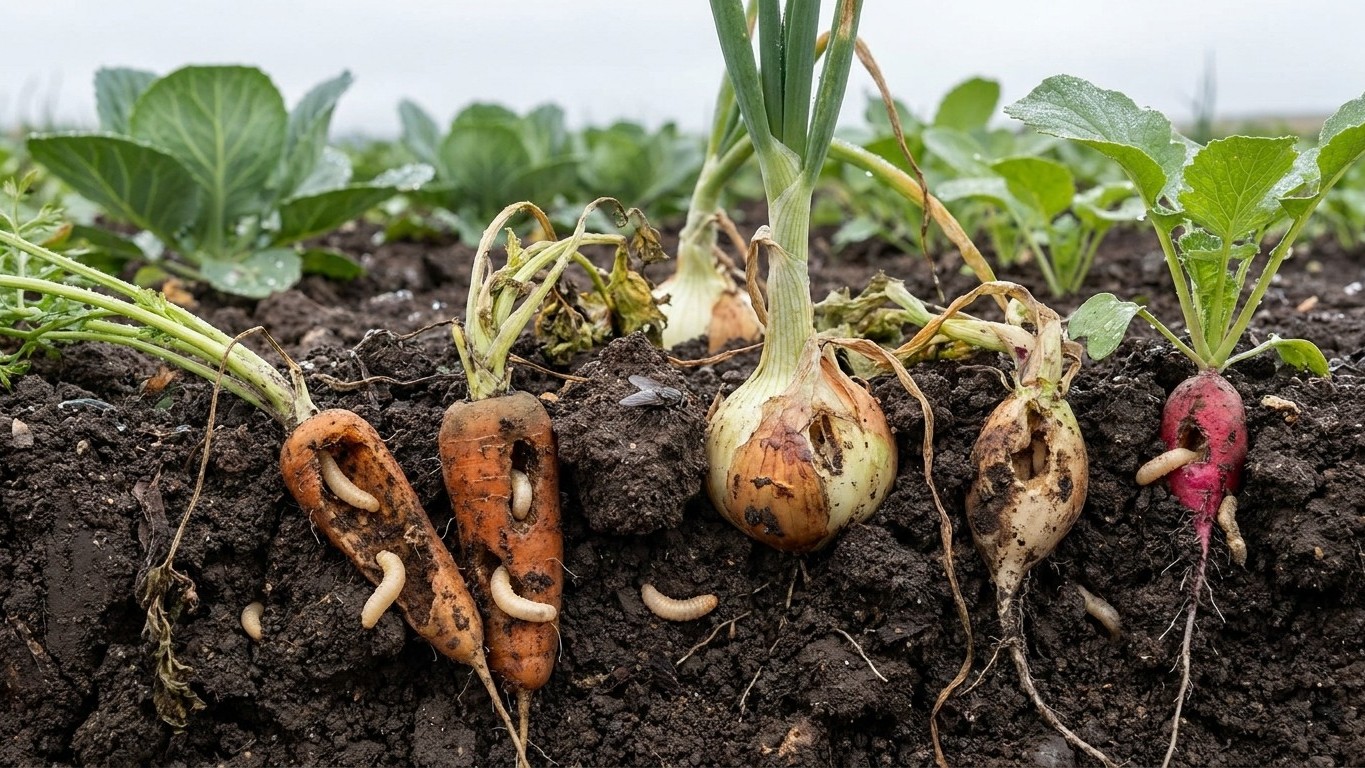

Sow hardy unusual roots such as salsify, scorzonera and burdock in early spring, as soon as the soil crumbles instead of smearing. Hold tender ones until after the April 9 to April 21 band for the last 32°F freeze. Fall sowings of quick roots go in late summer, ahead of the October 21 to October 30 band for the first one. Those dates come from Indianapolis, and the rest of the state shifts around them.
The short answer for Indiana
What do the Indiana frost dates actually measure?
The spring range, April 9 to April 21, comes from the NOAA 1991-2020 Climate Normals for the Indianapolis station. It is the band where the probability of a 32°F freeze sits between 30 and 70 percent. The fall range, October 21 to October 30, is the same kind of band for the first freeze of autumn (NOAA NCEI station data). Neither range is a date when frost stops or starts. Purdue adds that roughly a 10% chance of a 32°F event remains after the published spring date. A gardener who sets out tender roots on April 9 is taking a real gamble and should have row cover ready.
Southern Indiana runs earlier in spring and later in autumn than the north by a fortnight or more. Treat the Indianapolis dates as the middle of the state’s range.
When do different unusual roots go in?
The frost band sorts these crops into three groups. Hardy roots shrug off a freeze and can go in before the band opens. Tender tubers need the band behind them. Quick fall roots work backward from the autumn band. Packet days to maturity for direct-sown roots count from sowing, so subtract them from the autumn dates to find your last safe sowing day.
| Type of root | Examples | Sowing or planting window |
|---|---|---|
| Hardy, slow, direct-sown | Salsify, scorzonera, burdock, parsnip | Late March into April, once the soil is workable, before or during the spring frost band |
| Perennial tubers | Jerusalem artichoke, skirret | Early spring, or fall once the tops die back |
| Tender, warm-season | Yacon, oca and similar tropical tubers | After April 21, with cover ready for the 10% tail |
| Quick fall roots | Daikon and other large winter radishes | Late summer, timed so they mature before the October 21 to October 30 band |
For a look at which roots are worth the bed space, see The Best Unusual Roots to Grow in Indiana. The broader overview sits in Growing Unusual Root Crops in Indiana.
What will not work here
Can you plant tender roots on the early edge of the frost range?
Not safely. April 9 sits at the early end of the band, where a 32°F freeze is still a live possibility, and the 10% tail extends past April 21. Tropical tubers killed back to the soil line in April lose weeks of growth they cannot make up. They also have a short window in which to bulk up. The gap between the spring band and the autumn band is roughly six months, and crops that form most of their tubers late in the season need nearly all of it. A frost in the last week of October can end that bulking just as it gets going.
The practical fix is to wait for the late edge of the spring band. Start tender roots indoors or in pots, and plant out only when the forecast stops showing lows near freezing. Keep sheets or row cover handy for the first two weeks.
What about leaving roots in the ground over winter?
The mean daily minimum of the coldest month in Indianapolis is 20.9°F. That is an average, so individual nights run colder. Hardy roots like parsnip, salsify, scorzonera, burdock and Jerusalem artichoke handle that cold in the ground, and a layer of mulch makes digging easier on a frozen morning. Tender tubers do not. Yacon and oca left in an Indiana bed will not come back, so lift them before the first fall freeze and store them indoors.
Does the humid summer cause trouble?
It does for close spacing. Indiana summers are humid, and a dense stand of roots holds moisture around the crowns and leaves. Tight rows of burdock, parsnip or salsify stay damp after rain and invite leaf diseases and rot. Give each plant room, thin early, and water deeply less often instead of lightly every few days.
Late sowings of slow roots fail for a related reason. A slow root such as salsify or scorzonera started in midsummer will not size up before the October band arrives. Those two want a spring start. Only the fast radish types belong in the late-summer slot.
What changes across Indiana
The USDA Plant Hardiness Zone Map 2023 (built on the 1991-2020 normals) places Indiana across zones 5b to 7a. That is a spread of several zones, so there is no single answer for the whole state. The zone system rests on one variable, the average annual extreme minimum temperature, which tells you what survives winter. It says nothing on its own about when to sow.
The Indianapolis dates in this article fit the middle of the state. A gardener in the northern counties should expect the spring band to arrive later and the autumn band earlier, by a fortnight or more compared with the south. In practice that means delaying tender plantings into May, favoring the faster hardy roots, and pulling quick fall sowings forward into midsummer. Slow crops like scorzonera get less margin up north, and a short summer favors the roots that finish early.
Southern Indiana has the opposite advantage. Spring work can start sooner, and autumn lasts later, so a fall daikon sown in late summer has extra time to size up. Tender tubers get a longer season to bulk before frost. The same warmth that helps those crops also stresses cool-season roots earlier in summer, so sow hardy types promptly in early spring.
Hardiness matters most for roots left in the ground. Perennial roots that overwinter reliably in one part of the state may need heavier mulch or a dug-and-stored approach in another. Look up your own location on the USDA Plant Hardiness Zone Map instead of guessing, then compare it with the Indianapolis reference when you adjust any date here.
Where to check this for your own county
Start with Purdue Extension, the land-grant university’s service, which has an office in every county. A statewide calendar is a starting point, and a county recommendation beats it. The Extension educators work with local soil, local frost pockets and local pests, and they hear which crops failed last year.
When you reach the site, look for three things:
- The local vegetable planting calendar for your county, or the nearest one, with spring and fall dates for root crops.
- Any variety trials run in your area, since a root that did well in a trial a few counties away is a better bet than one grown only in a different climate.
- The county office contact, so you can ask about unusual crops that the general guides skip.
Calendars on extension sites usually list common vegetables. Unusual roots often do not have their own entry, so find the closest relative. Parsnip guidance fits salsify and scorzonera for timing. Radish guidance fits daikon. For tender tubers, use the date your county gives for warm-season crops like peppers and tomatoes, which also need frost behind them.
Check which weather station a calendar uses, too. A date built on Indianapolis data will run early or late for a garden far from it.
Checking this against your own garden
Your own beds outrank every date above. A south-facing slope against a wall warms days before an open lawn, and a low corner holds cold air long after the rest of the yard has cleared. Three simple observations will tell you more than any chart.
Soil warmth by feel. Push your hand into the bed to wrist depth and hold it there. If the soil feels cold enough to make your fingers ache within a few seconds, wait on tender roots. Hardy ones tolerate that. Do this in several spots, and the difference between the warmest and coldest tells you how much your microclimate varies.
First leaves on nearby plants. Watch when wild weeds, grass and the shrubs and trees around your yard start leafing out. Early growth in your yard compared with a neighbor’s across town tells you whether your site runs warm. If dandelions and lilacs push growth in your yard before the usual date, you can lean toward the early side of the sowing window.
First true leaves on a test sowing. Sow a short row of a hardy root early. When the first true leaves appear (the second set, after the seed leaves), you know how fast your soil is moving. A slow, uneven start means a cold or heavy bed. A quick one means you can plant the rest with confidence.
Keep notes for a season or two: the date of your last frost, the date tender plants first thrived, the date of the first autumn frost. After two years your own dates will be more useful than any range here.
Common questions
What is the best month to plant unusual root vegetables in Indiana?
April suits the hardy, slow roots such as salsify, scorzonera, burdock and parsnip, starting as soon as the soil is workable. Tender tubers go in after the April 9 to April 21 frost band, with cover ready. Fast fall roots like daikon go in late summer.
When is the last frost in Indiana?
At the Indianapolis reference station, the NOAA 1991-2020 normals put the 30 to 70 percent probability band for a 32°F freeze at April 9 to April 21. Purdue notes roughly a 10% chance of a 32°F event after the published spring date. Southern Indiana runs earlier and the north later by a fortnight or more.
When is the first fall frost in Indiana?
The Indianapolis reference band runs October 21 to October 30 for a 32°F freeze. Plan fall crops and tender-tuber harvests to finish before it, and expect the north to arrive sooner and the south later.
Which hardiness zone is Indiana in?
The USDA Plant Hardiness Zone Map 2023 places Indiana across 5b to 7a, so no one zone covers the whole state. Check the USDA map for your own location, since hardiness zones measure winter minimum temperature and not the sowing date.