
Iowa’s frost-free window for summer squash runs roughly from late April through mid-October, but the real planting date depends on which end of the state you’re in and how much risk you’re willing to take with a probability band, not a guarantee.
The short answer for Iowa
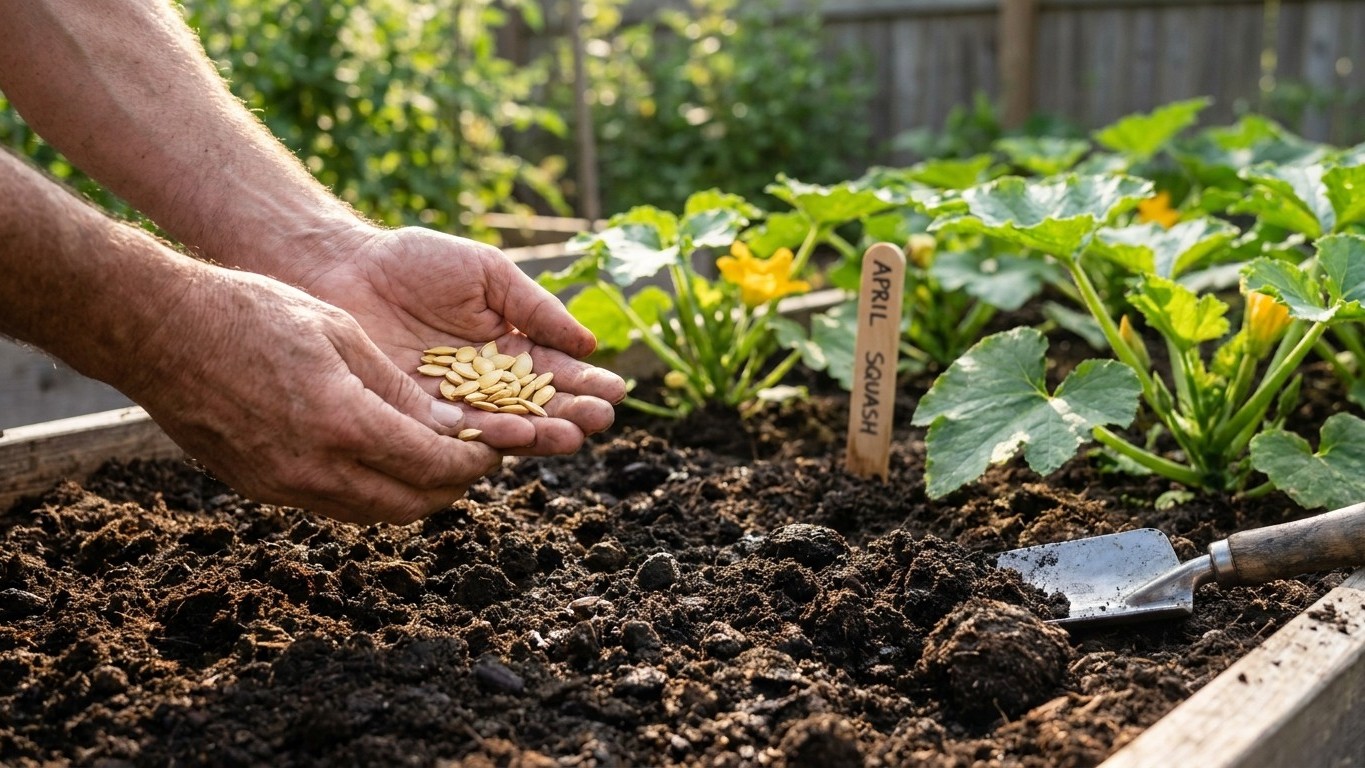
Sow summer squash directly into the ground after your area’s last spring frost has passed. At the reference weather station used for these normals, that date falls somewhere between April 12 and April 24, a 30-to-70 percent probability band for a 32F freeze, not a hard cutoff. Iowa State Extension’s own county-level data, drawn from 1950 to 2021, runs about four days later in spring than that airport figure. So a gardener working from county numbers rather than the airport station should treat late April into the first days of May as the safer start, especially for a heat-loving, frost-tender crop like squash that will not tolerate a cold snap the airport data didn’t quite catch.
The other end of the calendar matters just as much. First fall frost at the reference station lands between October 14 and October 25. But the same Extension caution applies in reverse: county figures run about ten days earlier in fall than the airport station. That shifts the practical end of the season closer to early-to-mid October in a lot of Iowa counties, not the 25th. Summer squash matures fast compared to winter squash or pumpkins, so this earlier fall edge rarely threatens the harvest the way it would for a slower crop. But it does mean a second or third succession sowing needs to go in the ground with that earlier date in mind, not the optimistic one.
Put together, the safest working answer for most of Iowa is: direct-seed from late April through late May, watching soil warmth as much as the calendar, and plan your last sowing so it has time to produce before early-to-mid October. That’s not one date. It’s a six-week window shaped by two different frost datasets that don’t quite agree, which is exactly why the next section matters.
What will not work here
Planting right at the early edge of that spring frost band is the first mistake worth naming. April 12 is a 30-to-70 percent probability, not a promise. A gardener who seeds squash the moment that date appears on a calendar app is gambling on the lower end of that range holding, and a late cold snap will take out tender seedlings outright. Waiting the extra four days that Iowa State’s county data suggests, or watching soil temperature directly, costs little and removes most of that risk.
Heat load is the bigger threat once the plants are up. Des Moines averages 18.4 days a year at 90F or hotter, and that heat arrives right in the middle of squash’s active growing and flowering period. Blossom drop and stalled fruit set are common results when daytime highs stack up during a dry stretch, and July is exactly when that stretch tends to happen: it’s the driest summer month at just 3.82 inches, compared to 5.26 inches in June and 4.17 in August. A gardener who waters once a week on a fixed schedule, treating July like an average month, is watering into a shortfall the plants are already feeling by the time the leaves wilt in the afternoon sun.
Humidity works the other way
June’s wetter pattern, over five inches on average, creates a different failure mode: powdery mildew and other foliar disease pressure on squash planted too close together. Tight spacing that might be fine in a drier climate keeps leaves wet longer after a June rain, and squash foliage is notoriously prone to mildew once air doesn’t move through the canopy. Wider spacing than a seed packet’s minimum, plus morning watering instead of evening, does more to prevent this than any spray applied after the fact. The rainfall figures here are 1991-2020 normals for the reference station, not a forecast for any single summer. But the pattern they describe, a wetter early summer and a drier July, is consistent enough that it’s worth planning around rather than ignoring.
What changes across Iowa
Iowa’s USDA hardiness zone spans 4b to 6a, a range built entirely on one measurement: the average annual extreme minimum winter temperature. That’s a three-zone spread inside a single state, which means there is no single frost date or planting date that applies evenly from the Minnesota border to the Missouri line. The frost dates and heat figures cited above are tied to a specific reference station, and a garden in the colder end of that zone range will see a later last frost in spring and an earlier first frost in fall than the figures here suggest. A garden at the warmer end will see the opposite: more margin on both ends of the season.
What that means practically is that a gardener in the northern part of the state should shift the sowing window later than the state-level range given above, and treat the fall end of the season as arriving sooner. A gardener in the southern part of the state has more room to push an earlier sowing and squeeze in a later succession planting before frost. Neither shift is large, usually a week or so in each direction, but it’s enough to matter for a fast-cycling crop like summer squash where a single successful succession can be the difference between three harvests and four.
None of this tells an individual reader which zone their own yard falls into. The hardiness zone map is built at a resolution far finer than “north Iowa” or “south Iowa,” and a low spot, a slope, or a nearby water body can shift a specific property’s effective zone by more than the general north-south gradient would suggest. The map itself, not a regional guess, is the tool for pinning that down.
Where to check this for your own county
Iowa State University’s Extension and Outreach service is the source for county-level planting guidance that goes beyond the state-wide frost and heat figures cited on this page. Two things are worth looking for specifically once there. First, the local planting calendar for your county, which will reflect the four-day-later spring and ten-day-earlier fall pattern already flagged in the frost data above, rather than the more optimistic airport-station numbers. Second, any variety trial results for summer squash conducted in or near your county, since Extension often publishes which varieties performed well under local disease and heat pressure, information no state-wide page can offer with any precision.
This page draws on statewide climate normals: one reference station’s frost probabilities, one reference station’s heat and rainfall averages, and a hardiness zone range that spans three-quarters of the USDA scale. That’s useful for understanding the pattern across Iowa as a whole, but it is not a substitute for a number specific to one county. A county-level recommendation from Extension will always be more accurate than a state-level one, for the simple reason that it’s built from more localized data. Where the two disagree, follow the county figure.
Checking this against your own garden
Every date on this page is a normal, an average built from thirty years of weather at one or two reference stations. Your own garden is a single data point that can differ from that average in either direction, and three simple observations will tell you more about your actual planting window than any calendar.
- Soil warmth by feel: press a bare hand into the top few inches of soil in the bed where you plan to sow. Squash seed wants soil that feels warm, not just frost-free; cold, damp soil that still feels chilly to the touch will rot seed before it germinates, even weeks after the official last frost date has passed.
- The first flush of male flowers: summer squash produces male blooms before female ones, and their appearance signals the plant has shifted into active reproductive growth. If male flowers show up unusually early or late compared to what you’d expect from the sowing date, that’s a sign your particular spot is running warmer or cooler than the regional average.
- The first true leaves: the rounder seed leaves that emerge first are not the plant’s real foliage. Watching how long it takes the first true, squash-shaped leaves to appear after germination gives a rough read on how favorable your specific soil and sun conditions are, independent of what the calendar says the date should be.
A rain gauge, if you have one, adds one more useful check: comparing what actually falls in your yard during June, July, and August against the 13.2-inch summer normal cited above tells you whether your particular property is tracking the regional pattern or running its own, drier or wetter, story.