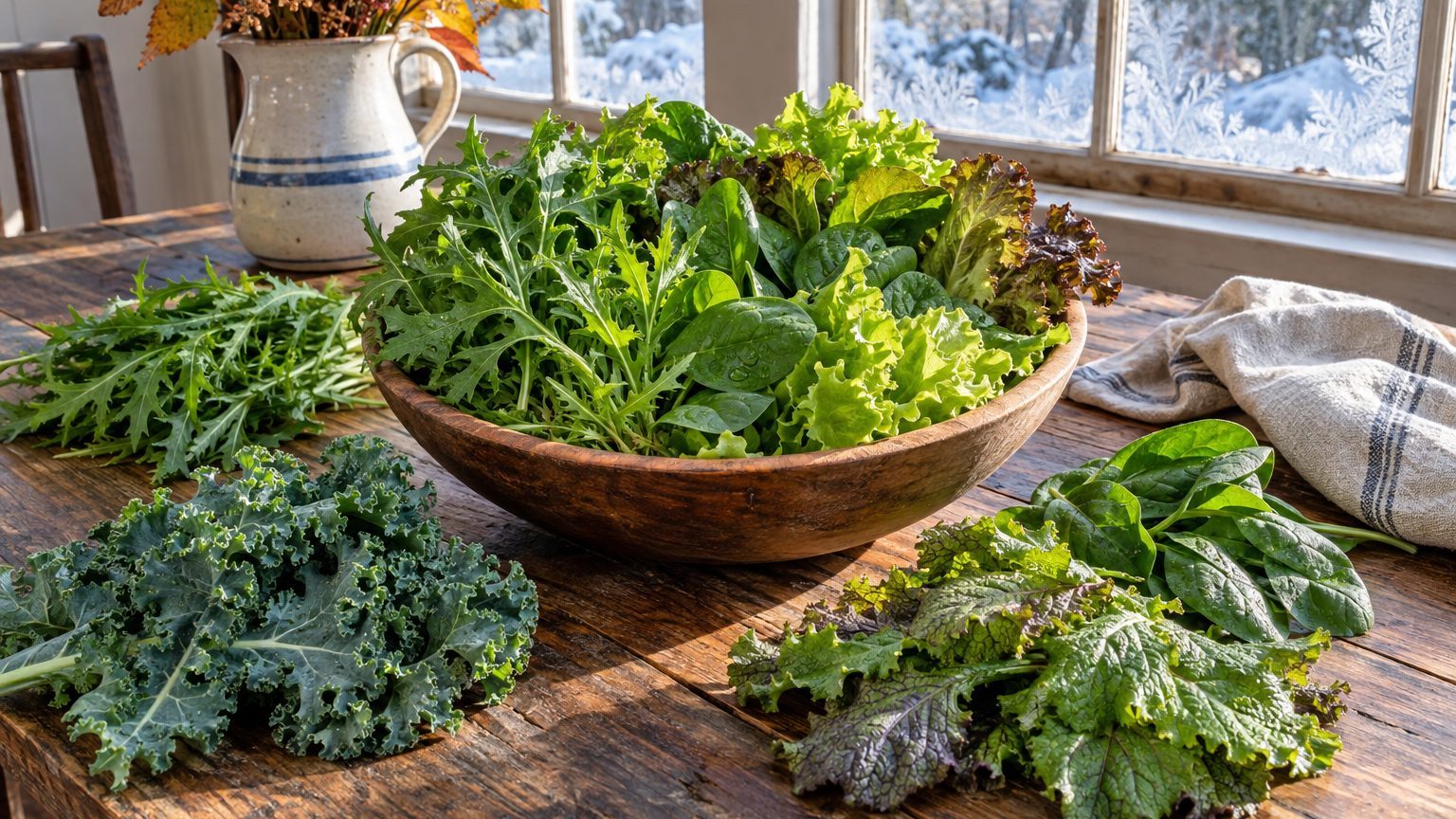

Iowa’s best winter salads are the cold-hardy leaf crops: spinach, mâche, claytonia, kale and the sturdy Asian mustards, sown in fall and sheltered under a cover. Heading lettuce and anything slow to mature belongs to spring and early fall instead. The broader picture is in Winter Salads for Iowa Gardens. This page narrows it to what to grow.
The short answer for Iowa
Choose by type, not by cultivar name. Iowa gives you three working groups: true cold-lovers (spinach, mâche, claytonia) for the cover, tough brassicas (kale, mustards, tatsoi) for the open bed, and tender salad crops (leaf lettuce, arugula) for the fall shoulder only.
Two numbers explain the sorting. The first fall frost lands between October 14 and October 25, according to NOAA’s 1991-2020 Climate Normals. Those dates are the band where the chance of a 32°F freeze at the airport station runs from 30 to 70 percent. They are a probability, not a calendar promise. And the coldest month’s mean daily minimum at the Des Moines reference station is 13.8°F. That is an average night, not a record low, so the colder nights in a hard winter go well below it.
A plant that sulks at a 32°F freeze will not make it to January in an open bed. A plant that shrugs off 13.8°F nights, with some cover over it, can sit alive through the dark months and resume growing in late winter.
| Type | Examples | Role in Iowa | Protection needed |
|---|---|---|---|
| Cold-lovers | Spinach, mâche, claytonia | Hold through winter, harvest late winter and early spring | Low tunnel or cold frame in the coldest stretches |
| Tough brassicas | Kale, mizuna, tatsoi, mustards | Harvest from fall into early winter, then regrow in spring | Light cover helps after hard freezes |
| Tender salads | Leaf lettuce, arugula | Fall harvest before the deep cold | Cover required once nights stay below freezing |
One caution about the dates. The airport figures are the optimistic end. Iowa State Extension county figures from 1950 to 2021 run about 4 days later in spring and about 10 days earlier in fall. If your garden sits inland and away from town, plan for the earlier fall frost. Sowing dates built on those numbers are laid out in When to Sow Winter Salads in Iowa.
What will not work here
Heading lettuce in an open bed in January will not work. With the coldest month averaging nights of 13.8°F, tender lettuce under nothing but sky ends up as translucent mush after the first serious cold snap. Leaf lettuce can last longer under a cover, but it is a fall crop in Iowa, not a winter one.
Slow crops fail on the calendar. The first fall frost arrives October 14 to October 25 at the airport station, and potentially 10 days sooner by Extension county figures. A cabbage-family green or a head-forming endive sown in late summer has only weeks to size up before growth slows to a crawl. Plants that are still small when cold arrives rarely catch up, because daylight keeps shrinking, and a seedling in October stalls rather than grows. Winter salad success depends on plants being nearly full size before the cold sets in, so they can be harvested slowly all winter rather than grown over it.
Late sowing is the most common Iowa error. Seed started in October because the garden finally had a free weekend usually germinates, then sits at seedling size until March. That is not a crop. It is a hopeful lawn. Sow earlier, or switch to a cold-lover like mâche, which does fine as small plants.
Spring sowing of winter salads does not work either, and it surprises people. The last spring frost runs April 12 to April 24 at the airport (4 days later by county figures), which looks like a generous window. But spinach and mâche sown in a warming April soil bolt as days lengthen, so the harvest is short and bitter. These crops want cool, shortening days, which means fall.
Overcrowding under covers is the quieter failure. Plants packed tight under a low tunnel hold damp air against their leaves, and that invites mold and rot on winter days when the cover stays shut. This page does not have Iowa humidity or summer temperature figures, so treat that as general practice: give plants room and vent the cover on mild days.
What changes across Iowa
Iowa is not one garden. The USDA Plant Hardiness Zone Map (2023 edition, built on 1991-2020 normals) places the state in zones 4b to 6a, so there is no single answer. That spread covers several half-zone steps, from the north and northwest down to the southeast corner. The system rests on one variable only, the average annual extreme minimum temperature, which says nothing about frost dates or summer heat.
The 13.8°F figure above belongs to the Des Moines reference station. Treat it as a central Iowa anchor, not a statewide number. A grower in the colder north will see winters that are harder than that, and one in the south will see milder ones. Frost dates and cold minimums do not move in lockstep either, so a place can have a late fall frost and still dip very cold in midwinter.
If you garden in the north, shift your plan in three ways. Sow earlier than the statewide guidance suggests. Lean harder on the cold-lovers (mâche, claytonia, spinach). Treat any cover as required equipment, not a bonus. Gardeners in the south get a little more slack: their tough brassicas stay productive longer, and their tender salads may carry a few weeks deeper into fall.
Local quirks matter as much as latitude. A low spot where cold air pools can behave like a zone colder than the rest of your yard, while a bed against a south-facing wall behaves warmer. To see where your own address falls, look it up on the USDA map rather than guessing from the statewide range.
Where to check this for your own county
Your state extension service is the next stop. Iowa State University Extension has county offices with staff who know local frost pockets, soil types and which varieties actually survived there. That knowledge cannot be reproduced in a statewide article.
When you get there, look for two things. First, a local planting calendar for fall-sown greens. Frost data for your county will differ from the airport figures used here, and as noted, the Extension county numbers run about 4 days later in spring and 10 days earlier in fall. Second, any list of varieties trialled in your county. A cultivar that wins a trial in a nearby county has been tested against your region’s real winters, not a catalog description.
A county recommendation beats a state one, and this page is the state one. Use it to decide what types to buy and when to start thinking about sowing, then let the county office correct the details. If the local calendar says to sow a week before or after what you planned, follow the local one.
If you cannot find a county-specific winter-salad guide, ask the office directly. Staff and Master Gardener volunteers field these questions every fall, and a short phone call can save a failed bed.
Checking this against your own garden
Your own observations outrank every date here, and three of them cost nothing.
- Soil warmth by feel. Push your bare hand a few inches into the bed in late summer. Soil that still feels warm will refuse to germinate cold-loving seed such as spinach. When it feels pleasantly cool, those seeds will sprout. A bed that cools sooner than your neighbor’s is telling you it is a colder microclimate.
- First true leaves. The first pair after the seed leaves marks a seedling that has started to grow. If seedlings are still at that stage when frost arrives, they are probably too small to harvest all winter. Note the date, and next year sow that many days earlier.
- What blackens first. The first frost kills the most tender plants in the garden, such as basil or squash vines. Watch which beds go first. The ones that blacken early are your cold pockets, and the ones that last longest are your best spots for winter salads.
Write the dates down. One season of notes will beat any statewide table for your own backyard.
Common questions
What is the single most reliable winter salad green for Iowa?
Spinach is the usual answer, along with mâche and claytonia, which tolerate cold well. All three do best sown in fall and covered during the harshest cold, since the coldest month’s mean daily minimum is 13.8°F at the Des Moines reference station.
Can I grow lettuce through an Iowa winter?
Not reliably. Leaf lettuce handles light frost and gives a good fall harvest, but it does poorly in the cold of an Iowa midwinter. Use it as a fall crop and rely on the cold-lovers for winter.
Do I need a greenhouse?
No. A low tunnel or cold frame is enough for the hardy types, and the toughest brassicas often get by with a light cover. A heated greenhouse is not required for a winter salad bed.
Which frost dates should I trust?
Use the airport figures (April 12 to April 24 in spring, October 14 to October 25 in fall) as the optimistic end. Extension county figures run about 4 days later in spring and 10 days earlier in fall, and those are safer for planning. Either set describes odds of a 32°F freeze, not a guarantee, so a freeze outside those windows is always possible.