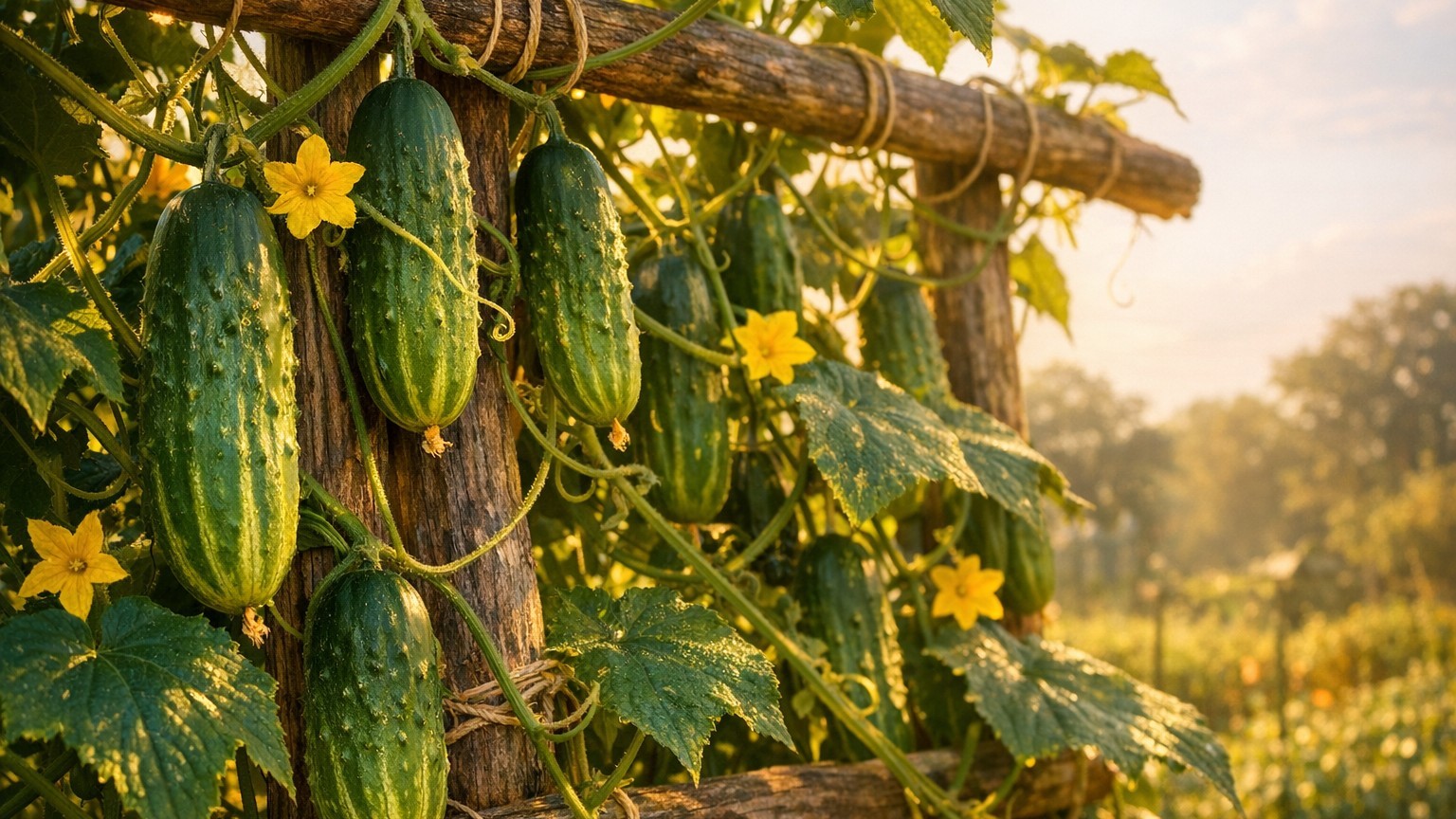

Kentucky’s frost-free season, running from roughly the last week of March or first week of April to early-to-mid November, gives cucumbers plenty of room to grow no matter the type you pick. The bigger variable isn’t season length. It’s the state’s heavy mid-summer heat load and humidity, which decide whether a vining, bush, or burpless type actually thrives once it’s in the ground.
The short answer for Kentucky
Start with the numbers that actually govern this decision. The reference station used for Kentucky’s climate normals shows a last spring frost window of March 24 to April 4, and a first fall frost between November 2 and November 12. That’s a frost-free stretch of somewhere between 213 and 233 days, depending on where in that window your particular spring and fall land. For a crop that typically moves from seed to first harvest in under two months, that’s not a tight window at all. Season length is not the limiting factor here, and it doesn’t need to be the first thing you weigh when picking a type.
Heat is the bigger driver. The reference station averages 37.2 days a year at or above 90°F. That’s a serious heat load stacked right in the middle of cucumber season, and it changes how a plant performs more than any calendar date does. Vines under that kind of stress drop blossoms, stall pollination, and produce fruit that turns bitter or misshapen if watering isn’t consistent. This matters more for variety selection than most gardeners assume.
Given that combination, long season plus heavy summer heat plus humid air, the types worth favoring in Kentucky are:
- Vining slicers or picklers trained vertically, which lift the fruit and foliage off humid ground air and improve airflow around leaves.
- Parthenocarpic or burpless types, which set fruit without heavy pollinator dependence and tend to hold up better when heat stress interrupts bee activity.
- Bush types for smaller raised beds or containers, where trellising isn’t practical but airflow still matters.
None of that means a specific cultivar name belongs in this article. Seed catalogs change their offerings every year, and what performs well in Lexington clay isn’t guaranteed to perform the same way in the Purchase area’s sandier ground. The right move is to decide on type first, using the reasoning above, then check which actual varieties your county extension office has trialled locally before buying seed. That’s covered in more detail further down this page.
What will not work here

The clearest failure pattern in Kentucky gardens isn’t a variety that can’t finish in time. It’s a variety, or a watering habit, mismatched to the state’s heat and humidity numbers. Three specific things go wrong often enough to call out directly.
Weekly watering under 37 days of 90°F heat
Cucumber fruit is mostly water, and a plant under repeated 90°F-plus stress pulls moisture out of the soil fast. Summer rainfall across the state averages about 12 inches over June, July, and August combined, with August running driest at 3.71 inches. Spread that across a month with several days over 90°F, and a once-a-week watering schedule leaves long stretches of dry soil in between. The result shows up as bitter fruit, blossom drop, or fruit that swells unevenly and cracks. Any type, vining or bush, fails under that watering pattern once heat stacks up the way it does here. Consistent, more frequent watering matters more than which variety is in the ground.
Dense, ground-level planting in humid summers
Twelve inches of summer rain arriving as thunderstorms, combined with Kentucky’s summer humidity, creates exactly the damp, still air that powdery and downy mildew need. Vines sprawled flat on the ground in a tight block trap that moisture against the leaves overnight. Trellised or staked plants, spaced with real air gaps between them, dry off faster after a storm and hold up noticeably better through August. Ground-sprawling plantings packed close together are the pattern most likely to collapse to mildew by late summer, regardless of variety.
Rushing the ground before it’s actually warm
The frost dates above describe air temperature, not soil temperature. Cucumber seed sown into cold, wet soil right after the last frost date, rather than once the ground has genuinely warmed, germinates poorly or not at all. This is a bigger risk in Kentucky’s rural areas than the frost dates alone suggest, since the reference station used for those dates is urban and NWS Louisville has noted directly that surrounding rural Jefferson County runs a tighter window, later in spring and earlier in fall. A gardener working off the urban dates alone, without checking their own soil, can end up sowing into ground that isn’t ready.
What changes across Kentucky
Kentucky is not one climate. The USDA Plant Hardiness Zone Map places the state across a 6a to 7a range, built on average annual extreme minimum winter temperature, which is a different measurement than the frost dates or heat days discussed above but still a useful marker of how much the state’s growing conditions shift from one end to the other.
That 6a-to-7a spread generally tracks with elevation and latitude. Higher, more interior parts of the state trend toward the cooler 6a end, while lower-elevation, more southerly and westerly parts trend toward 7a. What that means in practice for a cucumber grower is that the frost dates cited earlier in this article, tied to one reference station, will run later in spring and earlier in fall for a garden sitting at higher elevation or further from that station, and the reverse for a garden in a warmer western pocket of the state.
The heat-day and rainfall figures are also averages taken from a single reference station, not a promise for every county. A garden in a warmer, lower-lying part of the state could easily see more than 37.2 days above 90°F in a given summer, while a cooler, higher pocket might see fewer. None of this changes the type-level advice above, vertical training and consistent watering are useful everywhere in the state, but it does mean the exact planting date and the exact watering frequency needed will shift depending on where in Kentucky the garden actually sits.
This page can’t tell an individual reader which zone their own yard falls into. The USDA’s map is the tool for that, and it’s worth checking directly rather than assuming based on the county name alone, since elevation inside a single county can shift the zone at the edges.
Where to check this for your own county
Everything above is a state-level pattern, built from one reference station’s climate normals. A county recommendation will always beat a state one, because it accounts for local soil, local elevation, and the specific varieties that have actually been trialled in that part of Kentucky rather than averaged across the whole state.
The University of Kentucky Cooperative Extension Service, listed through the USDA NIFA land-grant directory at extension.ca.uky.edu, is the right place to go next. Each county has its own extension office, staffed by an agent familiar with local soil conditions and local pest pressure, and most publish or can point to a county-specific planting calendar rather than a statewide one. That calendar will reflect the actual frost pattern for that county’s elevation and location, not just the urban reference station cited in the climate normals above.
Two things worth asking a county agent, or looking for on the county extension page, specifically:
- The county’s own recommended planting window for cucumbers, which may run tighter or later than the state-level frost dates depending on elevation and local microclimate.
- Which cucumber varieties have actually been trialled or recommended for that county, since disease pressure and soil type vary enough across Kentucky that a variety performing well in one county can struggle in another.
This page is deliberately built at the state level, using types rather than named varieties, because that’s the level at which the climate normals cited here actually apply. The county office is where the specific variety names live.
Checking this against your own garden
No planting calendar, state or county, outranks what the garden itself is showing. Three signs are worth checking by hand before trusting any date on a chart.
Soil warmth is the first and most direct check. Push a finger a few inches into the planting bed on a morning several days after the last expected frost. Soil that still feels cold and damp, rather than warmed through, isn’t ready for cucumber seed yet, whatever the calendar says, and sowing into it usually just means waiting longer for slow, uneven germination instead of gaining time.
The first flush of male flowers is the second signal. Cucumber vines typically produce a run of male blossoms before the female flowers, the ones with the small swelling at the base that becomes the fruit, show up in real numbers. A vine putting out mostly male flowers for a stretch isn’t behaving abnormally, but a garden where female flowers are dropping without setting fruit, once temperatures are consistently in the 90s, is showing the heat stress described earlier, and it’s a cue to check watering frequency before assuming the variety itself is the problem.
The first true leaves, the serrated ones that appear after the rounded seed leaves, tell a grower whether the plant has moved past the fragile seedling stage. Slow, pale, or stalled true-leaf growth after warm soil and steady watering usually points to a local microclimate issue, thin soil, poor drainage, or a shadier spot than expected, worth working out on-site rather than blaming on the type of cucumber in the ground.