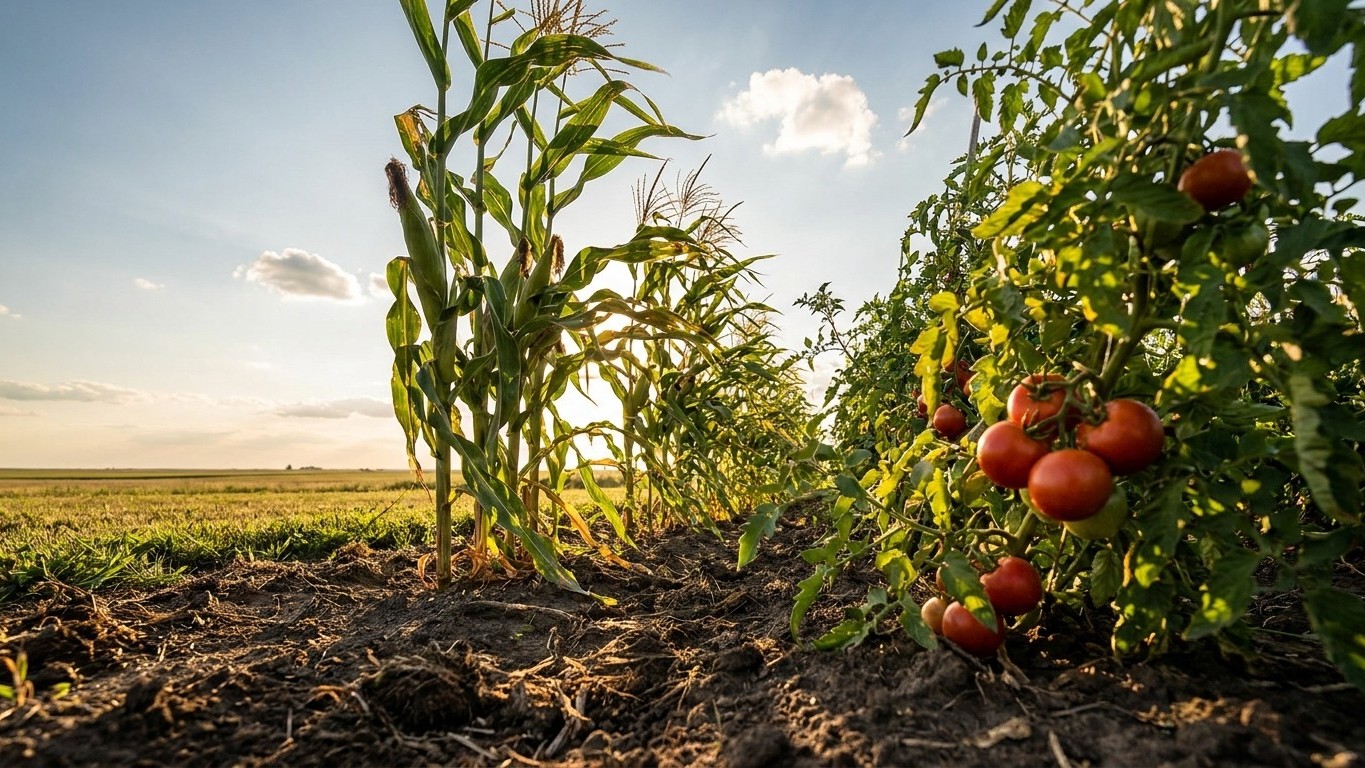

In Kentucky, sweet corn goes into the ground when the soil says so, not the calendar. That means at least 60 F, which arrives well after the last spring frost. From that day, 60 to 90 days to harvest fits before autumn, even for a slow variety. The harder part comes after picking. Sugar starts leaving the kernel immediately, and heat speeds it up.
The short answer
Soil warms after the frost date
Louisville’s last spring freeze falls between March 24 and April 4, according to NOAA’s 1991-2020 Climate Normals (the 30-70% probability band for a 32 F freeze). Those dates mark when frost stops threatening tender leaves. They do not mark when corn seed can germinate. Soil lags the air by weeks, and 60 F soil is a different milestone from the last frost. Treating the two as the same day is the most common way to sow too early.
Utah State University Extension puts the floor at soil above 60 F. Clemson Extension splits it by type: “Do not plant before the soil temperature at the 4-inch depth is at least 50 ºF. Wait to plant extra-sweet varieties until soil temperatures reach 65 °F.” Keep the depth in mind. A thermometer pushed into the top inch on a sunny afternoon reads warmer than the layer where the seed sits. No calendar date for 60 F soil is published here, and I won’t invent one. A soil thermometer set 4 inches deep, read in the morning, answers the question for your own bed.
The first fall freeze lands between November 2 and November 12 in the same NOAA data. The National Weather Service office in Louisville warns that this urban station runs later in spring and earlier in fall than the rural countryside around it. A farm garden in the surrounding county should expect a tighter window than those dates suggest. For the sowing side of the story, see When to Sow Sweet Corn in Kentucky.
Summer heat matters too. The Louisville reference station averages 37.2 days a year at 90 F or higher. That number measures heat load, not average summer temperature, and it matters because heat is what strips sugar from picked corn.
Two clocks, two questions
The 60 to 90 days run from planting. They tell you whether a variety fits the season at all. A separate clock, roughly 17 to 24 days counted from silk emergence, tells you which week to start checking ears. Don’t merge the two numbers. One is for choosing seed, the other for standing in the patch with your hand on a husk.
Ripeness takes three signs together, never one alone: the silks are dry and brown, the husk is still moist and green, and a punctured kernel releases milky juice. Clear juice means too early. Doughy paste means you waited too long.
Then the fading starts. Clemson Extension states it plainly: “Sweet corn loses sugar from the kernel rapidly at high temperatures… Sweet corn can be stored under optimal conditions for about five days, but will lose sweetness with each day of storage.” Read “about five days” as a ceiling under ideal conditions, not a promise. The old advice about racing from garden to pot has a mechanism behind it. Genotype changes the pace, too. Standard su types lose sugar fastest, se types hold it longer, and sh2 types hold it longest.
Does a late variety fit here?
Run the arithmetic against the frost data. From the last spring freeze to the first fall freeze there are roughly seven months. Soil warming eats several weeks of that, and 60 to 90 days of growth is about two to three months. The window is wide, so both ends of the range fit with room left over. Here is how each plays out.
A 60-day variety
An early type sown into warm soil finishes in about two months, well ahead of any frost. That opens the door to a second sowing. Counting 60 days back from November 2, the earliest edge of the first-frost band, lands in early September. That is arithmetic, not a recommendation. The day count assumes summer growing weather, and September days are shorter and cooler, so a sowing that late has almost no margin. A rural garden, where frost can come sooner, has even less.
The better use of a fast variety is staggering. Sow a block, then another a couple of weeks later, and the harvest stretches instead of arriving all at once. Remember that corn fades fast in the kitchen and slowly in the ground, so a staggered patch eats better than one big pick.
A 90-day variety
Yes, it fits. Sown once the soil is warm in spring, a 90-day type reaches the table long before November. The window only closes on late sowings. Counting back 90 days from November 2 gives early August, and anything sown after that leaves no cushion against an early frost, especially outside the Louisville heat island. Spring sowings are safe.
The real cost of a late variety here is not the frost but the heat. A long-season type often ripens in the hottest stretch of summer, in a state with 37.2 days at 90 F or higher in a typical year. Those ears fade faster once picked, so pick them close to mealtime. If the main goal is sweetness, pairing a late variety with an sh2 type, which holds sugar longest, protects the work. Just plant sh2 only in soil that has reached 65 F at 4 inches.
What goes wrong here
Three failures account for most disappointing patches. Two come from the climate. The third has nothing to do with it.
- Seed sown into cold soil. A mild week in March tempts people to plant, but the last freeze can still come as late as April 4, and soil stays cooler than the air. Extra-sweet seed needs 65 F at 4 inches and rots at 50 F rather than germinating. That is why the same gardener can succeed one year and fail the next just by switching varieties. Remedy: sow by soil thermometer, at the 4-inch depth, and match the threshold to the type.
- A variety too late for the season. A 90-day type that goes in too late meets the first frost, which can arrive as early as November 2 and sooner in the country. Remedy: count back from the first-frost band, add a margin for cooler fall days, and pick a 60-day type for any sowing after midsummer. Our guide to what eats corn in Kentucky, and when covers the other thing that punishes a late patch.
- Sweetness lost to the neighbors. No weather causes this one. When su, se and sh2 types tassel at the same time, the sweetness is lost, because pollen from one type changes what the kernels of another become. The source gives no separation distance, so I won’t offer one. The condition is timing: the types must not tassel together. Remedy: grow one type per season, or stagger sowings so tassel windows don’t overlap. Plant in blocks of three or more rows, not a single long line, so pollen actually reaches the silks.
For the full growing picture, start with Growing Sweet Corn in Kentucky.
Common questions
How do I know an ear is ready to pick?
Check three signs together. The silks should be dry and brown, the husk still moist and green, and a punctured kernel should give milky juice. About 17 to 24 days after silks first appear is when to start checking, but the three signs decide, not the count.
Can I plant as soon as the last frost has passed?
Not safely. Soil warms well after the last freeze, which falls between March 24 and April 4 at the Louisville station. Wait until the soil at 4 inches reaches the threshold for your type: at least 50 F for ordinary sweet corn and 65 F for extra-sweet.
How long does picked sweet corn stay sweet?
Not long. Clemson Extension says it can be stored under optimal conditions for about five days, “but will lose sweetness with each day of storage.” Heat speeds the loss, and su types fade fastest. Eat it the day you pick it if you can.
Is it a problem to grow two kinds of sweet corn?
It can be. Sweetness is lost if su, se and sh2 types tassel at the same time. The extension source gives no distance, so the safe approach is to grow one type, or to time plantings so they don’t tassel together, always in blocks of three or more rows.